
Foundries planning capital projects in 2026 are looking beyond machine speed. The real questions are more practical: Can the line produce more accepted castings with the same shifts? Will operators spend less time correcting unstable processes? Can added output move through drying, sand handling, pouring, and finishing without creating a new bottleneck?
إن automated lost foam casting line can improve repeatability and production control, but automation is not a return on investment by itself. A sound business case connects equipment decisions with labor hours, saleable output, total installed cost, and payback.
In this article, EPC refers to evaporative pattern casting, also known as expendable pattern casting or lost foam casting. It does not refer to engineering, procurement, and construction.
Start With the Business Problem, Not the Machine List
Establish the Current Production Baseline
Before requesting a quotation for معدات صب الرغوة المفقودة, record several weeks of operating data:
- Direct labor hours per shift
- Accepted EPS patterns per hour
- Mold-change and downtime losses
- Pattern rejection and casting scrap
- Drying-room batch turnover
- Utility demand
- Downstream sand handling and pouring capacity
Do not use catalog cycle time as the production baseline. A molding machine may run on schedule while coated clusters wait outside a full drying room. Buying another molding machine in that situation increases work in process rather than shipments.
Define the Commercial Target
State what the investment should change: annual capacity, overtime, pattern consistency, product range, or equipment reliability.
The RFQ should also include casting drawings, output targets, pattern dimensions, density requirements, product mix, shifts, utilities, and available floor space. These inputs influence automation scope and total lost foam casting line cost.
Calculate ROI Before Selecting the Final Equipment Package
Measure Net Labor Benefit
Automation may reduce manual feeding, repeated adjustments, material movement, and production recording. It may also require additional controls and maintenance support.
Annual measurable labor benefit = documented labor cost eliminated + documented cost avoidance + additional contribution generated by reassigned labor − added technical labor cost
Reassigned labor should be counted only when it produces measurable output, avoids overtime or new hiring, or removes another documented cost.
For example, when an operator moves to inspection or mold preparation, the benefit may appear through lower overtime, fewer interruptions, better accepted-pattern output, or reduced quality losses rather than direct headcount reduction.
Measure Saleable Throughput
Use accepted patterns and saleable castings, not raw machine cycles:
Additional annual contribution = additional saleable castings × contribution margin per casting
Account for product changes, mold losses, drying turnover, maintenance, rejection, and downstream capacity. More patterns have little financial value if pouring or finishing cannot process them.
Include Total Installed Investment
| Cost category | Typical items |
| Equipment | Machines, controls, silos, vacuum equipment, and handling |
| Tooling and site work | Molds, fixtures, foundations, power, steam, piping, and ventilation |
| Delivery and startup | Freight, customs, installation, commissioning, training, spares, and ramp-up |
Simple payback period = total installed investment ÷ annual net cash benefit
Consider a hypothetical $900,000 installed project. If annual labor and output benefits reach $340,000 and added maintenance and utility costs total $40,000, the net annual benefit is $300,000. Simple payback is three years.
This is an illustrative model, not an OC Technology customer result. Simple payback excludes financing costs, taxes, depreciation, and the time value of money.
Which White-Area Equipment Has the Largest Effect on ROI?
EPS Pre-Expansion and Bead Stability
إن EPS Pre-Expander Machine establishes the bead condition used in pattern molding. OC Technology’s fully automatic unit uses PLC control, stored parameters, automatic operation, and an integrated fluidized drying bed. Remote parameter adjustment and system-update functions are also available.
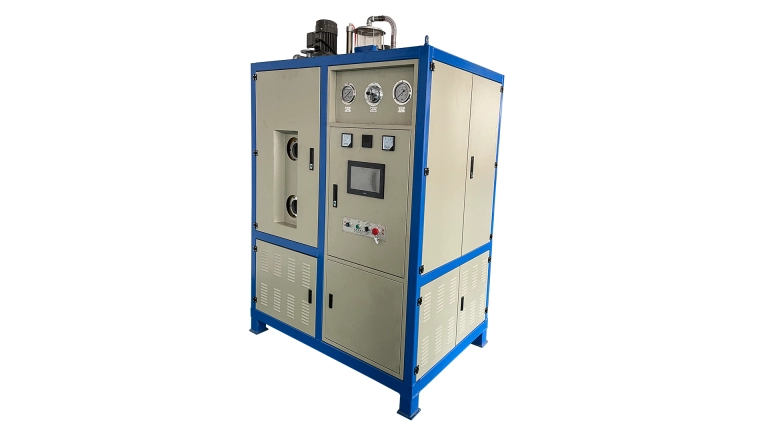
Its commercial value comes from repeatable bead preparation and predictable material supply. Pre-expansion output must match total molding demand and maturation capacity; otherwise, one stage waits while another carries unnecessary cost.
EPS Pattern Molding and Accepted Output
OC Technology offers vertical PLC hydraulic EPS molding machines and horizontal EPS molding machines for different pattern geometries, mold-handling methods, production schedules, and factory layouts.
Machine selection should consider patterns per cycle, filling stability, cooling time, mold orientation, changeovers, net operating hours, and accepted-pattern percentage. A fast theoretical cycle can still produce weak financial results when filling is inconsistent or mold changes take too long.
A qualified مصنع معدات الصب الرغوة المفقودة should review actual pattern geometry and the production schedule before recommending machine size.
Drying Capacity and Central Vacuum Demand
إن وحدة تجفيف بمضخة حرارية تعمل بالهواء supplies heated air to the drying room, condenses and removes moisture, and returns recovered heat to the drying room for reuse. OC Technology’s rear-mounted models are listed for drying-room areas from approximately 40–50 m² to 100 m², depending on the selected configuration.
Sizing also depends on moisture load, rack arrangement, batch frequency, airflow, ambient conditions, and drying time. A larger room is not automatically a more productive room.
The Central Vacuum System should be sized around simultaneous demand, pipe length, pressure loss, and future expansion. A pump may look adequate when machines are checked separately, yet pressure can fall when several stations run together.
Use Published Project Scale Instead of a Standard Package
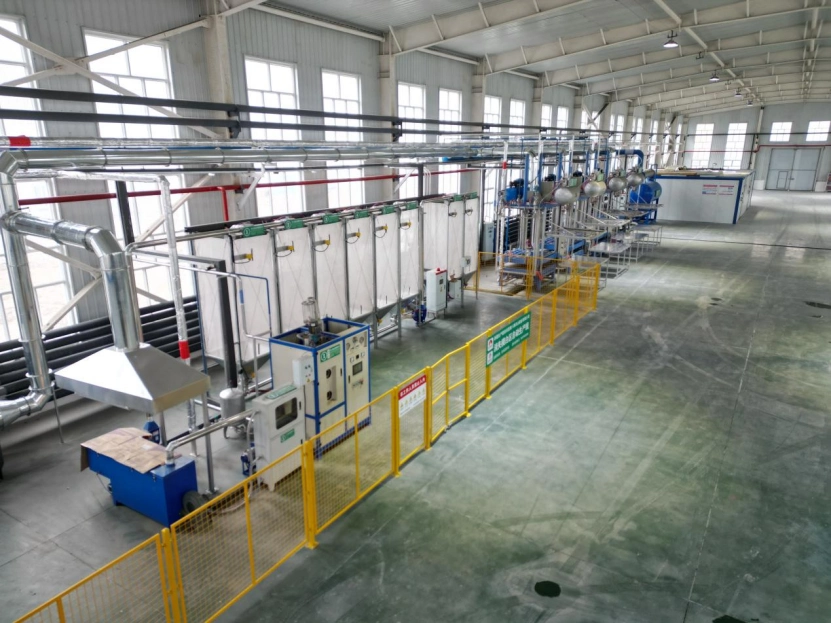
OC Technology’s published project portfolio covers different products, countries, and production scales:
| Project | Published Annual Project Scale | Scope |
| شركة مسبك القاهرة ، مصر | 5,000–6,000 tons/year | Gas-stove casting white-area line |
| مجموعة جرارات Itfco Itfco | 10,000 tons/year | Tractor-parts white-area line |
| شينجيانغ تيانشان لصناعة الألومنيوم | 10,000 tons/year | Turnkey white- and yellow-area project |
| Jiangsu Changfa Agricultural Equipment | 15,000 tons/year | Agricultural machinery and box-shell parts |
These figures reflect the annual production scales or capacities stated on OC Technology’s published case pages. They are not universal output guarantees. Actual production depends on product geometry, tooling, drying load, material flow, automation level, operating hours, rejection rates, and commissioning conditions.
For a deeper review of capacity matching and bottlenecks, see OC Technology’s production-line sizing guide.
Turnkey Lost Foam Casting Line or Phased Upgrade?
When a Turnkey Project Fits
أ turnkey lost foam casting line usually suits a greenfield foundry, major expansion, new casting program, or plant with poorly matched existing systems.
A complete EPC casting production line can place pre-expansion, maturation, pattern molding, drying, vacuum supply, controls, and material flow under one engineering plan. It also creates a clearer responsibility boundary during installation and commissioning.
When a Phased Upgrade Makes More Sense
A phased investment may be more practical when the existing line is usable and one bottleneck has been confirmed.
A plant might improve bead preparation first, expand drying during the next shutdown, and add molding capacity after demand is proven. The initial cost is lower, but future utilities, space, piping, and controls should be planned from the beginning to avoid expensive rework.
What Buyers Should Expect From a Supplier Proposal
A professional proposal should state:
- Equipment configuration and capacity assumptions
- Process flow, layout, and utility requirements
- Automation and operator scope
- Installation and commissioning responsibilities
- Training, spares, and expansion allowances
- Commercial exclusions
It should also separate machine price from total installed cost. That makes supplier comparisons more useful and prevents major site or startup expenses from appearing late.
خاتمة
An automated lost foam casting line becomes a sound investment when it removes a measured bottleneck and raises saleable output without restricting another process.
The best project is not the one with the most machines. It is the one that balances pre-expansion, maturation, molding, drying, vacuum demand, utilities, and downstream capacity around real plant data.
Foundries planning a turnkey project, an EPC casting production line, or a phased white-area upgrade can send OC Technology their project requirements, including drawings, output targets, pattern dimensions, product mix, shifts, utilities, and layout. OC Technology can then prepare a project-specific equipment configuration, preliminary capacity review, scope definition, and commercial quotation.
الأسئلة الشائعة
Q1: How much does an automated lost foam casting line cost?
A: Cost depends on capacity, pattern size, machine quantity, automation, drying, vacuum demand, tooling, utilities, freight, installation, and commissioning. Compare total installed cost rather than machine price alone.
Q2: How is the payback period calculated?
A: Divide total installed investment by annual net financial benefit. Include labor savings and added contribution from saleable castings, then deduct added maintenance, utility, and technical labor costs.
Q3: What production capacity can a lost foam casting line achieve?
A: Capacity depends on accepted patterns per cycle, productive hours, product mix, mold changes, drying turnover, rejection rate, and downstream capacity. Nominal machine speed is not guaranteed annual output.
Q4: What information is required for a quotation?
A: Provide casting drawings, pattern dimensions and density, output targets, product mix, shifts, utilities, available space, and the required automation scope.
Q5: Is a turnkey line better than a phased upgrade?
A: Turnkey delivery usually fits greenfield plants and major expansions. Phased upgrades fit plants with usable equipment and one confirmed bottleneck. Compare integration risk, shutdown time, capital availability, and expected output gain.


 Arabic
  English
  Hindi
Hindi  Indonesian
  Japanese
  Korean
  Malay
Malay  Portuguese
  Spanish
  Thai
Thai  Vietnamese