
A vertical vs. horizontal EPS molding machine decision for lost foam casting should be based on the pattern portfolio, mold envelope, loading method, factory layout, utilities, and acceptance test—not on orientation alone.
Neither layout is universally better. A vertical machine is the stronger candidate when its model-specific working table and stroke suit the intended molds and handling route; a horizontal machine is the stronger candidate when its mold-face size, product-height allowance, opening distance, and access suit the project.
For a defensible purchase, send the same part list, mold data, cycle definition, utility conditions, and responsibility matrix to every bidder. That lets a foundry compare complete technical offers instead of treating “vertical” or “horizontal” as a guarantee of cycle time, energy use, labor, or quality.
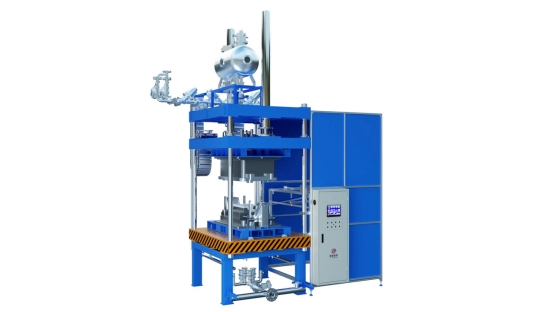
Vertical vs. horizontal EPS molding machine: the short answer
| Decision point | Vertical configuration | Horizontal configuration |
| Primary check | Working-table envelope, machine travel, mold installation and handling | Mold-face envelope, product height, opening distance and access |
| Best-fit evidence | Representative mold drawings and a loading/unloading trial | Representative mold drawings and a loading/unloading trial |
| Do not assume | Automatically smaller footprint, faster cycles, or lower labor | Automatically higher output, easier automation, or lower energy use |
| RFQ result | A model-specific offer with confirmed interfaces and test conditions | A model-specific offer with confirmed interfaces and test conditions |
The orientation changes the mechanical arrangement, but the purchasing task remains the same: prove that the proposed model can receive the mold, complete the agreed process sequence, release the pattern without unacceptable damage, and fit the site. Performance comparisons are meaningful only when both options are evaluated with the same pattern, mold, utilities, operating sequence, and acceptance method.
Match the machine to the pattern and mold portfolio
Begin with the parts that will carry production, not with a machine brochure. Group the planned patterns by overall dimensions, projected area, depth, geometry, expected annual demand, family changeover frequency, and handling sensitivity.
Identify the heaviest or most awkward mold assembly separately from the largest finished pattern; those are not always the same purchasing case.
OC Technology groups both orientations within its EPS Molding Machine range. For procurement, that creates a useful rule: choose the orientation only after the supplier maps the actual mold portfolio to a named machine model.
Ask which molds fit without qualification, which need design changes, and which fall outside the proposed envelope. This prevents a general product-family claim from becoming an unsupported project guarantee.
A mixed portfolio needs more than a “maximum size” check. The buyer should also review how steam, cooling, filling, venting, ejection, and mold services will be arranged for representative tools.
The final process settings depend on the EPS material, pattern geometry, mold construction, site utilities, and validated production recipe; they should not be copied from an unrelated machine or casting.
Compare the verified equipment envelopes model by model
OC Technology lists five vertical EPS Molding Machine models with working-table sizes from 1200 × 1000 mm to 2800 × 2200 mm, together with model-specific machine travel values. These numbers define available catalogue envelopes, not automatic confirmation that a particular mold or pattern will run. Clearance, connections, mold mass, lifting method, service access, and the full operating sequence still require engineering review.
إن horizontal EPS Molding Machine models list three mold-face sizes: 1200 × 1400 mm, 1400 × 1700 mm, and 1600 × 1800 mm. Each listed model also shows a 350 mm product height and a 1200 mm mold opening and closing distance. Use those values as a shortlist boundary, then ask the supplier to confirm the selected mold, tooling interfaces, access, and release method in the quotation.
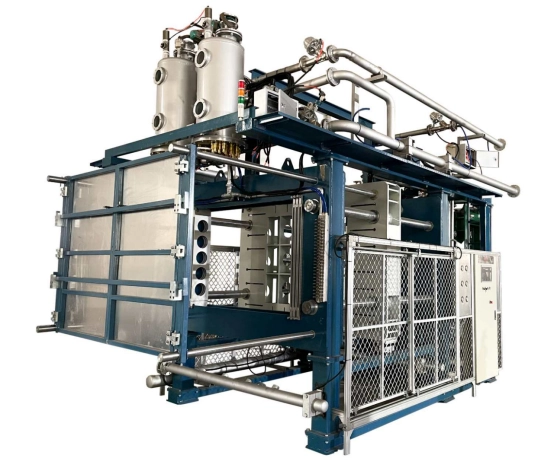
OC Technology can map a buyer’s mold drawing to both orientation options before a model is frozen. Keep that review in the technical return schedule: named model, checked dimensions, interface notes, excluded molds, and trial-dependent items. It is a stronger selection record than a general statement that either configuration is suitable.
Do not compare a vertical working-table dimension directly with a horizontal product-height or opening-distance value as though they describe the same axis. Request a marked-up mold drawing that identifies every compared dimension. A simple interface drawing will expose orientation errors earlier than a commercial table and gives production, tooling, maintenance, and purchasing teams one review basis.
Check loading, release, access and factory layout
The practical difference often appears around the machine. Map how the mold arrives, how it is lifted or changed, where the operator stands, how the pattern is supported after opening, and how maintenance staff reach valves, sensors, piping, and moving assemblies. Include guarding and site safety review in the plant layout; the equipment orientation does not remove the owner’s obligation to assess the installed workplace.
Run the proposed sequence on a scaled layout before freezing the order. Show doors, columns, pits if any, overhead lifting, material routes, platforms, utility drops, maintenance pull space, and downstream pattern transfer. A configuration that fits the nominal floor rectangle may still create a conflict when the mold is open or when a service component must be removed.
- Provide mold dimensions, mass, connection faces, lifting points and changeover method.
- Show the required operator, maintenance and pattern-transfer access zones.
- State whether loading is manual, assisted or integrated with other handling equipment.
- Define how a pattern will be supported, inspected and transferred after release.
- Ask the supplier to mark all owner-supplied civil, lifting and utility work.
Compare process controls and utilities on the same duty
A fair comparison uses one written cycle definition. State the filling, heating, pressure-control, cooling, blowing, opening, ejection, and transfer steps that the project expects, while allowing the supplier to propose the final sequence.
Ask for the control architecture, measured variables, valve and sensor functions, alarms, recipe handling, data requirements, and any project-dependent assumptions.
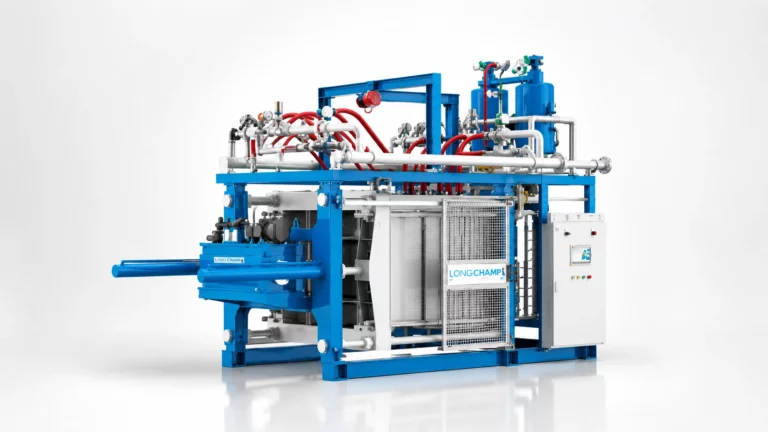
OC Technology’s horizontal configuration includes hydraulic locking, digital proportional valves, position and pressure sensing, and a Siemens control system. These are relevant configuration details, but they do not prove a universal advantage over every vertical proposal.
Require the vertical and horizontal bidders to identify the included control elements, optional items, utility design basis, and the exact conditions under which any performance statement will be verified.
Steam supply, cooling water, compressed air, electrical power, drainage, water quality, pressure stability, and ambient conditions can change the achieved cycle. Ask for normal demand, peak demand, connection conditions, and tolerances at the machine boundary. Energy or cycle claims should name the tested mold, material, load, recipe, measurement boundary, and test duration; otherwise mark them as unverified.
Build an RFQ that makes the two layouts comparable
Use a single return schedule for both orientations. The related EPS shape molding machine guide can support the broader process review, while the comparison RFQ should stay focused on the buyer’s actual mold set and site. Require deviations beside the affected requirement instead of accepting a general statement that the machine is suitable.
- Submit representative pattern and mold drawings, including dimensions, mass, interfaces and lifting points.
- State the normal mix, target shift output, changeover pattern and any future product family.
- Provide the site layout, utilities, environmental conditions and owner-supplier boundary.
- Ask for the selected model and a dimension-by-dimension fit confirmation.
- Define controls, documents, spare parts, installation, training and commissioning scope.
- Separate factory function checks from site-dependent process acceptance.
- Require assumptions, exclusions and unresolved engineering items in the offer.
For acceptance, start with document and configuration checks, then use an agreed representative mold where practical. Record the load, EPS material, utility conditions, operating sequence, observations, measured outputs, open items, and retest responsibility. A factory check can confirm machine functions; installed performance that depends on final plant utilities or downstream handling may need a separate site test.
خاتمة
The right vertical vs. horizontal EPS molding machine is the configuration that fits the verified mold portfolio, operating sequence, handling route, utilities, layout, and acceptance plan. Orientation is a design choice, not a stand-alone performance result.
Shortlist named models from dimensioned drawings, compare both offers on one duty, and keep every cycle, energy, labor, and quality statement tied to a defined test condition.
To request an engineering review, send OC Technology the representative pattern and mold drawings, production mix, factory layout, utility data, handling concept, and required acceptance evidence. The response can then identify the suitable orientation and model, required interfaces, and any values that remain subject to tooling or process trials.
الأسئلة الشائعة
Is a vertical EPS Molding Machine always more compact?
No. Orientation alone does not establish the installed footprint. Compare the full machine envelope plus mold-open position, operator space, guarding, lifting path, utility routing, maintenance pull space, and pattern-transfer area. Ask for a project layout for the selected model rather than relying on a generic footprint statement.
Which orientation gives a faster cycle?
The orientation by itself does not prove cycle time. Pattern geometry, mold construction, EPS condition, filling, steam and cooling supply, pressure control, recipe, release method, and handling all matter. Compare time only with the same representative mold and a documented measurement boundary.
What drawings should be sent with the RFQ?
Send the finished pattern drawing, mold assembly dimensions, mass, connection and lifting details, required opening or access, and the factory layout. Add production mix, changeover frequency, utilities, handling method, and acceptance expectations so the supplier can confirm a model instead of making a catalogue-only selection.
Can the machine be accepted only at the factory?
Factory checks can verify configuration, controls, movement, alarms, and agreed functions under the available test setup. Results that depend on final site utilities, installation, production material, molds, or downstream handling may require site verification. Define both stages and the close-out process before purchase.


 Arabic
 English
 Hindi
 Indonesian
 Japanese
 Korean
 Malay
 Portuguese
 Spanish
 Thai
 Vietnamese