
Size an EPS aging silo from the peak conditioned-bead consumption of the molding area, the validated maturation window, measured loose bulk density, and the silo’s usable fill fraction.
First calculate the working bead mass. Then convert that mass to gross volume and divide it among enough bins to separate grades, lots, and residence-time states. Add reserve only for defined operating variation, not as a substitute for missing data.
This method applies to lost foam casting pattern production where pre-expanded beads mature before molding. It is a planning framework, not a universal equipment specification. Bead behavior, ambient conditions, conveying, mold demand, and the selected equipment must be confirmed by the material supplier, process trials, and project engineering.
Start EPS Aging Silo Sizing With Molding Demand
The downstream molding area sets the consumption duty. Record conditioned-bead use by product family and shift, then identify the highest sustained demand over a realistic production window. Do not size from the pre-expander nameplate alone: an upstream machine can fill storage faster than the molding area consumes material, while the storage system still fails if usable beads are in the wrong bin or not yet ready.
A silo calculation is one part of line balance. Use the broader method to size and configure the complete lost foam casting line when checking whether pre-expansion, molding, drying, and downstream foundry operations can run at compatible rates. Increasing storage cannot correct an undersized molding, drying, or conveying stage.
Define three demand cases: normal production, the highest sustained product mix, and recovery after a planned stop. A short instantaneous peak may be handled by existing working inventory; a long campaign may control total capacity. Write the time basis beside every consumption figure so kilograms per hour, kilograms per shift, and kilograms per batch are not mixed.
Calculate Working Mass and Gross Volume
Use two transparent equations. Working bead mass equals peak conditioned-bead consumption per hour multiplied by the validated maturation time in hours. Gross silo volume equals working bead mass divided by measured loose bulk density and divided again by the usable fill fraction. Keep any operating reserve as a separate multiplier so reviewers can see how much capacity comes from the process window and how much comes from scheduling policy.
| Variable | Hypothetical value | Source before purchase |
|---|---|---|
| Peak conditioned-bead use | 120 kg/h | Measured or calculated molding schedule |
| Validated maturation window | 10 h | Material guidance and production trial |
| Working mass | 1,200 kg | 120 kg/h x 10 h |
| Measured loose bulk density | 20 kg/m3 | Representative conditioned-bead sample |
| Usable fill fraction | 0.80 | Supplier design and discharge limits |
| Gross working volume | 75 m3 | 1,200 / 20 / 0.80, before reserve |
The example explains the method; it is not a recommended capacity or material value. If the validated window is a range, calculate both ends and decide which operating condition the plant must sustain.
If loose bulk density changes by grade or target pattern density, repeat the calculation for each production family and relate it to the selected EPS Molding Machine options rather than averaging incompatible cases.
Choose the reserve from named scenarios: a delayed molding start, variation in batch release, a planned grade transition, or the time needed to clean and return a bin. Document the scenario and duration. A blanket percentage may be convenient, but it can hide the real cause of uncertainty and either oversize the system or leave the critical disruption uncovered.
Choose the Number of Maturation Bins
Total volume does not determine bin count by itself. Use separate bins when materials must not mix, when density grades need independent residence times, when lot traceability must remain intact, or when one bin must discharge while another receives a fresh batch. The production schedule should show every state transition: filling, maturing, available, discharging, emptying, and cleaning.
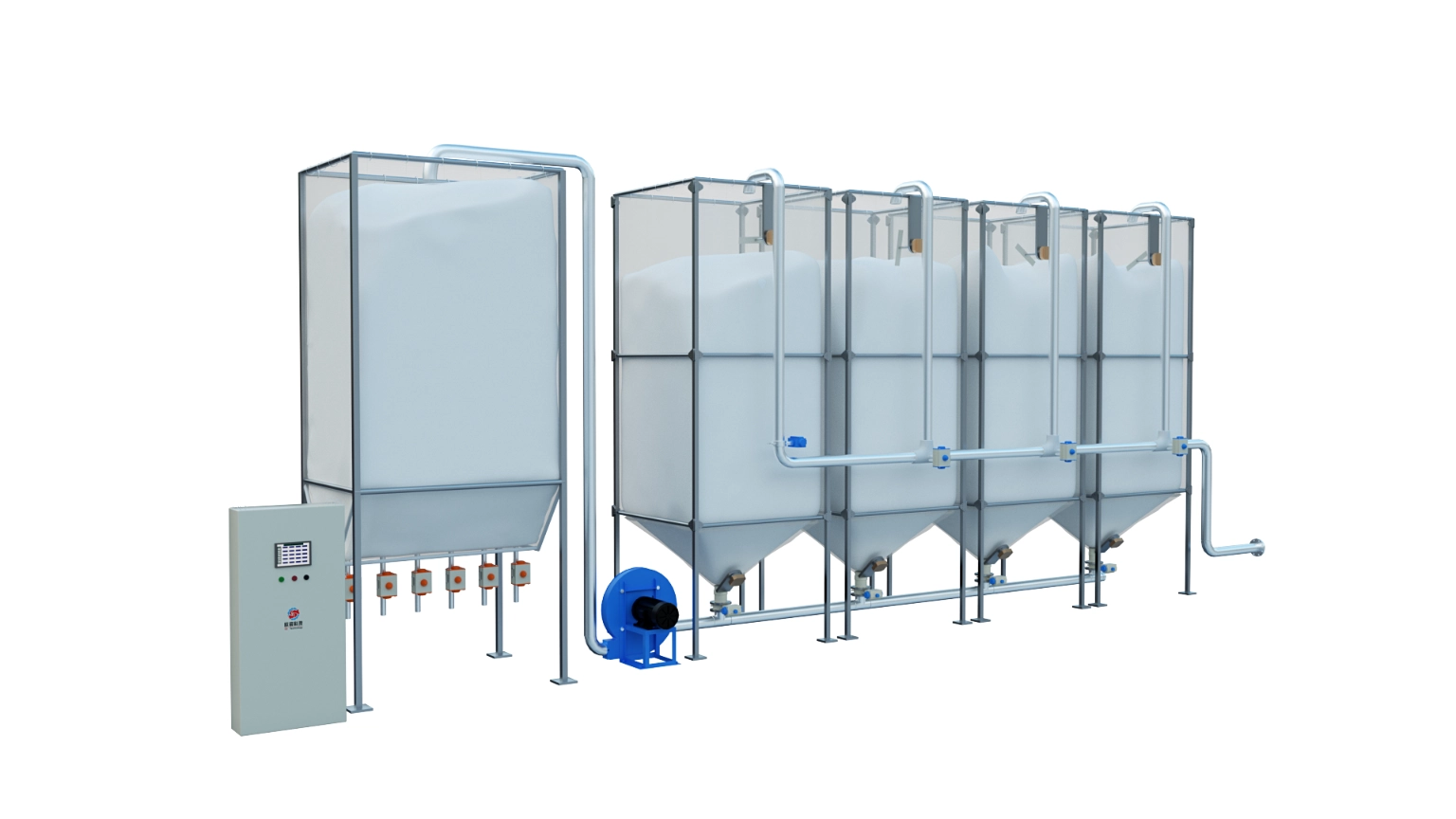
OC Technology’s verified maturation silo system uses independent maturation bins, level sensing, adjustable maturation-time parameters, and display of maturation time, bead type, and packing density at the human-machine interface.
Those functions make bin-state and traceability questions practical during specification. They do not determine capacity automatically; the buyer still needs consumption data, material rules, residence-time evidence, and an agreed usable fill limit.
- One active grade may still need more than one bin to separate receiving and discharging states.
- Multiple density grades normally require a segregation plan, not merely extra total volume.
- A spare or swing bin is justified only when a defined cleaning, maintenance, or recovery scenario needs it.
- Smaller bins can improve batch control but add valves, instruments, conveying routes, cleaning points, and structural support.
- Larger bins reduce equipment count but may complicate residence-time control and partial-batch changeovers.
Verify the Pre-Expansion and Molding Interfaces
Check the upstream release pattern as well as average output. Record pre-expander batch mass, cycle, discharge time, screening step, conveying rate, and the rules for routing a batch to a bin. The silo must accept a release without an unintended queue or material mix, while the controls prevent a fresh batch from being treated as mature inventory.
The OC Technology EPS Pre-Expander Machine uses PLC-controlled recipes and a double-layer stainless-steel vibrating screen before material moves to the maturation bin. For a project RFQ, that verified interface turns into specific questions: batch identification, accepted discharge rate, routing logic, rejected-material handling, and the signal that authorizes transfer. Confirm these details for the selected configuration rather than applying them to unrelated equipment.
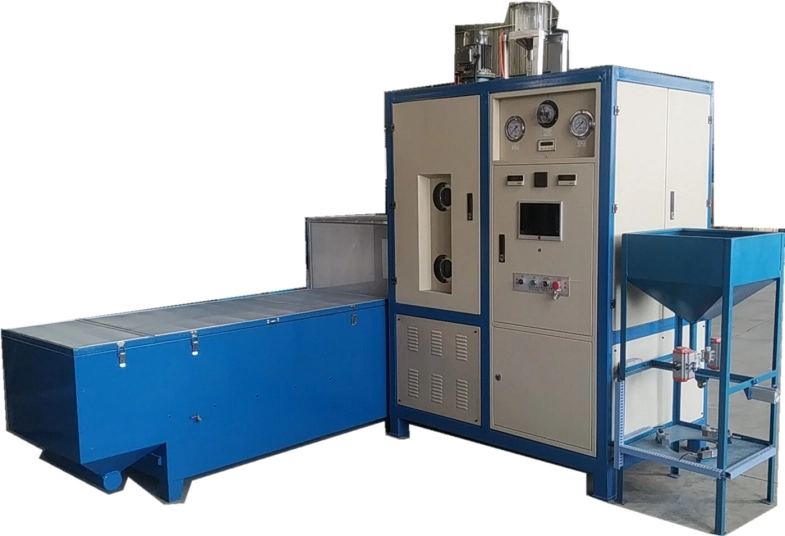
Downstream, actual demand must be tied to the selected mold and cycle assumptions. OC Technology’s EPS molding equipment range gives buyers a verified starting point for discussing molding within the same white-area system. Use project trials or agreed cycle data to convert the product schedule into bead consumption; do not infer consumption from a category name or a nominal machine count.
Test the Sizing Against Real Failure Cases
Run a simple time-based check before fixing the equipment. Simulate a normal shift, a peak product campaign, one late pre-expander batch, a molding interruption, and a grade change. Track which bin is filling, maturing, available, or discharging during each interval.
If the schedule requires one bin to receive and discharge incompatible states at the same time, the configuration is not workable even when total volume looks sufficient.
Environmental conditions can change the validated maturation window, so record the temperature and humidity range used in trials and define who approves a recipe change.
OC Technology’s product information uses 8 to 12 hours as a typical maturation reference and calls for temperature below 30°C, while also noting that environment changes the time. Treat that as a design discussion point, not a universal setting for every EPS grade.
Also test loss of a level sensor, blocked conveying, incomplete discharge, power interruption, and maintenance isolation. The RFQ should ask how operators identify affected batches, place material on hold, recover the system, and prevent cross-contamination. Capacity reserve is useful only when the control and operating procedure can preserve the status of the reserved material.
Prepare an EPS Aging Silo RFQ
- Provide peak conditioned-bead consumption by product family and time basis.
- Attach bead grades, target densities, measured loose bulk densities, and lot-separation rules.
- State the validated maturation window and the environmental conditions behind it.
- Show pre-expander batches, molding schedules, changeovers, cleaning, downtime, and recovery cases.
- Issue layout, clear height, support, access, conveying routes, utility, and control-interface data.
- Ask the supplier to return working mass, gross volume, usable fill, bin count, assumptions, and deviations.
- Agree how level logic, batch status, alarms, discharge, cleaning, and acceptance will be demonstrated.
Request a calculation sheet rather than only a model code. It should preserve units, identify the controlling production case, and show how each bin is allocated. Procurement can then compare proposals on the same basis and see whether a lower price comes from a different reserve, fill limit, segregation rule, or scope boundary.
Conclusión
An EPS aging silo should be sized as a timed production buffer, not as static storage. Begin with peak molding consumption and the validated maturation window, convert working mass to gross volume with measured bulk density and usable fill, and then divide capacity into bins that match grades, lots, and operating states. Test the result against changeovers and disruptions before adding reserve.
Send the consumption profile, material matrix, maturation evidence, batch schedule, layout, and interface requirements to request a silo sizing review from OC Technology. The result should identify confirmed inputs, open assumptions, the proposed bin logic, and the data still needed before final equipment selection.
PREGUNTAS FRECUENTES
Can daily EPS use alone determine silo capacity?
No. Daily use hides the timing of molding demand and the required maturation window. Two plants with the same daily consumption can need different working inventory when one runs steadily and the other operates in concentrated campaigns. Use a time-based consumption profile, then check batch release, usable fill, and segregation.
Why is loose bulk density needed for sizing?
The process requirement is often calculated as bead mass, while equipment is selected by volume. Loose bulk density converts between the two. Measure representative conditioned beads for each relevant grade or density family, because using an unverified generic value can materially change the calculated volume.
When is an extra maturation bin justified?
An extra bin is justified when the production schedule proves a segregation, receiving, discharging, cleaning, maintenance, or recovery need. It should have a defined role in the time-based simulation. Adding a spare without a control and routing plan creates volume, but it may not create usable production resilience.
Can one maturation time be used for every EPS grade?
Do not assume so. Material grade, pre-expansion condition, target density, ambient temperature, and humidity can change the required window. Establish settings from material guidance and trials, record the conditions, and keep grades separated when their approved recipes or traceability rules differ.


 Spanish
  English
  Arabic
  Hindi
Hindi  Indonesian
  Japanese
  Korean
  Malay
Malay  Portuguese
  Thai
Thai  Vietnamese