
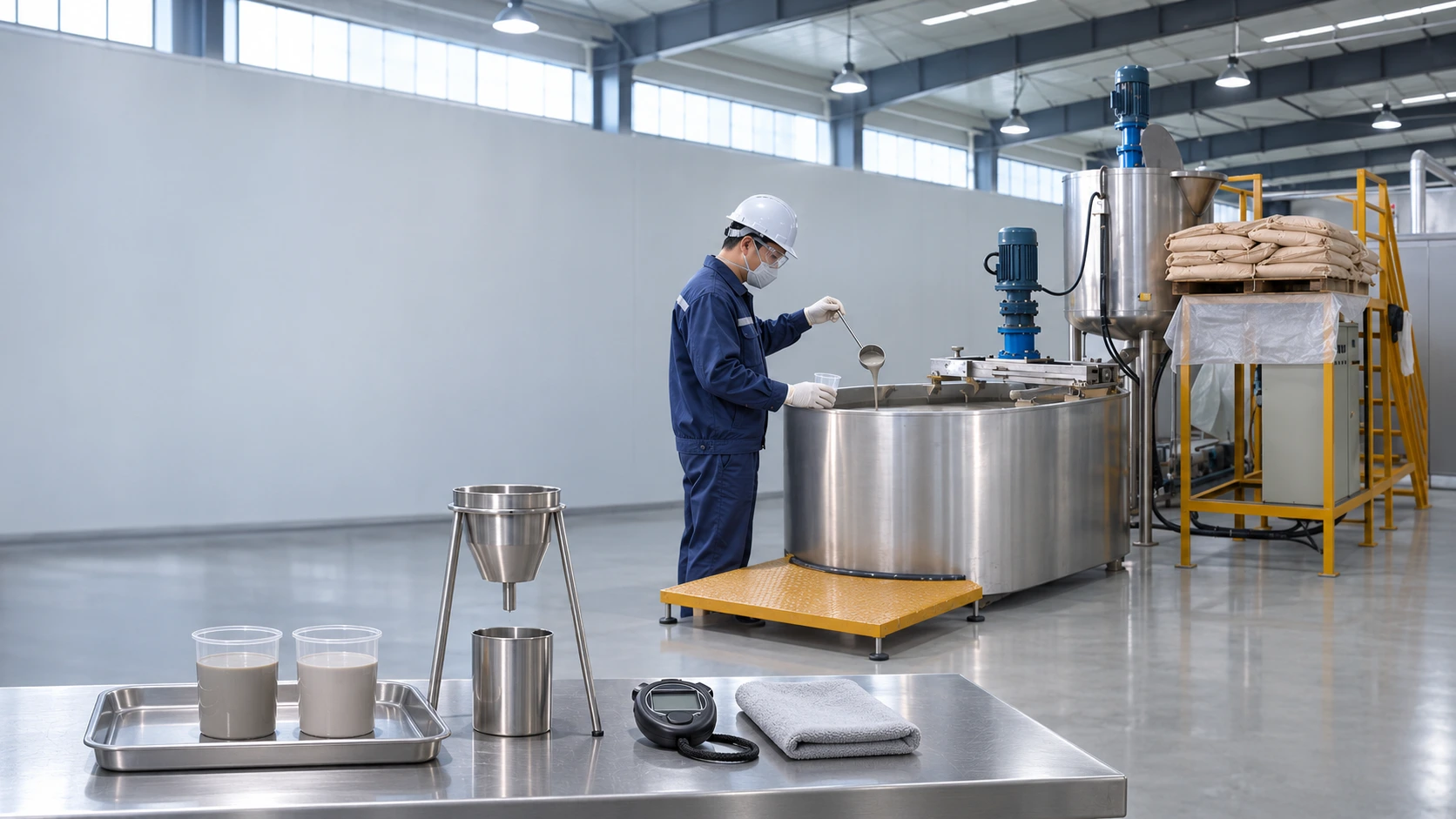
Lost foam coating viscosity should be controlled as a repeatable process condition, not corrected by eye at the dipping tank. A useful control routine standardizes mixing, temperature, sampling location, test method, waiting time, and the action taken after an out-of-range result. The target itself must come from the coating supplier and the foundry’s validated process because alloy, pattern geometry, application method, refractory formulation, and required coating thickness all change the acceptable window.
Why Viscosity Control Matters in Lost Foam Coating
The refractory coating must cover the EPS pattern without bare areas, excessive drainage marks, or heavy local buildup. It also has to dry into a continuous layer that supports the mold while allowing pattern-decomposition products to pass through at a controlled rate. Viscosity affects how the slurry moves during dipping, flow coating, or brushing, but it does not describe the complete coating condition. Solids content, density, temperature, thixotropy, particle suspension, and deposited thickness must be considered together.
A coating that appears thick after standing may become much more fluid under mixing. That shear-dependent behavior is why a reading taken immediately after high-speed agitation may not match a reading taken after the sample rests. Both may be repeatable, yet they represent different states. The first control decision is therefore to define exactly when and how the measurement is made.
Build a Repeatable Sampling and Measurement Method
Standardize the tank condition before sampling
Bring the tank to the normal production mixing condition before taking a sample. Record the batch identity, water additions, mixing time, coating temperature, and time since the last addition. Sample from a defined working zone rather than from surface foam or settled material at the tank bottom. When the tank has been idle, use the validated restart sequence before sampling; otherwise the test may measure local separation rather than the slurry being applied to patterns.
Choose one test method and keep its details fixed
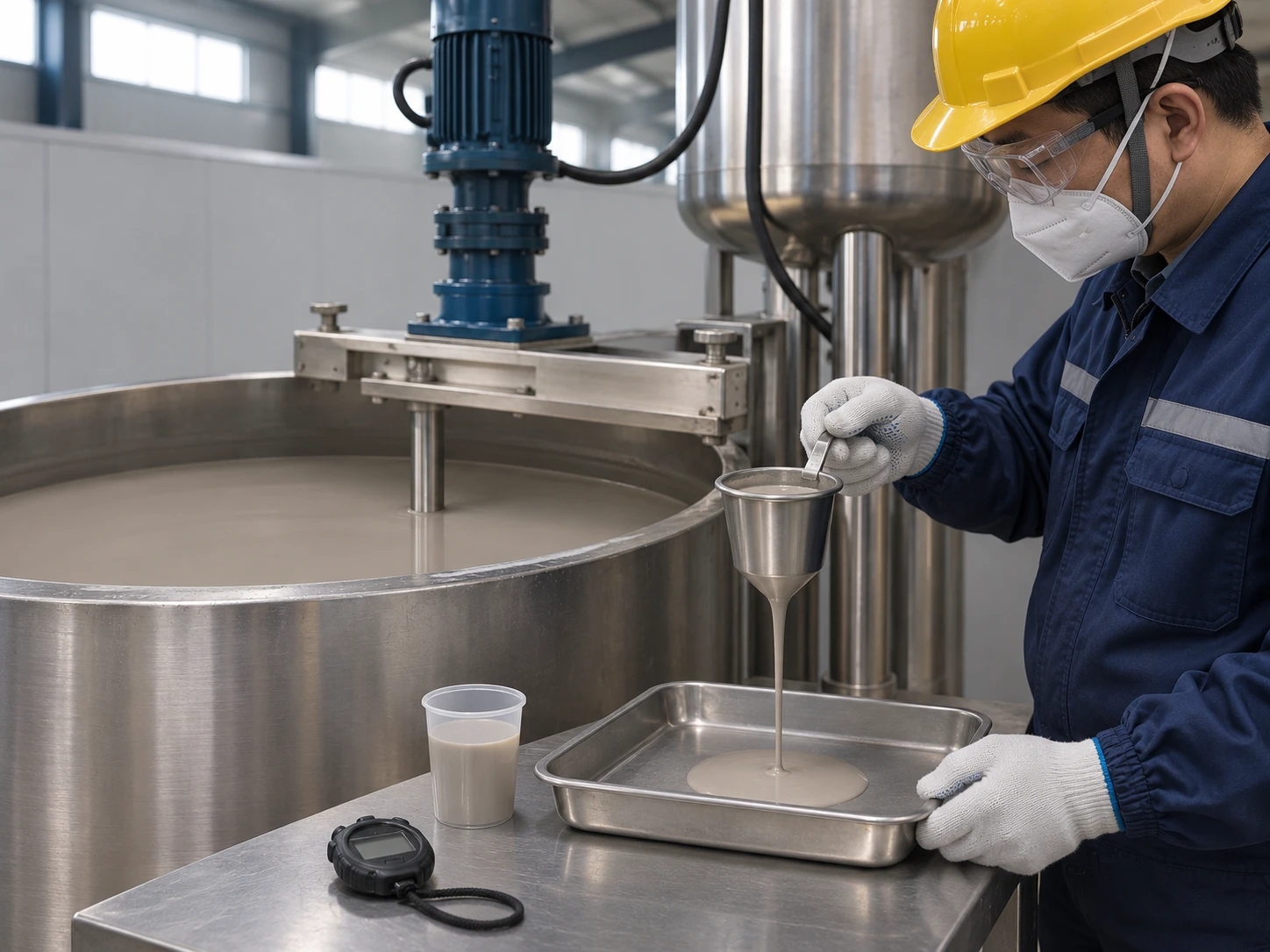
A flow cup reports efflux time, while a rotational viscometer measures resistance under a defined spindle and speed. These results are not interchangeable. For either method, use the same clean instrument, sample temperature range, test container, timing rule, and number of repeats. Follow the coating supplier’s method when one is specified. Do not convert a cup result into rotational viscosity with a generic chart unless the conversion has been validated for that exact coating.
Control temperature and waiting time
Temperature changes fluid behavior, and lost foam coating can rebuild structure after mixing stops. Define whether the sample is tested during circulation, immediately after mixing, or after a fixed rest period. Record temperature with every result. If summer and winter readings are compared without temperature control, operators may add water to correct an apparent viscosity change and unintentionally alter solids content and coating weight.
Use a Control Plan Instead of a Single Number
The control plan should contain a target range, a warning range, a stop-and-investigate limit, and an approved adjustment sequence. Establish those limits from qualified coating data and casting results. The plan should also specify who may authorize dilution or material addition and how the corrected batch is mixed and retested.
| Observation | Likely checks | Controlled response |
| Efflux time rises | Temperature, evaporation, idle time, bottom solids | Restore the validated mixing condition, retest, then adjust only under the approved recipe. |
| Efflux time falls | Recent water addition, warm slurry, low solids | Verify the addition record and temperature; do not add powder without a defined recovery procedure. |
| Reading varies between repeats | Dirty cup, bubbles, inconsistent timing, poor sampling | Clean the instrument, remove bubbles without changing the sample, and repeat the standard method. |
| Tank looks uniform but patterns drain unevenly | Thixotropy, application motion, dwell time, pattern temperature | Check the application cycle and deposited coating, not viscosity alone. |
| Hard settlement forms | Long idle time, inadequate circulation, formulation instability | Quarantine the batch if full redispersion cannot be demonstrated. |
Prevent Settling Without Overmixing
Suspension control is not simply a matter of running the mixer at maximum speed. Too little circulation can allow refractory solids to settle; excessive shear or air entrainment can change the measured condition and introduce bubbles. The operating goal is complete, repeatable circulation with enough turnover to keep the slurry homogeneous while avoiding a vortex that draws air into the coating.
A lift-type mixer can support controlled tank preparation when its lifting, mixing, and tank-handling arrangement matches the process. The OC Technology lift-type paint mixer should be evaluated against tank dimensions, batch volume, coating properties, required access, cleaning method, and the site’s safety controls. Final speed, impeller, and cycle settings must be established during application trials rather than copied from another slurry.
Connect Viscosity to Coating Thickness and Drying
A stable viscosity reading is useful only when it produces a repeatable layer on the pattern. At scheduled intervals, pair the tank test with a deposited-coating check. Depending on the validated method, the foundry may compare wet pickup, dried coating weight, thickness coupons, or measurements on representative pattern features. Use the same pattern orientation, immersion time, withdrawal motion, and drain time when comparing results.
Drying must also remain within the validated process. A heavier layer can extend drying time and retain moisture even when room temperature appears normal. Use the site’s drying acceptance method and periodically verify the room conditions described in the guide to airflow and temperature uniformity. Do not compensate for poor coating control by increasing temperature without checking the pattern and coating limits.
Create a Batch Record Operators Can Use
A practical record should make abnormal changes visible across shifts. Keep it short enough to complete at the tank, but detailed enough to reconstruct the batch:
- Coating product, lot, batch, tank, and date
- Start quantity and every water or material addition
- Mixing mode, elapsed mixing time, rest time, and sample location
- Coating temperature and the exact test instrument or cup
- Two or more readings when the method requires repeats
- Observed settling, foam, skinning, contamination, or unusual odor
- Pattern application result and deposited-coating verification
- Adjustment, authorization, retest result, and disposition
Trend the record rather than reviewing isolated passes and failures. A gradual increase in adjustment frequency may indicate evaporation, accumulated contamination, incomplete tank cleaning, or a change in incoming material. A sudden shift after a refill may point to mixing order, incorrect quantity, or a measurement inconsistency.
Procurement and Process Questions for the Mixer System
Equipment selection should begin with the coating process, not motor power alone. Define tank diameter and depth, working volume, slurry density range, expected settling behavior, batch frequency, application method, lifting clearance, cleaning access, and controls required by the plant. The broader lost foam coating equipment guide can support the initial equipment discussion, while site trials should confirm circulation and repeatability with the actual coating.
Conclusión
Reliable lost foam coating viscosity control comes from a defined method: condition the tank, sample from a fixed location, test at a recorded temperature and time, connect the result to deposited coating, and control every adjustment. Viscosity is one process signal, not a substitute for solids, thickness, suspension, and drying checks.
For an equipment fit review, contact the OC Technology technical team with the tank dimensions, batch volume, coating type, application method, current mixing cycle, and the problems observed during production.
Preguntas frecuentes
What is the correct viscosity for lost foam coating?
There is no universal value. Use the coating supplier’s method and a range validated for the alloy, formulation, application method, pattern, and required layer.
Can operators add water whenever viscosity is high?
No. First verify temperature, sampling, mixing state, evaporation, and solids. Any addition should follow an approved quantity, mixing, retest, and recording procedure.
Is a viscosity cup enough for process control?
A cup can provide a repeatable shop-floor signal, but it should be paired with temperature, batch history, suspension observations, and a deposited-coating check.
Why does the coating thicken after the mixer stops?
Many refractory slurries rebuild structure at rest. Standardize the rest period before testing so that results from different shifts are comparable.
How often should the tank be tested?
Set frequency from process risk and stability. Common control points include startup, after additions, after long idle periods, and at defined production intervals.


 Spanish
 English
 Arabic
 Hindi
 Indonesian
 Japanese
 Korean
 Malay
 Portuguese
 Thai
 Vietnamese