
¿Qué es una máquina preexpansora de EPS?
The Starting Point of Foam Pattern Quality
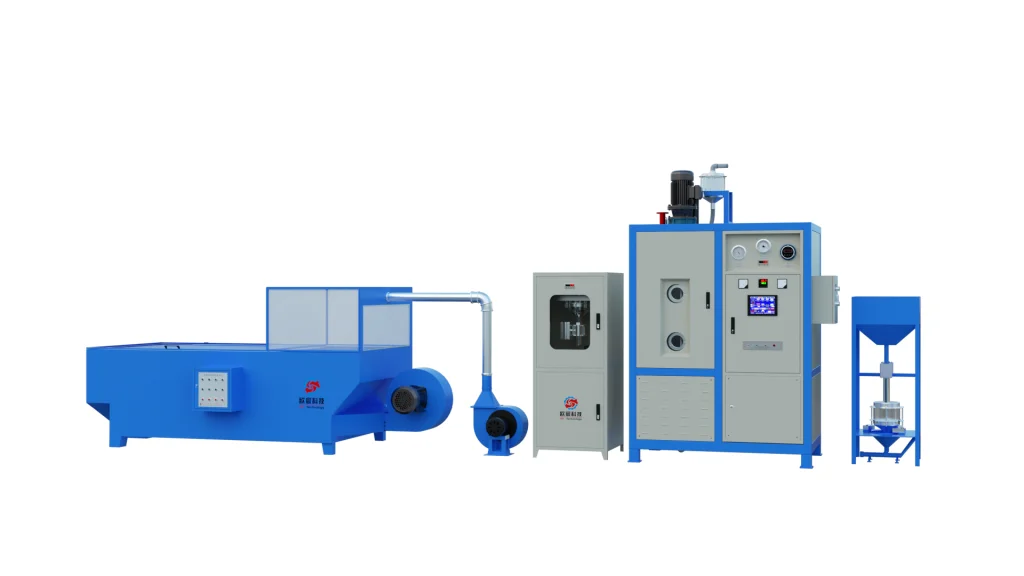
An EPS máquina previa al expansión expands raw expandable polystyrene beads into lightweight foam beads by using controlled steam, pressure, and agitation. This first expansion stage determines bead density, moisture condition, particle uniformity, and later molding performance. In a lost foam casting line, expanded bead quality affects pattern strength, coating behavior, sand vibration stability, gas release, and casting accuracy.
If the pre-expansion stage produces uneven beads, downstream molding cannot fully correct the problem. Stable pre-expansion reduces waste and improves repeatability.
How EPS Pre-Expansion Works
Steam Expansion, Cooling, and Aging
The process begins when raw EPS beads enter the expansion chamber. Steam softens the polymer structure and activates the blowing agent inside each bead. As internal pressure rises, the beads expand and form a closed-cell foam structure. Agitation keeps beads moving so heat transfer remains uniform and clumping is reduced.
After the target density is reached, expanded beads are discharged into drying equipment and then moved into maturation silos. Aging allows moisture to decrease and internal bead pressure to stabilize. This stage is essential because freshly expanded beads are often too soft or unstable for precision molding. Proper aging improves bead fusion, dimensional stability, and pattern surface consistency.
Máquina pre-expandidora EPS por lotes
High Precision for Flexible Production
A batch EPS pre-expander processes a measured quantity of raw beads in one cycle. The machine weighs the material, expands it according to a programmed recipe, and discharges the finished beads before the next cycle starts. This structure provides strong control over density and makes recipe switching easier.
Batch pre-expansion is suitable for production lines that handle different foam pattern sizes, densities, and casting types. Lost foam casting plants often produce complex components in varied batches, so flexibility is valuable. Accurate weighing, PLC recipes, steam control, and level sensing help maintain repeatable density from batch to batch.
The main benefit is precision. The main limitation is output speed. Because each cycle includes loading, expansion, stabilization, and discharge, throughput is usually lower than continuous production. For high-value patterns, however, density accuracy is often more important than maximum hourly output.
Continuous EPS Pre-Expander Machine
High Output for Stable Density Demand
A continuous EPS pre-expander feeds raw beads, applies steam, and discharges expanded beads in a steady flow. Instead of separate production cycles, the machine runs without frequent stops. This layout is suitable for large-scale production where density specifications remain stable for long periods.
Continuous pre-expansion supports higher output and smoother material supply to downstream equipment. It is especially practical when one density grade is required for repeated products or standardized patterns. The machine can reduce idle time and help maintain a continuous production rhythm.
The limitation is flexibility. Density changes require careful adjustment of feeding rate, steam pressure, residence time, and discharge control. For factories producing many pattern types in small or medium batches, continuous systems may be less convenient than batch systems.
Batch vs Continuous Pre-Expansion
Selection by Product Mix and Process Target
The choice between batch and continuous pre-expansion should be based on production strategy. Batch machines are better for flexible manufacturing, frequent density changes, and strict process control. Continuous machines are better for high-volume production with stable density requirements.
For lost foam casting, the decision should include casting type, pattern complexity, density tolerance, molding capacity, silo volume, steam supply, and operating skill. A line producing many pump housings, valve bodies, agricultural machinery parts, or complex assemblies may need batch precision. A line producing repeated foam patterns in large quantities may benefit from continuous throughput.
The best equipment choice is the one that matches the whole white area, not only the pre-expander itself. Pre-expansion, drying, silo aging, foam molding, coating, drying, sand filling, and pouring must work as one connected process.
Key Components of a Reliable EPS Pre-Expander
Chamber, Steam System, Weighing, Sensors, and PLC
A professional EPS pre-expander usually includes a stainless-steel expansion chamber, agitator, steam valves, pressure control system, material weighing unit, discharge system, drying section, sensors, and PLC control. Each component affects bead quality.
The chamber must distribute steam evenly. The agitator must keep beads moving without damage. The steam system must respond quickly and maintain stable pressure. In batch machines, the weighing system is critical because a small input error can change final density. Level sensors and temperature or pressure monitoring improve process safety and consistency.
PLC and touch-screen control allow operators to store density recipes, reduce manual errors, and repeat validated settings. Automation is especially important in industrial lost foam casting because pattern quality must remain stable across long production runs.
Why Density Control Matters in Lost Foam Casting
Pattern Strength and Casting Stability
Foam pattern density affects strength, dimensional stability, coating adhesion, gas generation, and vaporization behavior during pouring. If density is too low, patterns may deform during handling, coating, drying, or sand vibration. If density is too high, foam decomposition load may increase during metal pouring.
Uneven density is also a major risk. Different parts of one pattern may vaporize at different rates, creating unstable gas release and potential casting defects. Consistent pre-expanded beads help produce patterns with uniform fusion, predictable weight, and stable geometry.
In lost foam casting, the foam pattern remains inside the mold and is replaced by molten metal. This means pattern quality becomes part of mold quality. Pre-expansion accuracy is therefore directly connected to final casting reliability.
Operating Tips for Stable Pre-Expansion
Steam, Aging, Maintenance, and Material Storage
Stable steam supply is the foundation of stable density. Wet steam, pressure fluctuation, blocked steam holes, and leaking valves can all cause poor expansion. Steam pressure, cycle time, and discharge timing should be checked regularly.
Aging time should not be shortened without testing. Expanded beads need time to dry and stabilize before molding. Maturation silos should provide enough capacity for production rhythm and airflow.
Maintenance also matters. Agitators, valves, filters, sensors, and weighing units should be inspected according to a routine plan. Raw EPS material should be stored in a cool, dry environment to protect expansion performance.
PREGUNTAS FRECUENTES
What is the function of an EPS pre-expander machine?
An EPS pre-expander machine expands raw EPS beads into low-density foam beads before molding. It controls bead density, bead size, moisture condition, and production consistency.
Which is better, batch or continuous pre-expansion?
Batch pre-expansion is better for flexible production and frequent density changes. Continuous pre-expansion is better for high-volume output with stable density requirements.
Why is aging needed after EPS pre-expansion?
Aging stabilizes expanded beads by reducing moisture and balancing internal pressure. This improves bead fusion and foam pattern quality during molding.
How does pre-expansion affect lost foam casting?
Pre-expansion affects foam pattern density, strength, coating behavior, vaporization, and dimensional accuracy. Stable pre-expansion helps reduce casting defects and pattern deformation.
What should be checked before selecting a pre-expander?
Important factors include target density range, output demand, batch variety, steam supply, silo capacity, automation level, maintenance access, and compatibility with molding equipment.
For foundries, machinery importers, EPC project buyers, and industrial equipment distributors, a reliable lost foam casting equipment manufacturer, supplier, and factory can support stable white area production and long-term project planning. Tecnología OC focuses on high-end intelligent lost foam casting equipment and provides pre-foaming machines, foam molding machines, maturation silos, air dryers, central vacuum systems, foam sheet machines, and lift type paint mixers for complete lost foam casting production lines. Contacto Tecnología OC to discuss project requirements, equipment configuration, production capacity, and customized lost foam casting solutions.


 Spanish
  English
  Arabic
  Hindi
Hindi  Indonesian
  Japanese
  Korean
  Malay
Malay  Portuguese
  Thai
Thai  Vietnamese