
1. Peran Strategis Pre-Ekspansi dalam Produksi Casting Busa Hilang Modern
1.1 Mengapa Lost Foam Casting Terus Mendapatkan Pangsa Pasar
<a “="””" href="/id/”<a/" https:="””" style="”text-decoration:underline;”" www.oc-epc.com="””">https://www.oc-epc.com/products/”>Casting busa yang hilang (juga disebut pengecoran pola penguapan atau proses cetakan penuh) telah menjadi salah satu teknologi bentuk hampir bersih yang paling kompetitif untuk memproduksi besi yang kompleks, bernilai tinggi, besi duktil, baja, dan aluminium. Aplikasi khas termasuk blok mesin, kepala silinder, perumahan transmisi, badan katup hidrolik, hub turbin angin, komponen mesin pertambangan, dan bagian struktural besar untuk rel dan peralatan konstruksi.
Proses ini menghilangkan garis pemisahan tradisional, inti, dan sudut draf, memungkinkan geometri yang sulit atau mustahil untuk diproduksi secara ekonomis dengan pengecoran pasir atau metode cetakan permanen.
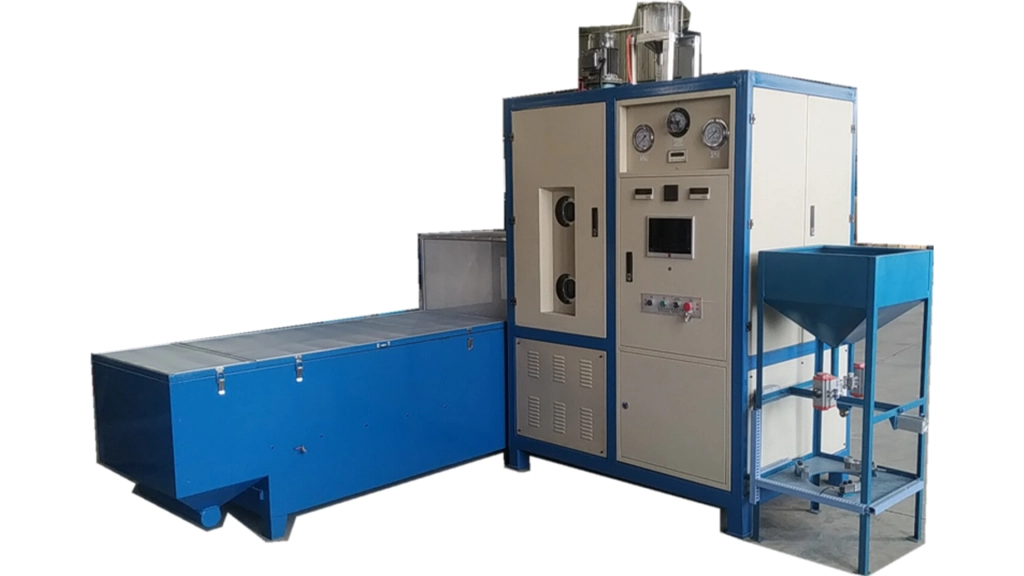
1.2 Pre-Ekspansi sebagai Titik Kontrol Kualitas Dasar
Dalam pengecoran busa yang hilang dengan spesifikasi ketat, kualitas pengecoran akhir - di atas semua permukaan (Ra 3,2-6,3 μm), batas ukuran (CT7-CT9), kekuatan dalam, dan tingkat cacat - sekarang ditetapkan terutama dalam langkah area putih. <a “="””" href="/id/”<a/" https:="””" style="”text-decoration:underline;”" www.oc-epc.com="””">https://www.oc-epc.com/product-category/pre-foaming-machine/”>Pra-ekspansi Ini adalah satu langkah utama di sini.
Pra-ekspansi yang dikelola dengan buruk mengakibatkan:
· pola memutar dan menekuk
· terlalu banyak perubahan menyusut garis
· lipatan permukaan dan tikungan
· bit berbasis karbon
· lubang gas dan ledakan
· tanda vena dan cacat kebocoran logam
Jadi, pengecoran atas melihat pengulangan kepadatan pra-ekspansi, bentuk manik-manik, dan sisa air sebagai pengaturan proses utama (CPP) di bawah panduan proses berbasis angka yang ketat.
2. Evolusi Teknis dan Prinsip Desain Inti
2.1 Pembatasan Pre-Expander Tradisional Hanya Uap
Pre-expander uap batch biasa, masih umum dalam penggunaan dasar, menunjukkan beberapa kelemahan bawaan saat membuat pola untuk casting yang kuat:
· Besar up-down dan sisi-ke-sisi perbedaan panas di dalam tabung
Tinggi sisa air tahan (sering 2-6%)
· Pengkumpulan manik umum dan pemblokiran selama aliran keluar
· Bagian besar manik-manik yang jatuh / buruk (2-8%)
· Penyebaran kepadatan lebar (± 3-6 g / L dalam banyak kasus)
Masalah semacam itu berubah menjadi tidak cocok ketika bertujuan untuk permukaan pengecoran lebih baik dari Ra 6,3 μm atau ketika membuat bagian yang tipis dan rumit bentuk.
2.2 Arsitektur Uap Tekanan Rendah Elektromagnetik Hybrid
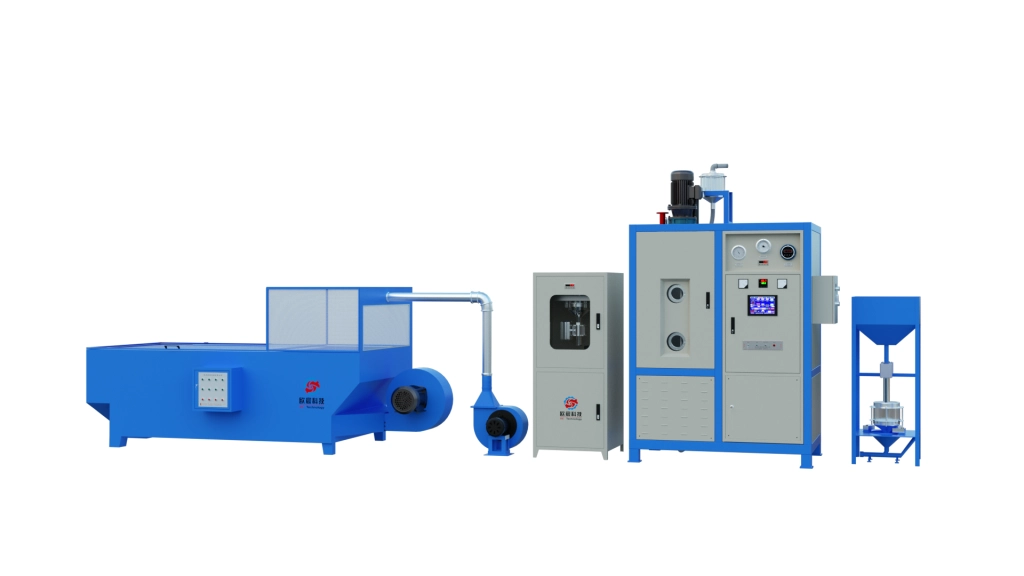
Pre-expander saat ini dibangun hanya untuk pengecoran busa hilang menggunakan rencana panas campuran:
· Pemanasan induksi elektromagnetik menjaga panas dinding tabung pada 96-99 ° C yang stabil. Ini membuat ruang kering dan panas tinggi.
· Uap tekanan rendah (0,02-0,08 MPa) hanya berfungsi sebagai panas ruang ekstra dan dorong tumbuh.
· Room push ditahan ketat (sering 0,01-0,04 MPa lebih dari push udara).
· Alat aliran keluar sink basis penuh memastikan cepat, kosong penuh tanpa menahan barang.
· Built-in cairan tempat tidur pengering dengan layar goyang baja dua lapisan (sering 2,0-2,5 mm atas 0,8-1,2 mm jaring bawah).
Campuran ini sangat meningkatkan bundaran manik-manik, memotong dalam air hingga 0,6-1,2%, dan mengurangi pecah panas dari dasar polistirena.
2.3 Subsistem Utama dan Fungsinya
· Tetapkan jumlah pemeriksaan berat listrik (± 1 g kebenaran)
· Katup uap cepat dan pengatur push-drop
· Pekerjaan PLC multi-bahasa HMI dengan 200-500 campuran ruang toko
· Live trend watch panas, dorong, berat, siklus waktu
· Jangkauan jauh, cek, dan keterampilan pembaruan lunak
· Ciri-ciri yang aman: penjaga bocor, memori kehilangan daya, kunci terlalu panas / terlalu mendorong
· Udara ditekan dingin dinding tabung setelah setiap siklus aliran keluar
3. Parameter Proses Kritis dan Hubungan Kuantitatif
3.1 Rekomendasi Operasi Windows untuk LFC-Grade EPS
| Parameter | Rentang khas | Toleransi yang lebih disukai | Pengaruh utama pada casting akhir |
|---|---|---|---|
| Target pre-diperluas kepadatan | 18–28 g/L | ±1.0–1.5 g/L | Penyusutan, permukaan, risiko runtuh |
| Variasi kepadatan dalam batch | — | ≤ ±1.2 g/L | Kemungkinan mengulang dimensi |
| Kelembaban sisa setelah pengeringan | 0.6–1.2% | ≤ 1.0% | Porositas gas, cacat karbon, lubang timbang |
| Waktu dewasa | 4-12 jam | — | Stabilitas pola, kontrol penyusutan |
| Tekanan uap | 0.02–0.08 MPa | ± 0,005 MPa | Keseragaman ekspansi, risiko pecahan manik |
| Daya elektromagnetik | 35-75 kW (tergantung pada model) | — | Kekeringan barel, pencegahan manik mati |
| Waktu siklus penuh (kecuali kematangan) | 180-420 detik | — | Produktivitas |
| Durasi pelepasan | ≤ 25-45 detik | — | Pencegahan gradien kepadatan & aglomerasi |
3.2 Kepadatan Pengulangan - Driver Kualitas Pusat
Kepadatan yang menyebar lebih dari ± 2,5 g / L di berbagai batch sering membawa:
· 0,8-1,8% celah dalam garis menyusut
· Tindakan pecah pola yang tidak rata selama menuangkan
· Tingkat lebih tinggi dari slag karbon dan cacat permukaan (kunci dalam abu-abu dan besi ductile)
Mesin campuran baru sering memukul ± 1,0-1,3 g / L berulang di bawah bahan dasar yang stabil dan pengaturan udara.
4. Integrasi ke dalam Foundry Cerdas dan Didorong Data
4.1 Pelacakan Penuh dan Kontrol Proses Statistis
Pengaturan saat ini memberikan:
· Catatan batch otomatis (kepadatan, air, pengaturan siklus, ID pekerja, tanda waktu)
· Campur jenis pegangan dan ubah masa lalu
· Dasar kualitas Shift-base
· Peta SPC hidup untuk kepadatan, waktu siklus, dan air
· Link ke MES / ERP (OPC UA, Modbus TCP, CSV, API)
4.2 Aliran Proses Area Putih khas
Silo bahan baku EPS → Makan otomatis & menimbang → Pre-expander hibrida → Pengeringan tempat tidur bercairan & penyaringan → Silo pematangan yang dikendalikan suhu / kelembaban → Mesin cetakan busa otomatis → Perakitan pola & lapisan
5. Manfaat Industri yang diukur dan pembenaran ROI
Pabrik pengecoran yang menukar pra-ekspander uap-hanya biasa untuk pengaturan magnetik campuran saat ini sering mencatat keuntungan ini:
· Penurunan tingkat limbah pola: 15-30%
· Casting bersih dan memperbaiki penurunan waktu: 18-40%
· Peningkatan hasil pertama kali: 8-22%
· Tingkat cacat bit karbon jatuh: 35-65%
· Penggunaan bahan baku EPS per ton casting yang baik: ↓ 10–20%
· Pekerja menghadapi tempat kerja panas dan basah: banyak potong
· Penggunaan daya penuh per kg manik-manik pra-tumbuh: ↓ 8–15%
Kemenangan ini mengarah ke waktu pengembalian yang cepat, sering dalam 12-24 bulan untuk pengecoran menengah hingga besar.
6. Portofolio Peralatan - Teknologi OC
OC Technology bekerja sebagai produsen yang fokus pada peralatan pengecoran busa hilang cerdas kelas atas. Line-up sekarang memiliki:
• Mesin pra-busa hibrida sepenuhnya otomatis seri OC-YF-Y450 (≈40 kg kapasitas batch) seri OC-YF-Y550 (≈60 kg kapasitas batch)
• Mesin cetakan pola busa presisi tinggi
• Garis ekstrusi lembaran busa otomatis
• Pengering tempat tidur fluidized dan sistem pematangan yang dikendalikan
• Stasiun perakitan pola dan peralatan pelapis
PERTANYAAN YANG SERING DIAJUKAN
Apa manfaat teknis utama dari pra-ekspansi uap tekanan rendah elektromagnetik hibrida?
Ini mencapai air sisa yang jauh lebih rendah, hampir berakhir manik-manik buruk, meningkatkan bundaran manik-manik banyak, dan memberikan kepadatan yang lebih ketat - semua kunci untuk pola busa hilang spesifikasi ketat.
Apa variasi kepadatan yang realistis dapat dicapai saat ini?
Di bawah pengaturan yang stabil, ±1,0-1,5 g / L batch-to-batch dan penyebaran dalam batch biasanya untuk gear saat ini.
Mengapa kontrol kelembaban residual begitu penting?
Terlalu banyak air membawa uap yang kuat saat menuangkan. Hal ini menyebabkan lubang gas, ledakan permukaan, dan bit karbon.
Apa waktu kematangan khas untuk manik-manik EPS kelas LFC?
4-12 jam, berdasarkan kepadatan tujuan, panas udara / air, dan campuran bahan dasar.
Bisakah mesin ini memproses bahan non-standar?
Ya - EPS standar, EPS kelas FD bergabung tinggi, campuran bersama, dan kelas henti api yang dipilih didukung.
Bekerja sama dengan Dedicated Lost Foam Equipment Manufacturer
Pabrik busa hilang, rencana peningkatan teknologi, tukang kayu gigi, dan pembangun EPC yang bertujuan untuk kualitas pola yang lebih baik, memotong tingkat cacat, meningkatkan hasil pertama kali, dan menurunkan biaya membuat penuh diminta untuk bergabung dengan produsen yang fokus.
OC Technology berjalan sebagai produsen pro, pemasok, dan pabrik yang ditetapkan hanya pada jawaban pengecoran busa hilang cerdas. Perusahaan menawaran selamat datang untuk bertanya tentang pembicaraan teknologi, pengaturan pra-tumbuh khusus, rencana sistem area putih penuh, tes pabrik, bantuan pengaturan, dan pakta layanan jangka panjang.
<a “="””" href="/id/”<a/" https:="””" style="”text-decoration:underline;”" www.oc-epc.com="””">https://www.oc-epc.com/contact/”>Hubungi tim rekayasa secara langsung: Tel / WhatsApp: 86 159 8847 9417 Email: zyh@oc-epc.com Situs web: https://www.oc-epc.com/


 Indonesian
  English
  Arabic
  Hindi
Hindi  Japanese
  Korean
  Malay
Malay  Portuguese
  Spanish
  Thai
Thai  Vietnamese