
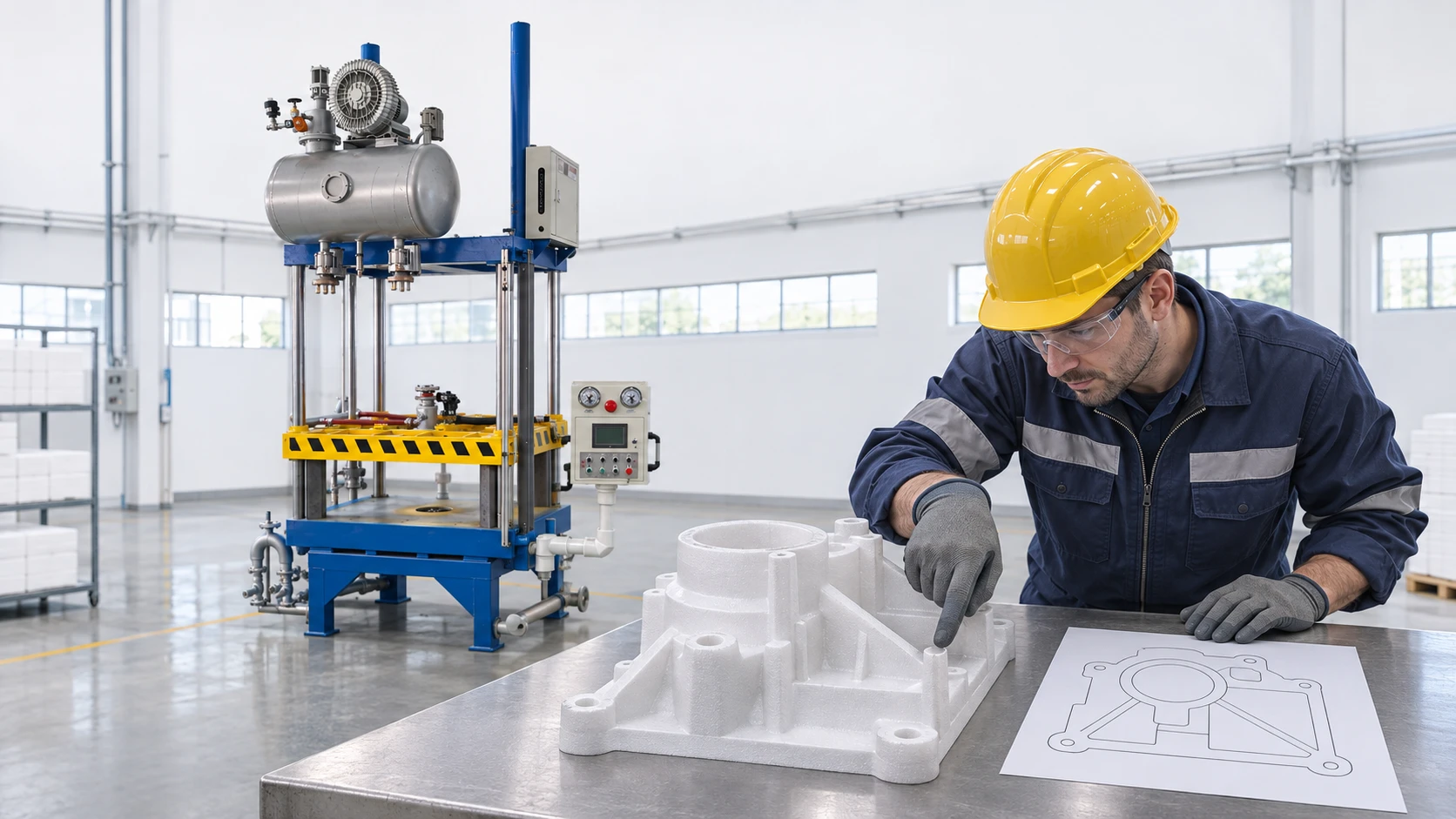
Incomplete EPS mold filling should be diagnosed by location and repeatability before anyone raises feeding pressure. A defect that repeats beside one fill gun points toward a local gun, passage, or vent problem. A defect that moves between cycles suggests bead condition, supply stability, or recipe control. Separating those patterns prevents a filling fault from being hidden by a steam or fusion adjustment.
Confirm That the Defect Is a Short Fill
A true short fill leaves part of the cavity without the intended bead mass. Missing rib tips, rounded incomplete corners, local voids, or a thin area that never packs can indicate a filling problem. Poor fusion is different: the cavity may be full, but the beads remain weakly bonded or visibly separate. Shrinkage and deformation occur later and require a different investigation.
Mark the defect on a mold diagram and photograph the same orientation for several consecutive cycles. Record whether the location remains fixed, whether more than one cavity is affected, and whether the symptom began after a mold change, material change, cleaning activity, or utility disturbance. A single rejected pattern contains less information than a sequence with the same traceable references.
Use Location to Select the First Check
| 観察されたパターン | First checks | Why |
| Defect repeats beside one gun | Gun opening, seal, stroke, local pipe and nearby vent | The fault is spatially tied to one feed path |
| Defect repeats at a remote thin rib | Gun layout, flow path, local venting and cavity restriction | The area may be difficult to reach or evacuate |
| Defect moves between cycles | Bead flow, hopper level, supply pressure and recipe repeatability | A changing defect usually indicates a changing input |
| Several molds change together | Plant air, material condition, feeding tank and common supply | A shared cause is more likely than several local failures |
| Pattern is full but weak | Steam distribution, fusion and bead condition | Do not misclassify a heating problem as short fill |
Inspect the Fill Gun and Local Feed Path
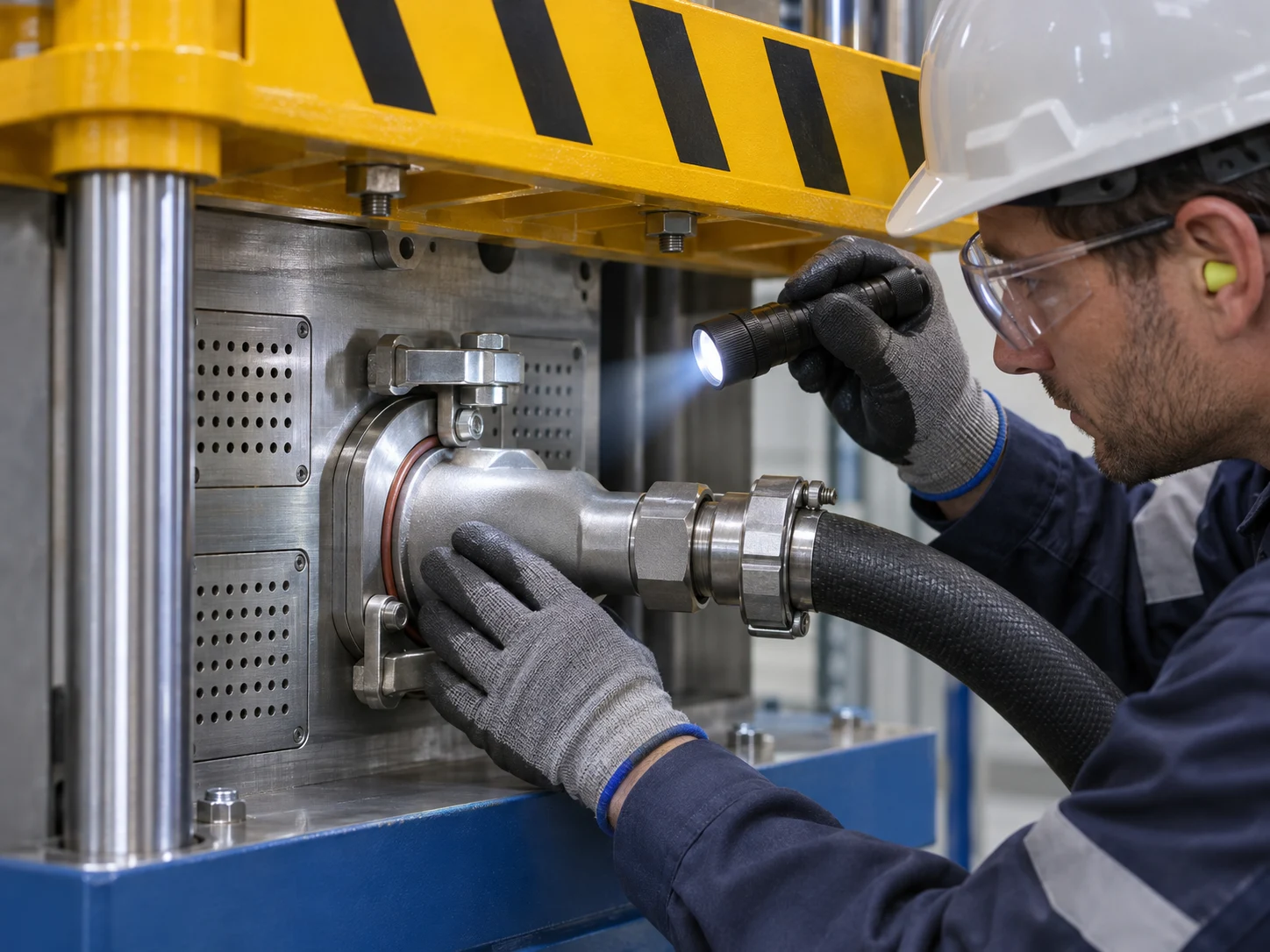
For a fixed local defect, inspect the affected fill gun under the approved lockout and maintenance procedure. Check that the gun is correctly seated, mechanically secure, clean, and able to complete its commanded movement. Examine approved seals and wear parts for damage. Verify the local material pipe is not kinked, leaking, obstructed, or carrying residual fused material.
Do not clean a gun by forcing unsafe tools or compressed air into an energized system. After maintenance, confirm the physical movement before returning to production, then run a controlled trial without changing unrelated steam or cooling parameters. If the gun repeatedly backs away from its correct position or the connection cannot remain sealed, treat the mechanical condition as the fault rather than compensating with time or pressure.
Verify Bead Condition Before Raising Pressure
Pre-expanded beads must flow through the supply route and pack into the cavity consistently. Changes in bulk density, moisture, clumping, particle-size distribution, electrostatic behavior, or maturation history can change filling even when the machine settings are unchanged. Compare the affected batch with the last accepted batch using the same sampling and test method.
「 The 熟成サイロシステム can track material type, packing density, level status, and maturation time. Use those records to determine whether fresh and mature material were mixed, whether a silo switched unexpectedly, or whether the feed history changed during the affected cycles. If beads are wet or clumped before molding, isolate that upstream problem instead of using additional pressure to push unstable material through the gun.
Check Pressure Under Load, Not at Idle
A normal gauge reading while the machine waits does not prove that the system maintains pressure during filling. Record the commanded and actual pressure through the fill event, along with hopper or pressure-tank level and any alarms. Look for a repeatable drop when several guns open, slow recovery between zones, or a response that differs from the stored recipe.
OC技術’s vertical PLC hydraulic forming machine uses a computer-controlled proportional air valve on its pressurized feeding tank and supports multi-point or grouped filling. This configuration can help stabilize supply and divide complex filling tasks, but the required pressure and sequence still depend on the mold, bead condition, and approved process. Do not copy a setting from another pattern simply because the machine model is the same.
Separate Filling From Venting
Beads can enter only as displaced air leaves. A blocked or poorly located vent may therefore look like a weak fill gun. Inspect the vents around the defect, but keep the diagnostic question precise: is the feed path unable to deliver material, or is trapped air preventing the cavity from accepting it?
A useful controlled test is to compare the same gun and recipe after approved vent cleaning, without increasing pressure at the same time. If filling improves, the restriction was at least part of the cause. If nothing changes, return to the gun, pipe, supply, and bead checks. Check venting near the affected cavity area when the same section repeatedly fails to fill.
Change One Variable and Preserve the Baseline
Before a trial, save or record the last approved recipe. Change only one controlled variable, such as fill time, one pressure setpoint, a zone sequence, or a repaired gun. Inspect the same locations on several patterns and record both improvement and new side effects. More pressure is not a neutral correction: it may alter packing near the guns, increase bead damage, or hide a restricted path without making the process robust.
When a new mold enters production, establish a signed baseline with gun identification, zone sequence, supply conditions, bead grade and density, silo source, vent status, and acceptance photographs. The horizontal EPS forming machine includes material-pipe docking within its mold-change approach; after any changeover, the connection check should be completed before tuning the recipe.
When to Escalate the Problem
Escalate when the defect remains after the local path is clean and mechanically sound, the bead batch passes its approved checks, supply pressure is stable under load, and the vents are confirmed open. At that point, the mold may need a fill-path or gun-layout review rather than another machine adjustment. Provide the equipment supplier or tooling engineer with the mold drawing, defect map, gun positions, vent locations, bead data, recipe, pressure trace, and photographs from consecutive cycles.
結論
Incomplete EPS mold filling becomes manageable when the defect pattern determines the test order. Start with repeatability and location, inspect the local gun and pipe, verify bead history, measure supply pressure during the fill event, and then separate feed limitations from vent restrictions. Change one variable per trial and compare the same area across several molded patterns to see how the adjustment affects filling.
申請審査のために、 send the OC Technology technical team the pattern dimensions, mold layout, fill-gun locations, bead grade and density, silo source, pressure record, current sequence, and marked defect photographs. These details are more useful than a general statement that the machine does not fill completely.
よくある質問
Should filling pressure be increased first?
No. First determine whether the defect is fixed or random and inspect the relevant gun, feed path, bead condition, pressure stability, and venting. Raise a setpoint only through an approved controlled trial.
How can a bad fill gun be distinguished from poor venting?
A gun problem often follows one feed location, while a vent restriction follows the area where air cannot escape. Check the gun and the vent in separate trials, keeping the other settings unchanged.
Can immature beads cause incomplete filling?
They can contribute to unstable flow or molding behavior. Confirm the actual maturation history, bulk density, moisture condition, and plant acceptance criteria before changing the machine.
What evidence should be sent for remote support?
Provide the mold drawing, gun and vent map, defect photographs, bead and silo records, stored recipe, pressure trace, alarm history, and the result of each controlled test.


 Japanese
 English
 Arabic
 Hindi
 Indonesian
 Korean
 Malay
 Portuguese
 Spanish
 Thai
 Vietnamese