
Expanded Polystyrene (EPS) moulding processes form the backbone of foam production for diverse industries, including lost foam casting where lightweight, precise patterns are essential. EPS shape moulding and EPS block moulding represent two core approaches, each transforming pre-expanded polystyrene beads into foam structures under controlled heat, pressure, and steam.
Understanding the differences between EPS shape moulding vs EPS block moulding helps manufacturers select the optimal method for efficiency, cost control, and pattern quality in lost foam casting applications. This comparison explores processes, outputs, mold designs, production scales, and sustainability factors, with a focus on integrating these techniques into lost foam pattern production.
Overview of EPS Moulding Fundamentals
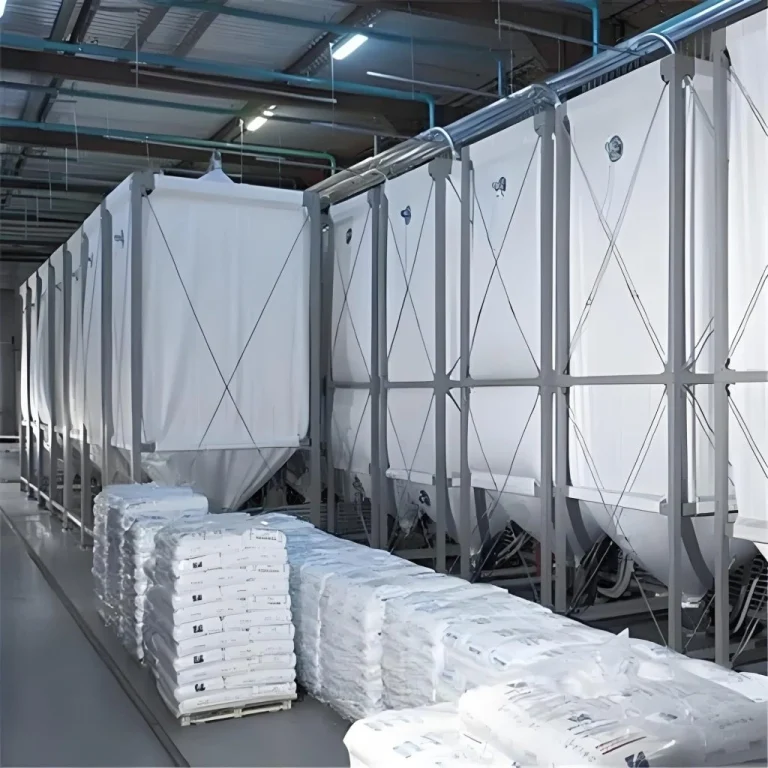
EPS moulding begins with raw polystyrene beads impregnated with a blowing agent, typically pentane. These beads undergo pre-expansion in a steam-heated vessel, where heat softens the polymer and vaporizes the agent, increasing bead volume significantly. Pre-expanded beads then enter a conditioning phase in silos or breathable containers, allowing air diffusion to stabilize internal pressures and prevent collapse during subsequent steps.
The core moulding phase involves filling a cavity with conditioned beads, followed by steam injection to induce secondary expansion and fusion. Cooling solidifies the structure, and ejection yields the foam product. In lost foam casting, EPS patterns must exhibit uniform density, dimensional accuracy, and smooth surfaces to ensure clean metal fill and minimal defects in castings. Both shape and block moulding adhere to these principles but diverge in execution and end-use.
EPS Shape Moulding Process
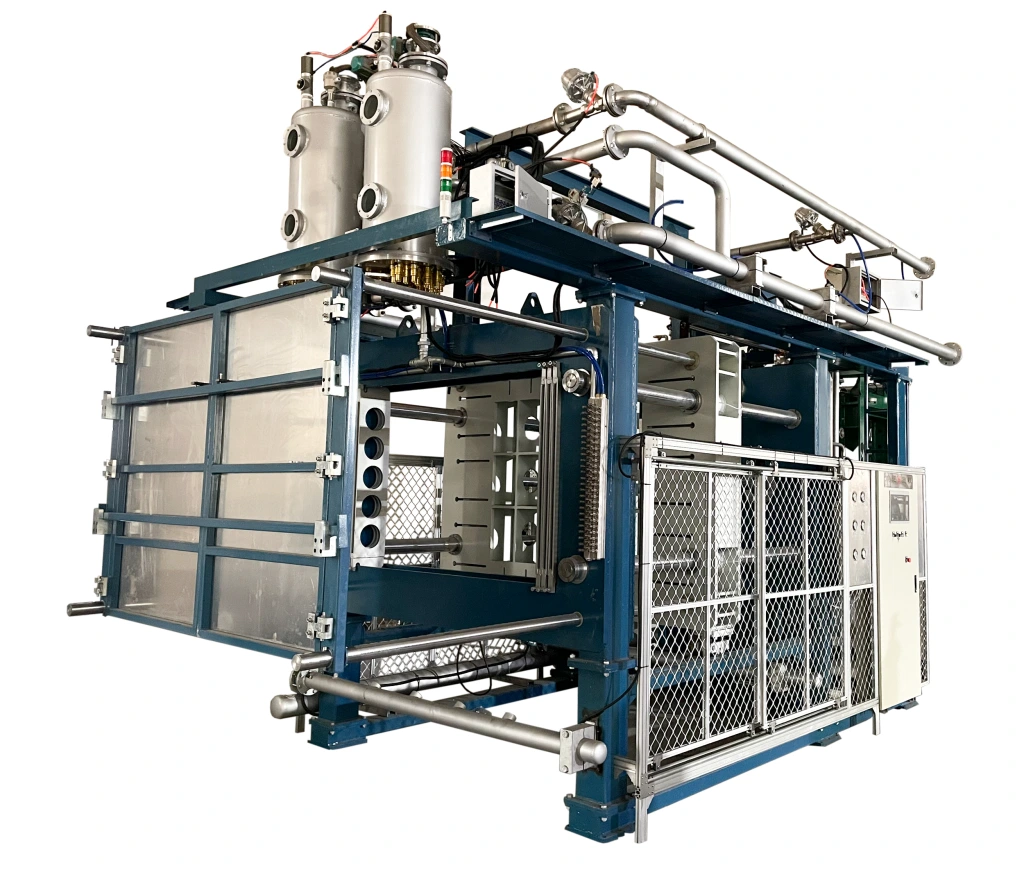
EPS shape moulding produces finished, custom-contoured products directly from pre-expanded beads, eliminating secondary cutting in many cases. This method suits lost foam casting patterns requiring intricate geometries, such as engine blocks or pump housings.
The process initiates with pre-expansion, controlling steam parameters to achieve target densities that balance pattern lightness with structural integrity for handling and coating. Conditioning follows, typically 6-24 hours, to equalize pressures and enhance bead resilience.
Beads fill a precision-engineered mold cavity via pneumatic systems, often with vacuum assistance for uniform distribution in complex shapes. Steam chest moulding injects high-temperature steam (110°C-130°C), softening beads and promoting fusion into a monolithic closed-cell structure. Cooling channels circulate water to solidify the pattern, while vacuum application accelerates moisture removal and stabilizes dimensions.
Ejection occurs via pins or robotic arms, followed by post-molding curing to evaporate residuals and prevent warping. In lost foam contexts, shape moulding minimizes material waste and ensures patterns replicate casting details accurately, supporting high-resolution refractories and reducing gas defects during pouring.
EPS Block Moulding Process

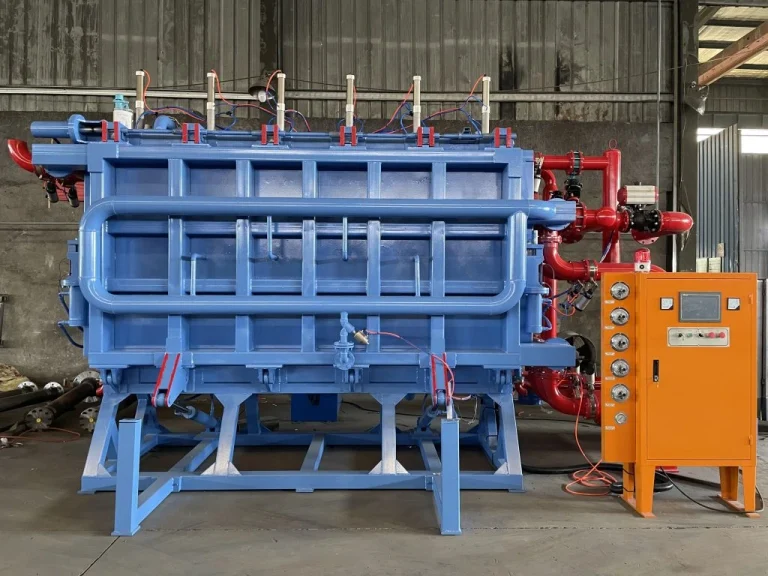
EPS block moulding generates large rectangular foam blocks, which serve as stock material for cutting into patterns or components. This approach fits lost foam casting when multiple patterns derive from a single block or when standard sizes suffice before customization.
Pre-expansion and conditioning mirror shape moulding, tailoring bead density for compressive strength in larger volumes. Beads fill expansive rectangular molds using pneumatic conveyance for even packing.
Steam penetration heats and expands beads uniformly across the block, fusing them under pressure. Rapid cooling prevents deformation in thick sections, and ejection conveys the block for curing, often several days to achieve full stability.
Post-molding, hot-wire cutting or CNC machining slices blocks into precise lost foam patterns. Block moulding excels in producing high-volume stock with consistent properties, allowing flexible pattern extraction while managing scrap through recycling.
Key Differences: EPS Shape Moulding vs EPS Block Moulding
Purpose and Output
EPS shape moulding yields ready-to-use items with defined geometries, ideal for direct lost foam patterns like turbine housings or valve bodies. Outputs require minimal finishing, streamlining assembly into casting clusters.
EPS block moulding creates versatile blanks, cut into sheets, panels, or custom patterns. This supports scalable production where patterns vary in size from one block, accommodating diverse casting requirements.
Mold Design and Complexity
Shape moulding demands intricate, multi-part molds with undercuts and inserts to capture fine details essential for lost foam accuracy. These molds integrate ejector systems for complex releases.
Block moulding uses simple, robust rectangular cavities focused on volume and pressure resistance rather than detail. Design prioritizes uniform steam distribution in large scales.
Production Volume and Flexibility
Shape moulding optimizes for repetitive, high-volume runs of identical patterns, with mold changes incurring downtime. Flexibility limits to pre-designed shapes.
Block moulding provides adaptability; one block yields multiple pattern variations via cutting, suiting prototype iterations or mixed-order lost foam projects.
Tooling Costs
Custom shape molds involve higher engineering and machining expenses due to precision requirements in lost foam replicas.
Block molds, being geometrically basic, lower initial investments, shifting costs to cutting equipment.
Post-Moulding Processing
Shape moulding limits finishing to deflashing and inspection, accelerating lead times for casting preparation.
Block moulding necessitates extensive cutting, increasing handling but enabling customization.
Material Efficiency and Sustainability
Shape moulding optimizes bead usage for specific volumes, reducing waste in pattern production. Energy focuses on targeted heating.
Block moulding may generate offcuts during cutting, though recyclable. Larger steam volumes suit batch efficiency.
| Ciri | EPS Shape Moulding | EPS Block Moulding |
|---|---|---|
| Primary Output | Custom-finished patterns | Large blocks for cutting |
| Mold Complexity | High (detailed, multi-part) | Low (rectangular) |
| Flexibility | Dedicated shapes | Post-cut variations |
| Tooling Cost | Higher per design | Lower overall |
| Post-Processing | Minimum | Extensive cutting |
| Lost Foam Suitability | Intricate, direct-use patterns | Versatile stock for multiple patterns |
| Energy per Unit | Targeted | Scaled for volume |
Sustainability Considerations in Lost Foam Applications
Both processes contribute to eco-friendly lost foam casting by using recyclable EPS and optimizing energy. Pre-expansion controls minimize excess blowing agent emissions. Steam recovery systems and vacuum cooling reduce water and energy consumption. Recycling pre-consumer scrap into bead mixes maintains quality while lowering virgin material needs.
In shape moulding, precise filling avoids overpacking. Block moulding integrates recycled content in cores, with cuttings reused. Advanced machines incorporate PLC controls for adaptive steam proportional valves, cutting cycles by 20-30% and ensuring low-moisture patterns that burn out cleanly in casting.
Integration with Lost Foam Casting Equipment
Selecting between shape and block moulding depends on casting complexity and volume. Shape moulding integrates seamlessly with coating and assembly lines for high-precision patterns. Block moulding pairs with automated cutting for efficient pattern nesting, reducing material in large-scale foundries.
Modern equipment enhances both: vertical PLC hydraulic forming machines support shape production with remote parameter storage and vacuum energy recovery. Horizontal systems enable quick mold changes (5-30 minutes) via one-touch mechanisms, minimizing downtime in pattern switching. Foam block machines feature stepless size adjustment via touch-screen encoders, pulse cooling for doubled efficiency, and high recycled material ratios.
These advancements ensure patterns meet lost foam standards: densities 15-30 kg/m³, dimensional tolerances ±0.5%, and surface finishes supporting uniform refractory layers.
Frequently Asked Questions (FAQ)
What is the main difference between EPS shape moulding and EPS block moulding?
EPS shape moulding produces finished custom products directly, while block moulding creates large blanks for subsequent cutting.
Which process is better for lost foam casting patterns with complex geometries?
Shape moulding excels for intricate, ready-to-use patterns requiring precise details without secondary operations.
How does EPS block moulding handle material recycling?
Advanced block machines allow high ratios of recycled beads, with post-cut scraps reintegrated, promoting sustainability.
What energy savings can be achieved in these processes?
Vacuum cooling and proportional steam controls reduce cycles by up to 50%, lowering consumption in pattern production.
Can shape moulding machines support quick product changes?
Yes, with one-touch mold systems, changes complete in 5-20 minutes, ideal for varied lost foam designs.
Are EPS patterns from both methods suitable for metal casting?
Both yield closed-cell structures with clean burnout, but shape moulding minimizes defects in detailed areas.
Partner with a Leading Manufacturer for Lost Foam Solutions
OC နည်းပညာ operates as a premier manufacturer, supplier, and factory of high-end intelligent equipment for lost foam casting and EPS processing. Advanced foam molding machines, pre-foaming systems, and block production lines incorporate PLC automation, hydraulic precision, and energy-efficient features like vacuum recovery and quick mold change systems. Contact the factory today di +86 159888479417 atau zyh@oc-epc.com to discuss customized EPS solutions that enhance pattern quality and production efficiency.

 Malay
Malay  English
  Arabic
  Hindi
Hindi  Indonesian
  Japanese
  Korean
  Portuguese
  Spanish
  Thai
Thai  Vietnamese