
A shared vacuum network rarely receives as much attention as an EPS molding machine during a new foundry project. Still, a poorly selected system can slow several machines at once.
Too little capacity may extend cooling time and create pressure fluctuations during peak production. Excessive capacity raises the initial investment and may leave large pumps running inefficiently during lighter shifts. Neither outcome is attractive.
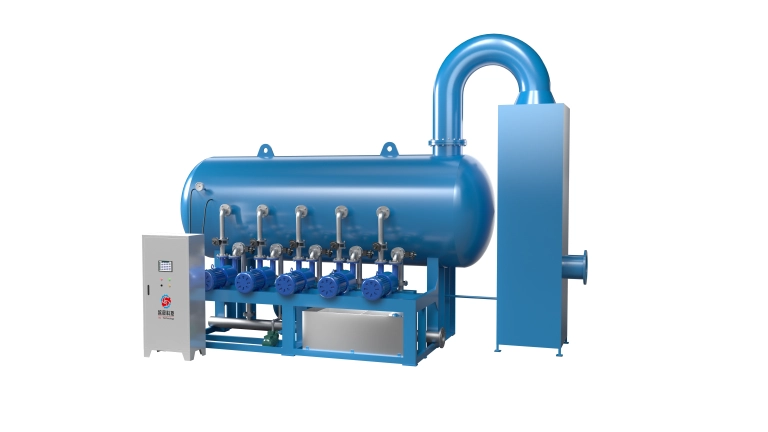
A well-designed ဗဟိုလေအိမ်စနစ် should deliver stable vacuum at each machine connection, respond to changing production loads, and leave enough room for planned expansion.
OC နည်းပညာ’s central vacuum system uses PLC automatic control and multiple vacuum pumps with variable-frequency control and adaptive start/stop operation. A tower condenser operates in a closed cycle, while a closed-loop heat-recovery system transfers recovered heat from the molding machine to the drying room.
For buyers, the main questions are straightforward:
- How much simultaneous vacuum demand will the line create?
- What vacuum level will be available at the farthest machine?
- Should the project use one large pump or several staged pumps?
- What will the system cost to operate and maintain?

White-Area Vacuum Is Not Casting-Area Negative Pressure
These systems are sometimes grouped together in lost foam casting discussions, but they serve different jobs.
| System | Main application |
| White-area central vacuum | EPS pattern cooling and demolding |
| Casting-area negative pressure | Sand-flask stabilization and gas evacuation during pouring |
This article focuses on the white-area network connected to EPS pattern molding equipment. For a broader explanation of both applications, see OC Technology’s guide to white-area central vacuum and casting-area negative pressure.
The distinction matters during procurement. A central vacuum system for EPS pattern cooling should be specified separately from the casting-area negative-pressure system used with the sand flask.
Why Vacuum Performance Affects Pattern Output
Cooling Is Part of the Production Cycle
Steam heats and fuses expanded EPS beads inside the mold. Before the pattern can be released and handled, enough heat and moisture must be removed for it to maintain its shape.
OC Technology’s ဒေါင်လိုက် PLC ဟိုက်ဒရောလစ် Forming စက် incorporates vacuum cooling and energy-recovery functions as part of its automated molding process. The equipment also stores process parameters and supports remote parameter debugging.
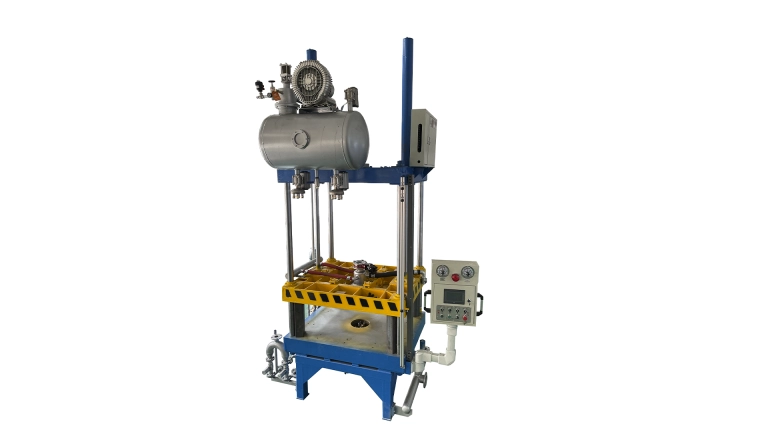
The central network must support that process consistently. When a second or third machine enters vacuum cooling, pressure at the first machine should not drop enough to disturb its cycle.
In practice, unstable vacuum may appear as:
- Longer cooling times
- Delayed demolding
- Different cycle behavior between machines
- More operator adjustments
- Vacuum-related alarms
- Lower accepted-pattern output per shift
A small delay is easy to ignore. Repeated across several machines and two or three shifts, it becomes a production problem.
Measure Pressure at the Machine
Pump-room readings do not tell the complete story.
A pump may meet its specified duty at the inlet while the most distant EPS molding machine receives weaker vacuum. Pipe length, diameter, elbows, valves, filters, condensate, leakage, and branch layout all affect point-of-use performance.
The supplier proposal should therefore define:
- Required pressure at each machine connection
- Pumping speed in m³/h
- Pressure reference, such as absolute or gauge
- Expected pressure variation during load changes
- Recovery time when another machine connects
Using one pressure reference throughout the quotation prevents confusion later. Mixing gauge vacuum and absolute pressure is a surprisingly common source of bad comparisons.
How to Size a Central Vacuum System
Calculate Simultaneous Demand
Vacuum pump sizing should follow actual machine cycles, not machine count alone.
Consider a plant with four molding machines. Two may frequently enter cooling together, while a third overlaps only for a short period. The design load is neither one machine nor necessarily the sum of all four maximum values.
The calculation should include:
- Machine models and quantities
- Required vacuum level or absolute pressure, together with the required pumping speed
- Cooling duration
- Expected cycle overlap
- Network leakage allowance
- Planned future machines
- Maintenance or redundancy requirements
OC Technology’s production-line sizing guide also treats simultaneous equipment demand, utilities, factory layout, pressure stability, and future expansion as connected project inputs.
Review Vacuum Piping Design
A larger pump does not automatically repair a poor network.
The vacuum system supplier should review:
- Main-header length and diameter
- Branch lengths and diameters
- Number of bends and valves
- Filter and separator locations
- Condensate drainage
- Distance to the farthest machine
- Access for inspection and cleaning
Long, narrow routes increase pressure loss. So do clogged filters and unnecessary fittings. In some plants, improving the header or separating a high-demand branch is more effective than adding another oversized pump.
This part looks simple on a layout drawing. Once the floor, utility trench, and machine foundations are finished, changing it is anything but simple.
Reserve Capacity Carefully
A new white-area project may start with two machines and add another after demand grows. The first-stage design can prepare for expansion through:
- Reserved pipe connections
- Electrical capacity
- PLC inputs and outputs
- Isolation valves
- Space for an additional pump
- Room for condenser expansion
However, unused pump capacity carries a cost. A clear proposal should separate capacity installed for immediate production from infrastructure reserved for a later phase.
Choose the Right Pump Arrangement
One Large Pump
A single-pump layout may have fewer control points and a simpler installation. It can work for a stable production schedule where demand changes little during a shift.
The main risk is dependency. If the pump stops for maintenance or repair, every connected machine may lose vacuum service unless a standby unit is available.
Multiple Staged Pumps
A staged arrangement can start or stop pumps as demand changes. During lower production, fewer units run. It may also allow maintenance on one pump while the remaining units support reduced output.
OC Technology’s central vacuum equipment uses multiple variable-frequency-controlled vacuum pumps with adaptive start/stop control rather than relying only on continuous fixed-speed operation.
The better arrangement depends on:
- Production-load variation
- Required redundancy
- Annual operating hours
- Local electricity cost
- Maintenance capability
- Cost of production downtime
A useful quotation explains how the pump sequence follows the molding schedule. Motor power alone is not enough.
Pressure Control and Operating Costs
Match Pump Output to Production Demand
Vacuum demand rises and falls during each molding cycle. Running every pump at full speed throughout the shift may waste electricity when only one machine is cooling.
Variable-frequency control can adjust pump operation according to network pressure. Staged start-and-stop logic can also limit unnecessary idle running.
Buyers should request estimated electrical demand for three conditions:
| Operating condition | Required information |
| Normal production | Typical machine overlap and expected power |
| Peak demand | Maximum planned simultaneous load |
| Low load or standby | Pump sequence and idle-power behavior |
No universal energy-saving percentage applies to every foundry. Actual operating cost depends on cycle overlap, leakage, pressure settings, pump efficiency, maintenance condition, and annual production hours.
Monitoring and Controls That Reduce Downtime
A practical control system should make faults easy to find. Useful functions include:
- Network-pressure display
- Individual pump status
- Pump running-hour records
- Overload and temperature alarms
- Pressure trend history
- Maintenance reminders
- Manual isolation controls
- Clear alarm descriptions
More screens do not automatically mean better control. Operators need the information that helps them respond quickly, not another menu buried five levels deep.
Project Scale Changes the Design Basis
OC Technology’s published case pages list annual production scales ranging from 5,000–6,000 to 15,000 tons for automated lost foam casting white-area lines. The projects cover gas-stove castings, tractor parts, agricultural machinery parts, and box-shell components. These figures describe the stated project scale and should not be treated as guaranteed operating output.
These capacities do not create a standard vacuum specification. They show why system engineering must follow the actual project.
A line running one casting family for long production batches may have predictable machine overlap. Another plant may change molds several times per shift. Machine quantity, cycle sequence, pattern geometry, factory dimensions, and expansion plans all change the required pump and piping arrangement.
Upgrade the Existing System or Replace It?
When an Upgrade May Be Enough
An upgrade may solve the problem when the pumps still have usable capacity but the distribution network or controls are limiting performance.
Possible improvements include:
- Repairing leaks
- Replacing blocked filters
- Enlarging restrictive pipe sections
- Improving condensate drainage
- Adding variable-frequency control
- Correcting pump sequencing
- Separating high-demand branches
Before investing, record pressure at the pump room and the farthest machine during normal and peak production. This helps identify whether the restriction is in vacuum generation, distribution, or cycle timing.
When Replacement Is More Practical
A new system may be justified when:
- Normal production already exceeds available capacity
- More EPS molding machines will be added
- Pump repairs are frequent
- One equipment fault stops the complete molding area
- Existing piping cannot be corrected economically
- Current controls cannot manage staged operation
- Critical spare parts are difficult to obtain
The decision should include lost-production risk, maintenance cost, and expansion requirements—not electricity use alone.
What to Include in the RFQ
Information From the Buyer
Provide:
- Molding-machine models and quantities
- Required pressure and pumping speed
- Mold and cycle information
- Expected simultaneous operation
- Factory layout and proposed pipe routes
- Shift schedule and annual operating hours
- Electrical conditions
- Expansion plans
- Required backup capacity
Information From the Supplier
The proposal should return:
- Pump type, quantity, and motor power
- Pressure at the machine connections
- Total and staged pumping capacity
- Simultaneous-load assumptions
- Pipe diameters and layout basis
- Control and alarm functions
- Condenser and condensate-handling scope
- Estimated electrical load
- Installation boundaries
- Commissioning and training scope
- Recommended spare parts
Final pump and pipeline selection should always be confirmed through project-specific engineering calculations.
Kesimpulan
A properly selected central vacuum system should maintain stable service across every connected EPS molding machine without running more pump capacity than production requires.
Reliable selection starts with actual cycle overlap, point-of-use pressure, vacuum piping design, control response, maintenance access, and future expansion. Foundries planning a new system or an upgrade can send OC Technology their machine data, layout, and production requirements for a project-specific configuration and commercial quotation.
FAQ များ
Q1: How is a central vacuum system sized for multiple EPS molding machines?
A: The calculation combines each machine’s pressure and pumping-speed requirement with realistic cycle overlap, pipe losses, leakage allowance, and future expansion. Adding every machine’s maximum demand without reviewing timing can lead to unnecessary oversizing.
Q2: What vacuum level should be specified for an EPS molding machine?
A: There is no single value for every machine and mold. The required pressure depends on the equipment design, mold volume, cooling cycle, piping network, and simultaneous demand. The quotation should state both the pressure reference and measurement location.
Q3: What causes unstable vacuum pressure?
A: Common causes include inadequate pumping capacity, leaks, narrow or excessively long piping, blocked filters, condensate buildup, restrictive valves, and several machines entering vacuum cooling at the same time.
Q4: What affects central vacuum system cost?
A: Major cost factors include pumping capacity, pump quantity, redundancy, variable-frequency controls, condensers, vacuum tanks, piping scope, electrical requirements, installation, commissioning, and spare-parts packages.
Q5: How should central vacuum system suppliers be compared?
A: Compare point-of-use pressure, load calculations, piping assumptions, pump sequencing, redundancy, electrical demand, maintenance access, commissioning support, spare-parts availability, and commercial exclusions—not the pump price alone.


 Malay
Malay  English
  Arabic
  Hindi
Hindi  Indonesian
  Japanese
  Korean
  Portuguese
  Spanish
  Thai
Thai  Vietnamese