
EPS foam molding is the process by which expandable polystyrene beads are molded into accurate, lightweight, stable foam parts. Some of the molded parts are used as packaging or insulation items and in this case they are the end item. The vast majority of molded EPS parts are used as sacrificial patterns in the lost foam casting process to make metal castings. Such parts require control of density, fusion strength, dimensional stability, coatings performance and reproducing ability.
The EPS foam molding machine is at the heart of a white-area production system for foundries and industrial users of equipment. By optimizing pre-foaming, maturation, conveying, mold filling, steam heating, vacuum cooling and drying as well as coating application and pattern storage within this process, it is possible to create a high-performance process that is fully under control. As a result, it is possible to produce castings of constant quality, with a low percentage of waste, a good surface finish and production costs that are easy to predict.
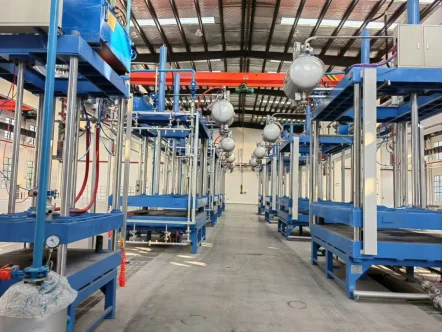
What an EPS Foam Molding Machine Does
Precision shape forming for industrial foam patterns
An EPS foam molding machine uses a custom mold cavity to shape pre-expanded beads into a three-dimensional part. Unlike block molding, which makes foam blocks for later cutting, shape molding forms near-net foam components directly inside the mold. Ribs, curves, bosses, inserts, and thin-wall features can be produced with repeatable geometry.
In lost foam casting, the molded pattern must match the intended metal component while allowing for shrinkage, coating thickness, and handling strength. A small pattern deviation can become a casting deviation. Mold accuracy, filling balance, heating uniformity, and cooling stability therefore become core equipment requirements.
Why EPS fits automated molding
EPS is lightweight, closed-cell, steam-expandable, and suitable for detailed shapes at controlled densities. Its bead structure allows complex molds to be filled and fused into rigid foam bodies. For lost foam casting, the material also disappears during pouring as molten metal replaces the coated foam pattern. Pattern density must be high enough for handling and sand compaction, yet low enough to support clean metal flow and controlled vaporization.
Step-by-Step EPS Foam Molding Process
Pre-expansion and density control
The process begins with expandable polystyrene beads. Steam heats the beads in a pre-expander, softening the polymer and activating the blowing agent inside each bead. The beads expand many times their original volume, creating a low-density foam material. This stage largely determines the target density of the future pattern.
Key variables in industrial pre-expansion such as steam pressure and temperature, filling weight, residence time and discharge conditions all need to be controlled to produce beads of consistent density. Inconsistencies in the expanded bead can cause problems in the subsequent mold filling, fusion, pattern strength and casting quality. The use of automatic feeding, weighing, pressure control and recipe storage allows for bead size distribution to be maintained from batch to batch.
Maturation and bead stabilization
Freshly expanded beads contain residual moisture and changing internal pressure. Maturation, also called aging or conditioning, allows air to diffuse into the beads while moisture decreases. Proper maturation improves bead elasticity, foamability, dimensional stability, and fusion performance inside the mold.
Beads are normally held in ventilated silos or hoppers for several hours, depending on raw material, density target, ambient conditions, and product requirements. Insufficient maturation can lead to weak fusion, shrinkage, poor surface finish, dimensional drift, and unstable casting results. For lost foam pattern production, maturation is a quality-control step rather than passive storage.
Mold filling, steam fusion, cooling, and ejection
After maturation, the beads are pneumatically fed into the closed mold cavity. Balanced filling matters because the finished pattern must have uniform density across thick and thin sections. Multi-point filling, air exhaust design, mold venting, and pressure protection help reduce voids and density gradients.
Steam then enters the mold and heats the beads again. The beads soften, expand slightly, and fuse into one foam structure. After fusion, the mold is cooled by water, vacuum, or combined cooling systems. Cooling must be fast enough for cycle efficiency but controlled enough to prevent deformation. Once the pattern becomes rigid, the mold opens and ejectors release the part.
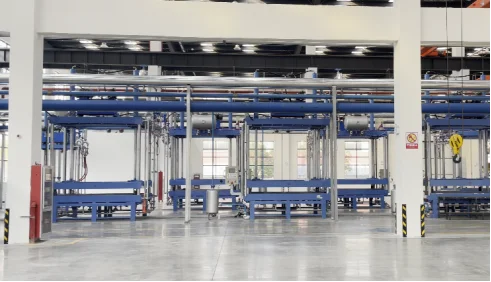
Machine Systems That Define Pattern Quality
PLC control and repeatable recipes
Modern EPS foam molding machines use programmable control systems to manage filling, steam, pressure, vacuum, cooling, and ejection. Recipe storage is important for factories producing multiple pattern types. When parameters are saved and repeated, operators can reduce trial adjustment and stabilize production after mold changes.
Sensors for pressure, position, temperature, and timing also support troubleshooting. A stable control platform makes it easier to analyze defects, compare batches, and standardize production across shifts.
Steam, vacuum, and cooling performance
Steam quality affects fusion strength and surface finish. Poor steam distribution leaves weak bead boundaries; excessive steam can increase cycle time, energy cost, and deformation risk. Efficient steam-water separation, well-designed piping, and controllable valves are therefore important.
Vacuum cooling improves moisture removal and shortens cooling time. In foam pattern production, moisture control matters because the next stages often involve coating and drying. Residual moisture can interfere with coating adhesion and drying uniformity.
Mold design and fast changeover
The mold defines product geometry, air flow, steam penetration, cooling rate and demolding. Therefore the design of a mold has to meet several demands which have to be considered during the planning. Among others the dimensioning of vents, the design of water channels, the stiffness of the mold, the surface finish and the ejection system. For the production of small lots a fast mold changing system is of great value, because the down time is directly converting into low machine output and high production cost.
From Foam Pattern to Lost Foam Casting
Coating, drying, and flask preparation
After molding of foam patterns, a series of processes, such as cutting, assembly, gating, coating, and drying, are required. The refractory coating on the surface of a pattern forms a controlled barrier between the molten metal and the surrounding sand. The coating’s permeability, thickness, degree of drying, and surface continuity determine the rate of gas release, the rate of fill, and the surface quality of the cast part.
Dried patterns are placed in a flask and surrounded by dry, unbonded sand. Vibration compacts the sand around the coated pattern, supporting the pattern without a conventional core system. This is one reason lost foam casting can simplify complex internal passages and integrated geometries.
Pouring, vaporization, and metal replication
As molten metal is poured down a chute into the coated pattern, the pattern vaporizes rapidly. The molten metal then fills the space where the pattern had been. With close control of the process, the resulting solidified casting will very closely resemble the original foam pattern. When used correctly, this method of casting can eliminate parting lines, cores, and all of the many assembly steps, as well as reduce grinding and secondary machining required.
All of the following factors interact: pattern density, fusion, coating, drying, sand compaction, vacuum, and pouring practice. A weak step can cause problems in a later step to result in porosity, misrun, surface defects, deformation, or dimensional errors.
FAQ
What is an EPS foam molding machine?
An EPS foam molding machine is used to fill a mold with matured expanded polystyrene beads, steam the beads to bond together, allow the part to cool and then eject the finished component, or the casting pattern.
Why is bead maturation important before molding?
Maturation stabilizes internal bead pressure, lowers moisture, improves bead elasticity, and supports better fusion. In lost foam casting, poor maturation can cause unstable foam patterns and later casting defects.
How does cooling affect EPS pattern quality?
Cooling fixes the shape of the fused foam pattern. Controlled cooling reduces deformation, moisture, shrinkage, and ejection damage. Vacuum-assisted cooling can also shorten cycle time and improve dimensional stability.
What makes EPS foam patterns useful for lost foam casting?
EPS foam can be molded into complex shapes to form a pattern that will pour up vapor in the melt to form the detailed casting without the need for cores, part lines, or assembly of multiple parts. The entire pattern is coated prior to pouring to assure complete vaporization of the pattern by the melt.
OC Technology is a lost foam casting equipment manufacturer, supplier, and factory focused on high-end intelligent lost foam white-area equipment. Its product range includes foam sheet machines, pre-foaming machines, maturation silos, vertical molding machines, horizontal forming machines, air dryers, central vacuum systems, and lift type paint mixers. For B2B projects requiring stable foam pattern production, automated equipment integration, and factory-level lost foam casting solutions, OC Technology provides a focused manufacturing partner for complete EPC production line development. Contact OC Technology today to discuss customized lost foam casting equipment solutions for factory production lines, EPC projects, and long-term manufacturing cooperation.


 English
  Arabic
  Hindi
Hindi  Indonesian
  Japanese
  Korean
  Malay
Malay  Portuguese
  Spanish
  Thai
Thai  Vietnamese