
1. Introduction
Lost Foam Casting (EPC) and Lost Wax Casting (also called Investment Casting or IC) are two advanced evaporative-pattern methods used today. Both ways work well to make complex metal parts with good accuracy and little waste. They play big roles in fields like automotive, aerospace, heavy machinery, energy, farming tools, and medical gear.
Even though both use a pattern that vanishes when metal pours in, Lost Foam Casting and Lost Wax Casting differ a lot. They vary in tools needed, steps taken, precision levels, surface look, metals that fit, cost for runs, and effect on the environment. Picking one depends on part shape, metal type, needed accuracy, how many parts to make, time limits, and total expenses.
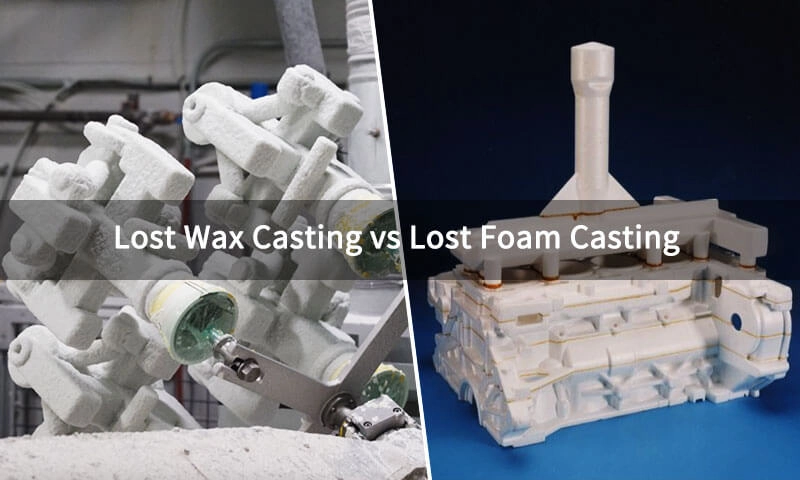
2. What Is Lost Foam Casting?
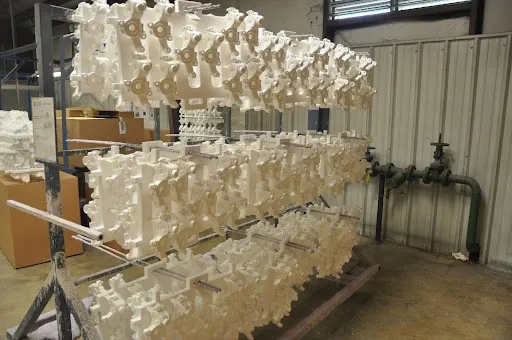
Lost Foam Casting is an evaporative-pattern way. It uses expanded polystyrene (EPS) foam as a pattern that gets thrown away. The foam sits inside loose dry sand. When hot metal pours, it turns the foam into gas right away. This leaves a clear space that the metal fills to shape the final piece.
Step-by-Step Process Overview
- Pattern Creation: EPS foam shapes come from CNC machining, injection molding, or 3D printing. They usually hit accuracy of ±0.5 mm and take 24–48 hours to make.
- Assembly: Many patterns (often 10–20 or more) get fixed to a gating tree. This helps pour more at once.
- Coating: A thin layer of refractory material (0.1–0.3 mm thick) goes on the foam. It helps make a better finish and stops sand from getting in.
- Molding: Dry silica sand gets shaken and packed tight around the coated patterns until it reaches 85–90% density.
- Pouring: Hot metal—like aluminum (~620 °C) or ductile iron (~1,400 °C)—burns away the foam and fills the empty space.
- Cooling: The metal hardens fast, often in 30–90 seconds based on wall thickness.
- Shakeout & Reclamation: The loose sand falls off easily. Up to 60% can get reused after simple screening.
- Finishing: Cast parts often need 1.5–3 mm extra material removed to cut off gates and fix small rough spots.
Key Characteristics
- No cores and one-piece mold cut out flash from parting lines. This also shortens mold setup time by up to 40%.
- Quick pattern making allows fast changes and easy prototypes.
- Sand gets reused a lot, so material use drops and waste costs go down.
- It handles big parts up to 2 meters long and 500 kg heavy.
- It sees wide use in automotive powertrain items (engine blocks, cylinder heads, intake manifolds), heavy equipment covers, pump bodies, gearbox casings, and hydraulic valve pieces.
3. What Is Lost Wax Casting?
Lost Wax Casting, often known as Investment Casting, is a precise method. It starts with wax patterns covered in many ceramic layers to build a strong shell. After the wax comes out and a high-heat burn, the shell gets filled with molten metal. This gives parts with fine detail and smooth surfaces.
Step-by-Step Process Overview
- Wax Pattern Injection: Hot wax goes into accurate steel dies. It repeats well within ±0.05 mm during 20–30 second cycles.
- Assembly (Treeing): Several wax patterns attach to a main wax sprue. The tree can hold up to 50 parts.
- Shell Building: The tree gets 8–12 layers of ceramic slurry and stucco. This takes 2–4 days (silica sol way) or 24–48 hours (water-glass way).
- Dewaxing: Wax leaves in an autoclave at about 150 °C. Over 99% comes out clean.
- Burnout: The shell heats slowly to 600–900 °C. This clears any leftover bits.
- Pouring: Hot alloys pour in by gravity, vacuum, or spin force.
- Cooling & Shakeout: Parts harden in 30–120 minutes. Then the ceramic shell breaks off.
- Finishing: Extra material needed is only 0.5–1.5 mm because of great as-cast accuracy and smooth look.
Key Characteristics
- Strong steel dies give steady results over thousands of uses.
- Thick ceramic shells stand up to pour temps as high as 1,660 °C.
- It works with many metals like stainless steels, nickel superalloys, titanium alloys, and other tough ones.
- It gives top as-cast surface (Ra 0.8–3.2 µm) and tight tolerances (±0.1–0.3 mm).
- It fits well for aerospace turbine blades and nozzles, medical implants, orthopedic items, valve bodies, pump impellers, precise defense parts, and fancy jewelry.
Comparative Analysis: Lost Foam Casting vs Lost Wax Casting
Process Complexity and Setup
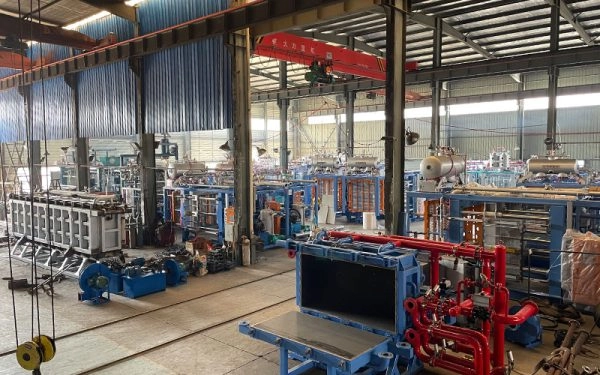
Lost Foam Casting uses basic single-use foam patterns. These come together fast without hard tools. Investment Casting needs days to build the ceramic shell, plus dewax and high-heat steps. So setup takes longer.
Surface Finish and Dimensional Accuracy
Lost Foam Casting usually gives surface roughness of Ra 6.3–12.5 µm and tolerances of ±0.5–1.0 mm. Extra grinding or blasting often helps. Lost Wax Casting reaches much smoother roughness (Ra 0.8–3.2 µm) and closer tolerances (±0.1–0.3 mm). This cuts down on later machining—sometimes by 30–50%.
Material Compatibility
Lost Foam Casting works best with aluminum alloys, ductile iron, and some low-alloy steels (up to about 1,450 °C melt point). Lost Wax Casting handles a bigger range. It includes stainless steels, nickel superalloys (like Inconel), titanium alloys, and other high-melt or reactive metals (up to 1,660 °C).
Tooling and Cost Considerations
Lost Foam Casting has very low start-up tool costs. Single foam patterns run $100–$300 each. Lost Wax Casting needs strong steel dies that cost $15,000–$60,000. But the cost spreads out nicely over medium to high runs.
Production Volume and Flexibility
Lost Foam Casting saves money at medium to high volumes (usually 5,000–50,000 parts per year). It shines when quick pattern changes happen. Lost Wax Casting fits better for low to medium volumes (500–10,000 parts per year). It stands out when top precision and little after-work matter most.
Environmental Impact
Lost Foam Casting gains from high sand reuse (up to 60%). But foam burning gives off volatile organic compounds. Lost Wax Casting creates ceramic waste and CO₂ from burnout. Still, modern plants recycle up to 75% of shell material.
Design Capabilities
Lost Foam Casting makes big hollow shapes, deep undercuts, and built-in cavities easy without cores. Lost Wax Casting allows very thin walls (down to 1 mm), tricky inner paths, and tiny surface details. These can prove hard or impossible with foam methods.
5. Strengths and Limitations Summary
Lost Foam Casting Strengths: Very low tool cost, fast pattern making, no-core mold setup, ability for big parts, high sand reuse.
Limitations: Okay surface and tolerances, limited metal choices, more finishing work needed.
Lost Wax Casting Strengths: Top accuracy and surface quality, wide metal range, little after-casting work, high repeat ability.
Limitations: High start tool cost, longer cycle time, harder shell steps.
6. Choosing the Right Process: Decision Framework
Look at part shape and detail level: Pick Lost Foam Casting for big pieces with hollow areas, undercuts, or built-in ribs. Go with Lost Wax Casting when very thin walls, complex inner features, or fine details matter.
Check material and strength needs: Lost Foam Casting fits aluminum and ductile iron for normal temp uses. Lost Wax Casting suits stainless steels, superalloys, and titanium in hot or harsh settings.
Review accuracy and surface needs: Lost Foam Casting meets basic function with ±0.5–1.0 mm tolerances. Lost Wax Casting gives precision-critical results with ±0.1–0.3 mm tolerances and better as-cast surfaces.
Think about volume and tool budget: Lost Foam Casting works well for medium-to-high runs. Lost Wax Casting pays off in low-to-medium runs where lower scrap and finishing save money overall.
Consider lead time and change speed: Lost Foam Casting allows quick prototypes and design shifts. Lost Wax Casting gives steady outcomes in set, high-precision production.
7. Conclusion
Lost Foam Casting and Lost Wax Casting each bring special benefits for different needs. Lost Foam Casting offers a cheap, flexible choice for bigger, simpler-geometry parts with good material use. Lost Wax Casting stays the top pick when highest precision, smooth surfaces, and strong material performance count most.
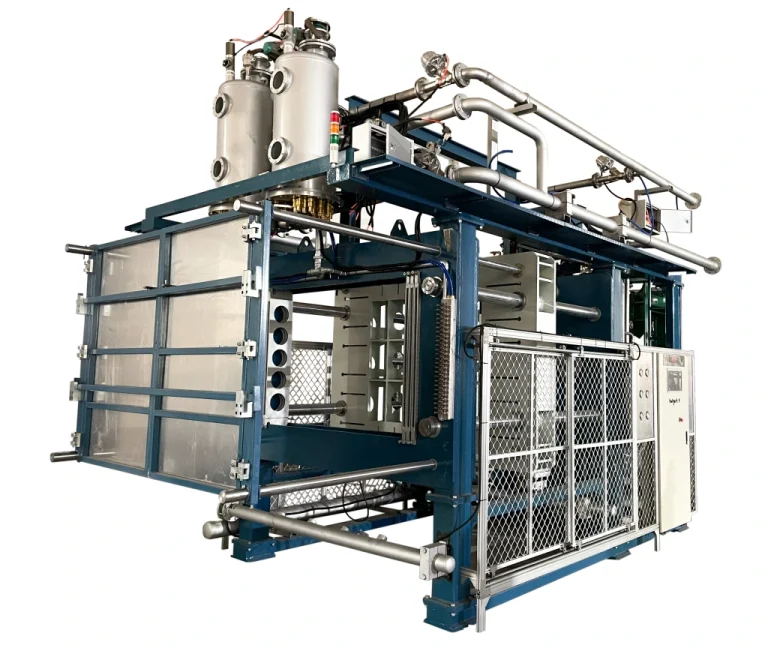
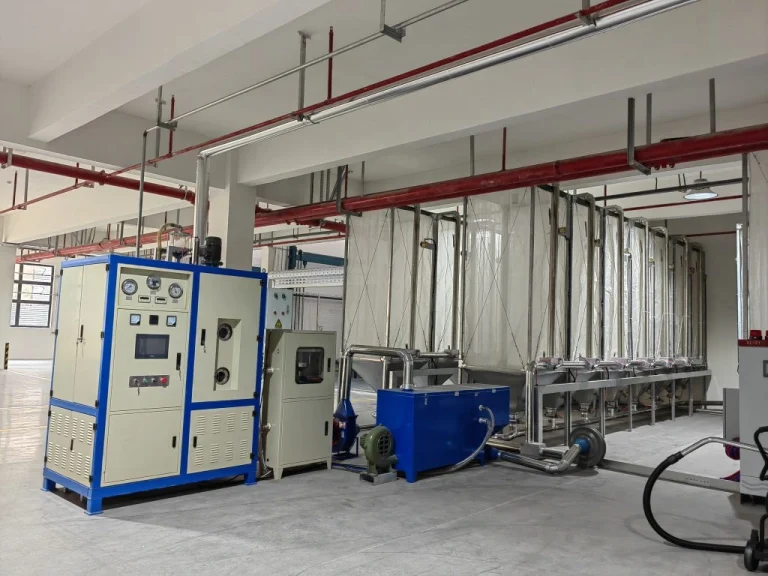
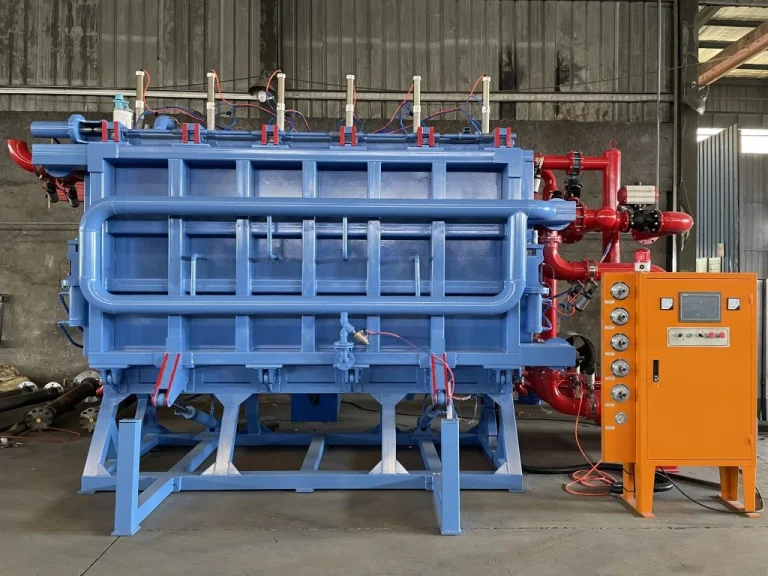
The right choice comes from balancing part details, production aims, and cost factors. Foundries that want to improve or grow Lost Foam Casting work best with skilled equipment partners who focus on automation and steady process control. OC Technology, a national high-tech enterprise and strategic partner of the China Lost Foam Industry Association, specializes in advanced lost foam casting equipment. The company supplies fully automatic EPS shape molding machines, energy-efficient heat-pump air dryers, high-performance vacuum casting lines, central vacuum systems, lift-type paint mixers, and complete turnkey EPC production solutions designed for automation, precision, energy savings, and consistent high-quality output.
FAQs
Which casting method is better suited for large, geometrically simple parts?
Lost Foam Casting is better suited for large, geometrically simple parts, especially those made from ferrous metals. Its coreless design makes it ideal for engine blocks, cylinder heads, pump housings, and similar components.
Which casting method provides higher dimensional accuracy and surface finish?
Lost Wax Casting offers higher dimensional accuracy and superior surface finishes, making it the preferred choice for applications where precision and aesthetics are critical, such as aerospace components and medical devices.
Which casting method is more cost-effective for small production runs?
Lost Foam Casting may be more cost-effective for small production runs due to lower initial tooling costs. However, if high precision and minimal post-processing are required, Lost Wax Casting might deliver better overall value.
Can both casting methods produce parts with internal cavities?
Yes, both methods can produce parts with internal cavities. Lost Foam Casting achieves this naturally through single-piece foam patterns, while Lost Wax Casting accommodates internal features with careful design and additional process steps.
Partner with a Leading Lost Foam Casting Equipment Manufacturer and Supplier
Foundries, OEMs, equipment integrators, and production facilities seeking to upgrade, automate, or establish new Lost Foam Casting lines should connect with OC Technology—a dedicated lost foam casting equipment manufacturer, supplier, and factory. With expertise in fully automated white-area systems and complete EPC turnkey solutions, OC Technology delivers reliable, high-efficiency equipment tailored to modern foundry demands. Reach out to the team at +86 15988479417 or zyh@oc-epc.com, or explore detailed product information at https://www.oc-epc.com/.

 English
  Arabic
  Hindi
Hindi  Indonesian
  Japanese
  Korean
  Malay
Malay  Portuguese
  Spanish
  Thai
Thai  Vietnamese