
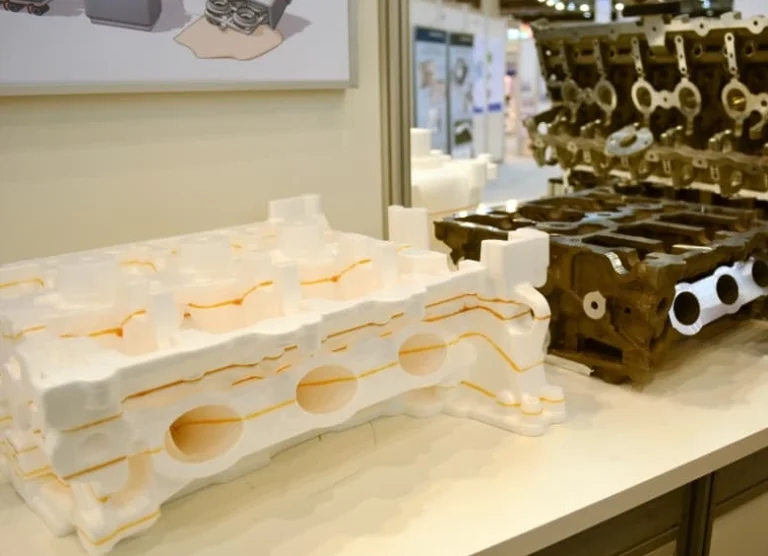
Lost foam casting (EPC), sometimes called evaporative pattern casting, stands out as one of the most practical and affordable ways to make complicated near-net-shape metal parts. The real key to success in this method lies in how well the refractory coating works on the EPS (expanded polystyrene) pattern. This coating does far more than just protect — it actually forms the main technical shield that guarantees good casting quality, precise dimensions, and smooth surfaces. This article gives a clear and detailed technical explanation of what the coating does, what it contains, how to choose it, how to mix it, how to apply it, and how to dry it properly during lost foam casting production.
1. The Role, Basic Composition and Performance of Lost Foam Coating
(1) Main Functions of the Coating
The refractory coating plays four major roles in lost foam casting:
- Strengthening the foam pattern The coating greatly boosts the stiffness and toughness of the delicate EPS pattern. It stops bending or breaking while workers move it, dip it, fill sand around it, or compact the sand.
- Isolation barrier between molten metal and dry sand When metal is poured, the coating becomes the only thing that keeps liquid metal away from loose dry sand. It blocks metal from seeping into the sand (sand burning). It also keeps sand from falling into the metal flow. As a result, castings come out clean and the mold stays stable.
- Permeability and evacuation of pyrolysis products As soon as hot metal touches the EPS pattern, the foam quickly breaks down into gas and liquid byproducts.
- For cast iron and steel (1350–1600°C), most byproducts turn into gas → the coating needs outstanding gas permeability.
- For aluminum alloys (760–780°C), most byproducts stay liquid → the coating must wet easily and soak up liquid leftovers fast. Good removal of these byproducts prevents holes, wrinkles, carbon spots, and unwanted particles.
- Thermal insulation The coating slows down heat loss from hot metal into the cold sand. This helps metal feed better into thin sections and fill every corner.
(2) Basic Composition of Lost Foam Coating
A strong lost foam coating usually contains these parts:
- Refractory aggregate – The main structure that sets heat resistance, chemical steadiness, and insulation ability. Popular choices are zircon, silica, alumina, magnesia, graphite, kyanite, etc. Grain size range and shape (round or column-like works best) strongly affect how easily gas passes through.
- Binders – Factories use both organic types (starch, dextrin, CMC, PVA) and inorganic types (silica sol, sodium silicate, nano-bentonite). Organic ones burn away during pouring and create extra open paths. Inorganic ones keep strength at high heat.
- Carrier – Usually water-based or alcohol-based liquid mixtures.
- Surfactants (wetting agents) – These lower surface tension so the coating sticks well to the non-polar EPS surface.
- Suspending agents – Bentonite, attapulgite, CMC, or organic bentonite stop heavy particles from sinking quickly.
- Thixotropic agents – Mostly attapulgite. They make the coating thin when stirred but thick when still.
- Additives – Defoamers (n-octanol, tributyl phosphate), preservatives (sodium benzoate), and bactericides.
(3) Key Performance Requirements
People judge coatings in two groups:
Working performance:
- Strength at both low and high temperature
- Gas permeability
- Refractoriness (>1600°C for iron/steel)
- Ability to handle sudden heat changes
- Adsorption capacity
- Easy breakdown after pouring
Process performance:
- Spreads smoothly on EPS
- Levels nicely with little dripping
- Stays mixed well (no settling for 24–48 hours)
- Shows proper thixotropic flow for easy dipping
2. Selection of Lost Foam Coatings
(1) According to Chemical Properties (pH compatibility)
- Cast iron & carbon/low-alloy steel (acidic melt): Choose acidic or neutral refractories – quartz sand, kyanite, flake graphite, zircon silica.
- High-alloy steels (neutral): Pick weakly acidic or neutral types – zircon, corundum, zirconium englobe.
- High-manganese steel (alkaline): Use magnesia, forsterite, or magnesia-olivine based coatings.
- อลูมิเนียมโลหะผสม: Select special low-refractoriness coatings that breathe well and soak up liquid fast (often pearl sand or bauxite based).
(2) According to Pouring Temperature & Process Conditions
Higher pouring temperatures demand greater heat resistance and better resistance to sudden temperature jumps. Thin-wall complex parts need excellent breathability and thinner layers. Large heavy parts require thicker and tougher layers.
3.Coating Preparation, Quality Control and Storage
Modern Lost Foam Paint Mixer and Mixing Equipment
To achieve consistent, high-performance lost foam coatings, a professional lost foam casting paint mixer (also called high-shear coating disperser) is essential. Today’s advanced lost foam casting paint mixers adopt a lift-type design that combines a high-speed main disperser with a mobile anti-sedimentation immersion coating tank.
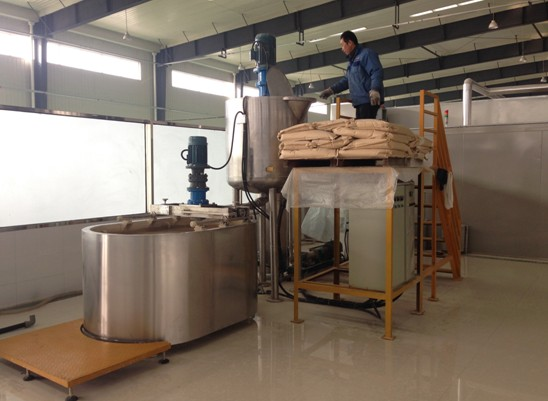
Key features of modern lost foam casting paint mixers include:
- Entire system constructed from 304 stainless steel – acid/alkali resistant, corrosion-resistant and easy to clean
- Variable-frequency high-speed motor (0–1100 rpm) with high-torque reducer for delicate, bubble-free slurry
- 1.5-meter-diameter mobile immersion tank with continuous low-speed rotation to eliminate coating sedimentation
- Automatic timed mixing, bottom discharge, and water-adding functions for fully automated operation
Compared with traditional stirrers, these dedicated lost foam casting paint mixers produce significantly finer particles, zero foam, and superior thixotropy and leveling performance, directly improving coating uniformity and final casting surface quality.
Preparation Process
- High-speed dispersion (≥2 hours) in the lost foam paint mixer: fully hydrate and shear all powders
- Low-speed de-aeration (≥2 hours) in the anti-sedimentation tank: remove entrained air
Key Quality Control Parameters
- Density (Baumé 65–80° Bé)
- Viscosity and thixotropic index
- pH value (usually 7–9)
- Residual moisture after drying (<1%)
Storage Recommendations
Prepare fresh batches daily whenever possible. Maximum summer storage 2–5 days, winter 5–10 days in cool conditions with regular low-speed agitation using the lost foam paint mixer.
4. Coating Application Methods and Precautions
(1) Application Methods
- Brushing: Works well for big single pieces or test runs
- Dipping/Flow coating: Perfect for large batches of small-to-medium complex parts
- Spraying: Best choice for thin-wall pieces or patterns that bend easily
(2) Coating Thickness Control
- Pattern surface: 0.5–2.0 mm (iron/steel), 0.3–1.0 mm (aluminum)
- Sprue & runner system: 2.0–4.0 mm for extra strength
(3) Key Operational Precautions
- Keep slow constant stirring (10–20 rpm) while dipping
- Do not shake coated patterns hard – just let excess drip naturally
- Never leave any bare (“dew”) spots on the pattern
- Control dipping angle and speed carefully to avoid trapping air
5. Advanced Drying Technology for Lost Foam Coatings
Proper drying is the final guarantee of coating performance. Traditional steam or electric drying has been largely replaced by energy-efficient air-source heat pump drying systems specifically developed for the lost foam industry.
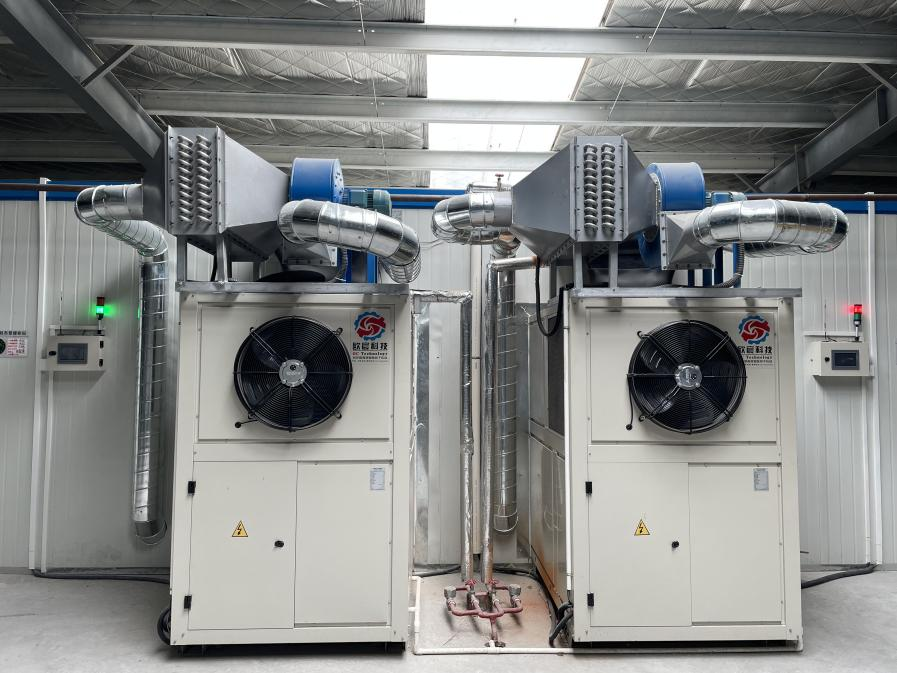
Modern Air-Source Heat Pump Drying Solutions
Leading manufacturers offer three configurations:
- Top-mounted units (compact, easy installation)
- Rear-mounted high-capacity systems (80–100 m² drying rooms)
- Indoor integrated units with precise wind-field design
ข้อดีหลัก
- Temperature precisely controlled at 35–50°C (±1°C uniformity)
- Relative humidity ≤15% for rapid, crack-free drying
- Closed-loop heat recovery >70%, COP >2.0
- Zero emissions, 60–70% energy savings vs traditional methods
- IoT remote monitoring via mobile app
These systems eliminate coating cracking caused by rapid heating and ensure complete moisture removal without softening the EPS pattern.
FAQ About Lost Foam Casting Coatings
Q: Why is coating permeability so critical in lost foam casting? A: Because the EPS pattern turns into huge amounts of gas and liquid the moment hot metal touches it. Poor permeability traps gas and causes pores, wrinkles, and carbon defects.
Q: Can the same coating be used for both cast iron and aluminum? A: No. Iron needs high heat resistance and strong gas release. Aluminum needs great liquid absorption and lower heat resistance. Using an iron coating on aluminum creates serious carbon defects.
Q: What is the ideal coating thickness for iron lost foam castings? A: Usually 0.8–1.8 mm on pattern surfaces and 2.5–4.0 mm on the gating system. Thicker layers reduce breathability. Thinner layers risk metal burning into the sand.
Q: How to avoid coating cracking during drying? A: Keep temperature under 50°C, raise heat slowly (<10°C/h), and provide even airflow. Choose coatings with the right thixotropy and binder mix.
Q: Why do some factories still fail even with good coating? A: Typical causes include bad drying control, too much moisture in patterns, wrong sand compaction, incorrect pouring temperature, or poor match between coating and metal type.
Partner with a Professional Lost Foam Casting Manufacturer & Supplier
OC Technology is a leading full-process lost foam casting factory and EPC (Engineering-Procurement-Construction) solution provider based in China. With more than 15 years of deep experience in lost foam technology, modern automatic coating lines, fast dispersion systems, and temperature-controlled drying rooms, OC Technology supplies top-quality iron, steel, and aluminum lost foam castings to customers worldwide in automotive, pump & valve, machinery, and rail transit industries.
As an ISO 9001:2015 and IATF 16949 certified lost foam casting manufacturer and supplier, OC Technology provides complete services from pattern design, tooling, coating development, casting production, all the way to machining and surface treatment.
ติดต่อ OC Technology วันนี้ for reliable, high-quality lost foam casting solutions. Email: zyh@oc-epc.com or call at +86 15988479417 One inquiry, lifetime partnership.

 Thai
Thai  English
  Arabic
  Hindi
Hindi  Indonesian
  Japanese
  Korean
  Malay
Malay  Portuguese
  Spanish
  Vietnamese