Giới thiệu
In the technical area of Mất bọt đúc, also known as evaporative pattern casting (EPC), the preparation of refractory coatings is a key step. This step affects the quality of the final casting in a big way.
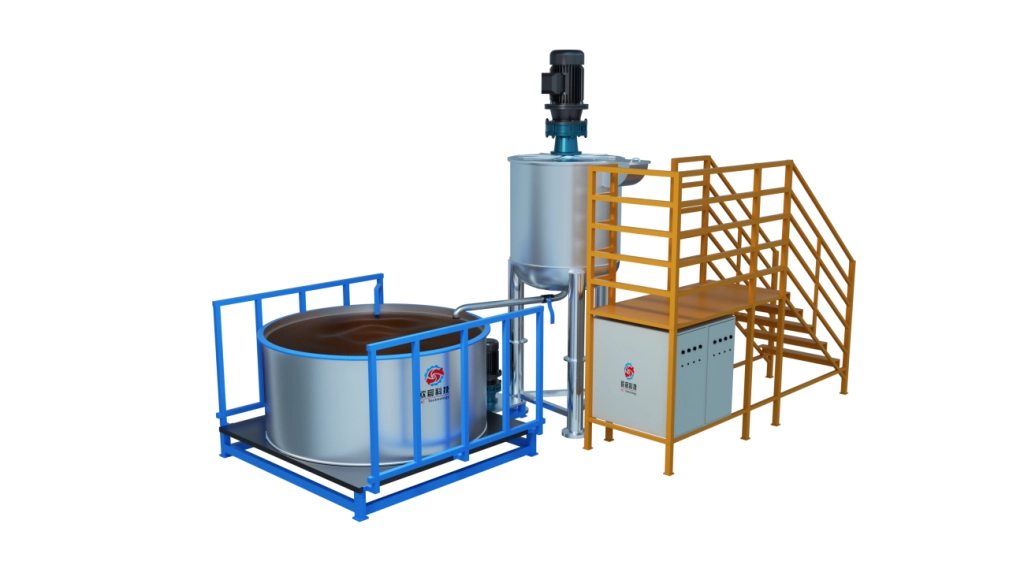
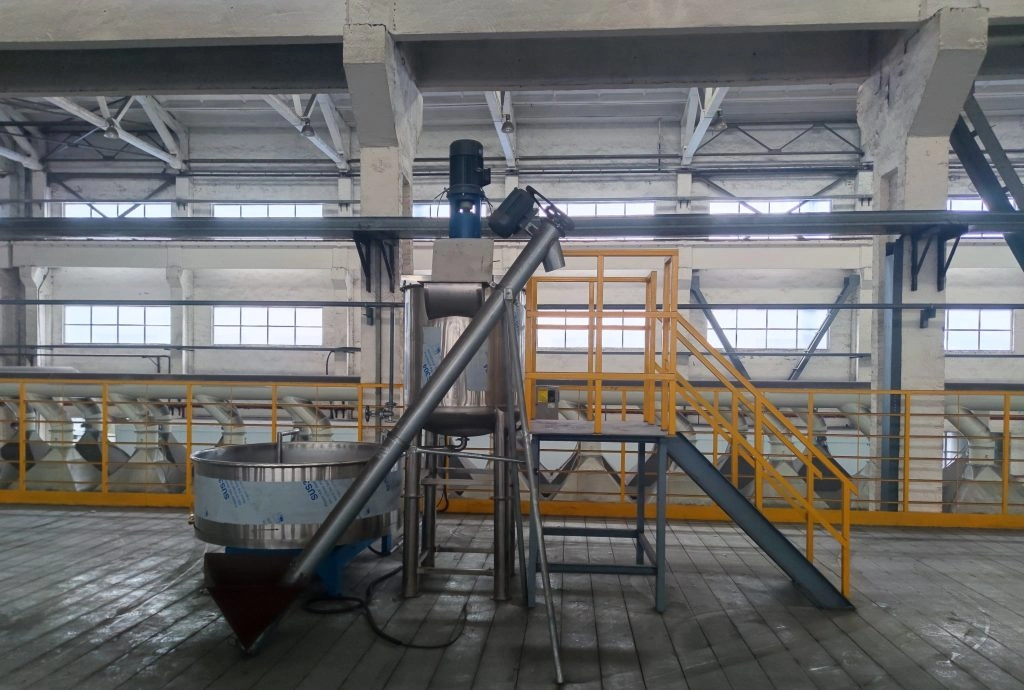
The Lift Type Paint Mixer is a special high-performance refractory coating blender. It combines high-shear dispersion with ongoing anti-sedimentation technology. Engineers designed this equipment to create stable, even, and well-dispersed slurries. These slurries are vital for coating polystyrene foam patterns in current foundry work.
It makes sure of exact rheological properties. These include viscosity, thixotropy, suspension stability, and permeability. The Lift Type Paint Mixer cuts down common problems like metal penetration, sand burn-on, gas porosity, and surface roughness. At the same time, it boosts production efficiency.
The Critical Role of Refractory Coatings in Lost Foam Casting Processes
Lost foam casting uses expendable foam patterns (typically EPS). Workers coat these patterns with a refractory slurry. Then, they assemble the patterns into clusters. Next, they dry them. After that, they embed them in unbonded dry sand. Finally, molten metal replaces the patterns.
The refractory coating forms a short-term ceramic shell. This shell must handle several tough tasks:
Structural Support
It strengthens the weak foam pattern against the pressure of packed sand.
Thermal Barrier
It endures high heat from molten ferrous and non-ferrous alloys.
Permeability Control
It lets gases from foam breakdown escape. This prevents backpressure or mold failure.
Surface Quality
It sets the smoothness and size accuracy of the final casting.
Anti-Stick Sand Properties
It stops direct contact between molten metal and molding sand.
Typical coating thickness goes from 0.5 to 2 mm. Workers achieve this through controlled dipping or spraying. Common refractory aggregates include zircon flour, bauxite, quartz, alumina, and talc. They mix these with binders like colloidal silica or sodium silicate.
The best powder-to-liquid ratios are often 1:0.6–0.9 by weight. Plus, strict mixing steps are needed to get the right Baume degree and rheological behavior.
Poor mixing causes particle clumping, too much foaming, settling, or wrong viscosity. These issues raise scrap rates. In bad setups, scrap rates can go over 10–15%.
Engineering Design and Key Technical Specifications of the Lift Type Paint Mixer
The Lift Type Paint Mixer has two main combined systems:
- A fast main mixing disperser
- A movable large-capacity anti-sedimentation immersion coating tank
Both use top-quality 304 stainless steel. This material resists acidic and alkaline settings, corrosion, and wear well. It also allows easy cleaning between batches.
Core Technical Features
Variable Frequency Drive System
It has a high-torque special reducer and frequency-controlled motor. This setup offers smooth speed changes from 0 to 1100 RPM. Operators can adjust speeds to fit needs. They use high speeds like 600–900 RPM for early dispersion. Then, they switch to lower speeds for air removal and settling.
High-Shear Dispersion Mechanism
The stainless steel spindle and dispersing wheel create strong blade action. This breaks refractory aggregates into a fine, low-foam slurry. The slurry has good flow and coating traits.
Anti-Sedimentation Immersion Tank
The 1.5-meter diameter tank holds large-scale cluster dipping. It rotates at slow speed all the time. This keeps things even during long production periods. It stops refractory particles from settling.
Automated Process Controls
The bottom discharge outlet helps. Automatic water addition works too. Programmable mixing timers make cycles repeatable. These features need little operator input. They suit high-volume making.
Lift-Type Mobility
It improves links with dipping stations, material handling systems, and automated production lines.
These design parts make the equipment useful for various refractory mixes. It handles aluminum, gray iron, ductile iron, and steel casting jobs.
Technical Advantages and Quantitative Performance Benefits
Superior Slurry Rheology and Stability
High-shear mixing gets even dispersion with little air trapped. Research on slurry viscosity shows that controlled mixing affects coating thickness, mold filling, and surface roughness. Lower viscosities that are well-handled (like 20–35 seconds on Zahn Cup #5) lead to thinner, more permeable coatings. These help gas escape while keeping strength.
Defect Minimization
Even coatings lower cases of burn-on, inclusions, and porosity. Good permeability control stops gas defects. Steady thickness keeps size stable and gives great surface finish. Ra values often improve by 30–50% compared to manual or old mixing ways.
Operational Efficiency and Scalability
Automation cuts mixing times. It lessens need for workers. It allows steady running. The big tank size fits high-output dipping of complex pattern clusters. This makes it good for automotive, aerospace, and heavy machinery lines.
Cost Optimization
Exact control reduces waste of refractory materials and energy use. Strong stainless steel build plus variable speed drives cut maintenance needs. They lower costs over the equipment’s life.
Versatility
The system works with different refractory setups. These go from zircon-based high-heat coatings for steel to simpler alumina or talc mixes for non-ferrous alloys. Users can adjust settings for various pattern shapes and thicknesses.
Best Practices for Refractory Slurry Preparation and Application
Mixing Sequence
Add refractory powders slowly to the liquid binder under fast dispersion (800–900 RPM for 30–40 minutes). Then, use slower agitation (<600 RPM) for maturing (often 2+ hours). A 24-hour rest is best for full wetting.
Viscosity and Density Monitoring
Check often with flow cups or densitometers. Automatic water addition allows changes in real time.
Application Techniques
Use multi-stage dipping. Start with a thin coat for penetration. Follow with thicker coats. Drain and shake right away for evenness. This removes extra slurry.
Drying Integration
Use controlled heat-pump or convection drying systems. They avoid cracks and remove all moisture fully.
Maintenance
Clean daily. Lubricate now and then. Check seals and blade wear. This keeps performance in rough settings.
These steps make the Lift Type Paint Mixer a solid base for error-free lost foam production.
Integration Within Comprehensive Lost Foam Casting Lines
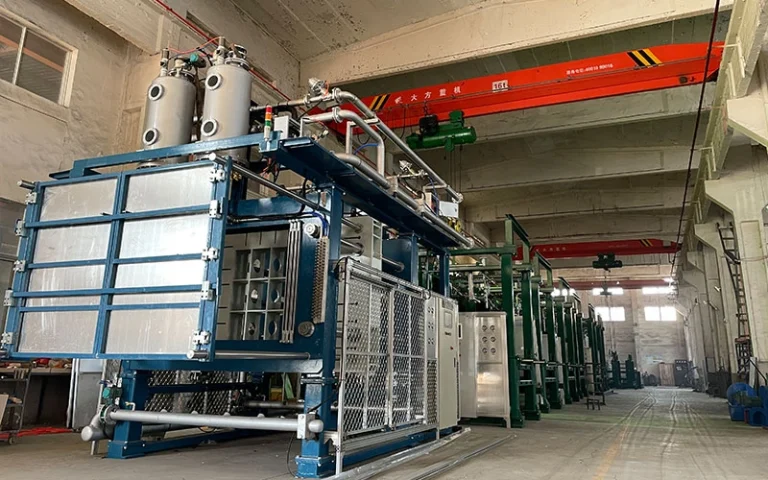
In a full lost foam facility, the coating system works in the “yellow area.” It sits with white-area equipment like foam pre-foaming and molding machines. It also joins black-area systems for sand handling, vacuum, pouring, and reclamation.
Smooth links with maturation silos, central vacuum systems, and automated dipping robots ensure steady control. This maximizes output from start to end.
Industry Applications and Strategic Value
The equipment fits high-value fields. These include:
- Automotive powertrain parts like engine blocks and cylinder heads
- Aerospace structural parts
- Agricultural machinery
- Valves and pumps
- Detailed artistic castings
Its role in combining parts, near-net-shape making, and less machining fits lean manufacturing and green goals of today’s foundries.
Câu hỏi thường gặp
What is the primary application of the Lift Type Paint Mixer?
It prepares and maintains high-quality refractory slurries for coating foam patterns in lost foam casting.
What construction materials ensure durability?
Premium 304 stainless steel for all wetted parts, providing excellent corrosion resistance and cleanability.
What is the speed range and control mechanism?
0–1100 RPM with variable frequency drive for precise high-shear and stabilization phases.
How does the anti-sedimentation system function?
The 1.5m diameter tank rotates continuously at low speed to keep refractory particles uniformly suspended.
Can it handle different refractory formulations?
Yes, suitable for zircon, alumina, bauxite, and other systems across ferrous and non-ferrous applications.
What automation features support production efficiency?
Programmable timers, automatic water addition, bottom discharge, and lift-type mobility.
Đối tác với một nhà sản xuất và nhà cung cấp đáng tin cậy
Foundries and casting manufacturers seeking to elevate refractory coating processes should collaborate with established specialists.
Công nghệ OC, a dedicated manufacturer, supplier, and factory of high-end intelligent lost foam casting equipment, offers proven solutions grounded in German EPS/EPP technology and proprietary innovations. Based in Xindeng Town, Fuyang District, Hangzhou, the company emphasizes automation, energy efficiency, and quality.
Liên hệ với OC Technology for technical specifications, customized configurations, or quotations on the Lift Type Paint Mixer alongside complementary systems including foam molding machines, pre-foaming machines, air dryers, maturation silos, and complete production lines.
Điện thoại: +86 15988479417
E-mail: zyh@oc-epc.com
 Vietnamese
  English
  Arabic
  Hindi
Hindi  Indonesian
  Japanese
  Korean
  Malay
Malay  Portuguese
  Spanish
  Thai
Thai