
Lost foam casting offers tremendous benefits but has underperformed on commercialization. Part of that is due to the perception of the process requiring large upfront capital and tooling expenses that make it a process only appropriate for large-volume production.
But foundries do not have to invest in capital equipment or even tooling to diversify into lost foam casting. For the modest cost of the necessary raw materials, any foundry producing iron, steel, aluminum, or brass castings can quickly produce prototypes and short-run lost foam castings. This lost foam method could be used as an alternative to additive manufacturing or for producing tooling for prototypes, replacement parts, or other small volumes.
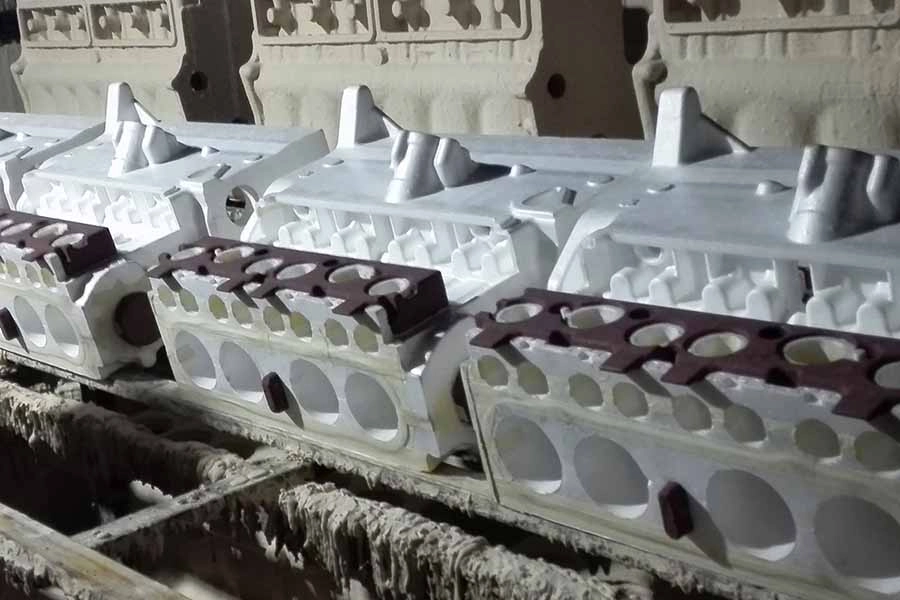
Lost Foam Advantages
The benefits of lost foam casting have been well documented. The near net shape process is known to permit complex shapes, and Department of Energy (DOE) research has reported that compared to traditional casting methods, lost foam provides 25%−30% energy savings, 46% savings in labor productivity, 7% less materials used, and production cost reductions of 20%−25%. Less solid waste as well as less particulate air emissions and greenhouse gases are created compared to traditional processes. An additional benefit is that with proper gating design, casting yields over 70% are common, and yields over 80% are feasible.
Tolerances of +/- 0.003 in.-per-in. are typical (0.076 mm/mm) and +/-0.002 in.-per-in. (0.05 mm/mm) are feasible in some cases. For the machined foam approach, the tolerance is dependent on the machining accuracy and typically 0.002 in. (0.05 mm) plus the machining tolerance. Recent DOE funded research concerning thin-walled ductile iron showed that even at 0.040 in. (1 mm), the tolerance for lost foam was +/-0.0015 in. (0.039 mm). This key benefit means that lost foam castings can either be used with zero or minimal metal machining. With proper component redesign this can result in enormous cost savings that offset the slightly higher cost of the process compared to traditional green sand or nobake casting.
Lost foam provides net or near net shapes that can have complex geometries such as interior channels, blind holes, and true position. Components can have zero or alternating draft. Processes have even been developed for as-cast threads. And lost foam can eliminate the need for tooling; foam can be machined and cast.
Steps to Trying Lost Foam
The lost foam process involves creating a foam pattern that evaporates during pouring. The key to having lost foam with minimal capital investment is to eliminate the need for expensive tooling and automated lines. This is done by machining the foam from foam stock and creating a fluidized bed by manually compacting the flasks. The remaining steps are essentially the same as standard lost foam casting.
Step 1: Obtain Foam
The first step is to obtain foam blocks for machining. Lost foam typically uses expanded polystyrene (EPS) foam. The ideal density is 1-1.5 lbs. per cu.ft. (0.016 g/cm³- 0.024 g/cm³). If carbon control is important such as in iron casting, using a co-polymer made of expanded polystyrene (EPS) and polymethyl methacrylate (PMMA) is desirable—this can also be obtained in block form for machining. One essential safety factor is to ensure that any foam used does not contain flame retardant, as such foams tend to explode during casting. Foundries should verify with their foam provider that the foam does not contain flame retardants, and they should also conduct a flame test themselves. If the machined foam won’t be used immediately, it is advised to age it for at least three weeks prior to use for dimensional stability.
Step 2: Pattern Machining
A CNC machine is necessary for machining the foam pattern. A wide range of machine tools are feasible. It may be necessary to conduct several trials as the feeds, speeds, depth of cut, etc. are going to depend on the machine, the foam, and the cutting tools used. The key is that the foam can be cut, and tiny chips are formed. Higher speeds and lower in-feeds and depth of cut are necessary to avoid tearing. When going from the part’s CAD design to CAM and machining, it is important to account for the metal shrinkage.
Step 3: Adhesive
The foam can be joined prior to casting using adhesives. This allows for highly complex shapes. Specialty adhesives designed for lost foam are recommended, applied by brush or dipping.
Step 4: Gating
Typically lost foam uses a consumable ceramic down-sprue funnel glued to a gating system. There is no gating ratio and no choke point. Gating design is complex and dependent on the casting. Aluminum is typically top fed, while iron, steel, and brass are bottom fed. Parts should be tilted to allow sand flow.
Step 5: Coating
A variety of coatings designed for lost foam are available. Consistent process is key, using a viscometer if mixing coatings. Dipping or pouring methods work.
Step 6: Drying
Moisture causes issues, so drying with fans or special rooms is essential.
Step 7: Coating Inspection
Inspect for cracks and touch up as needed. Avoid re-dipping entire assemblies.
Step 8: Compaction
Manual compaction uses a flask like a 55-gallon drum. Fluidize sand by vibrating or compacting with a mallet. Unbonded dry sand or beads are used.
Step 9: Casting
Higher superheat (50-100°F additional) is required. Pour fast to offset gas pressure.
Step 10: Finishing
Solidify, shake out, and finish similar to sand casting, often with reduced blast time.
Ready, Set, Go
For foundries with a need for rapid prototypes or customers desiring small volumes, the method of machined foam and manual compaction for lost foam is an opportunity to diversify with minimal capital expense. The melting, casting, and finishing processes are essentially the same as in current processes except for needing a higher pour temperature. The molding process for lost foam, while different, is something that can be done on a small scale to first conduct trials. This could even be done with metal that would otherwise be pigged out.
Typically, the machined foam approach works well from a cost perspective for volumes under 100 castings. For over 1,000 castings (total use) it usually makes sense to manufacture foam mold tooling at some point.
An existing sand foundry could conduct trials with the simple process first; once success with prototypes and larger batch sizes are ordered, it may be worthwhile to consider larger investments in tooling, foam blowing equipment, and an automated compaction line.
FAQ
What is lost foam casting?
Lost foam casting, also known as evaporative pattern casting (EPC), is a process where a foam pattern evaporates upon contact with molten metal, creating a near-net-shape casting with complex geometries and high dimensional accuracy.
What are the main benefits of lost foam casting compared to traditional sand casting?
It offers 25-30% energy savings, reduced labor, higher yields (70-80%+), complex shapes without cores or drafts, minimal machining, and lower emissions and waste.
Can any foundry try lost foam casting without major investment?
Yes, by using machined foam patterns from stock blocks and manual compaction in simple flasks, foundries can produce prototypes and short runs at low cost, without automated lines or tooling.
What foam materials are recommended for lost foam casting?
Expanded polystyrene (EPS) at 1-1.5 lbs/cu.ft. density is standard. For better carbon control in iron castings, EPS-PMMA copolymers are preferred. Avoid flame-retardant foams for safety.
What are common challenges in starting lost foam casting trials?
Proper gating design to ensure sand flow, consistent coating thickness, adequate superheat during pouring, and manual compaction to prevent mold collapse are critical to avoid defects like sand inclusions or incomplete fills.
Upgrade Your Lost Foam Casting Capabilities
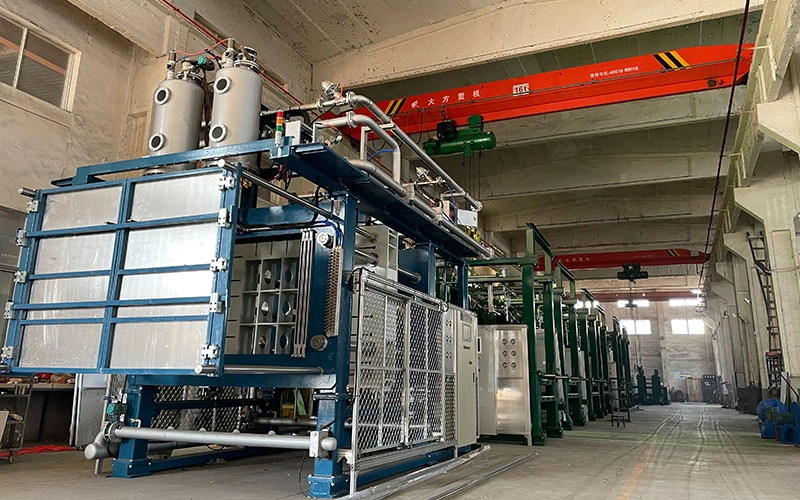
Manufacturers, suppliers, and factories seeking to scale from prototypes to high-volume production in lost foam casting can benefit from advanced equipment solutions. OC Technology, as a leading manufacturer, supplier, and factory of high-end intelligent lost foam casting equipment, specializes in automation for the white area and beyond. Their offerings include EPS foam sheet machines, horizontal and vertical PLC hydraulic forming machines, various air dryers (indoor, top-mounted, rear-mounted), central vacuum systems, lift-type paint mixers, maturation silos, and turnkey production lines. These solutions integrate German EPS/EPP technology with independent patents, delivering high efficiency, energy savings, and precision for foundries worldwide. Contact OC Technology via their website at https://www.oc-epc.com/ to explore customized equipment and enhance production performance.


 English
  Arabic
  Hindi
Hindi  Indonesian
  Japanese
  Korean
  Malay
Malay  Portuguese
  Spanish
  Thai
Thai  Vietnamese