
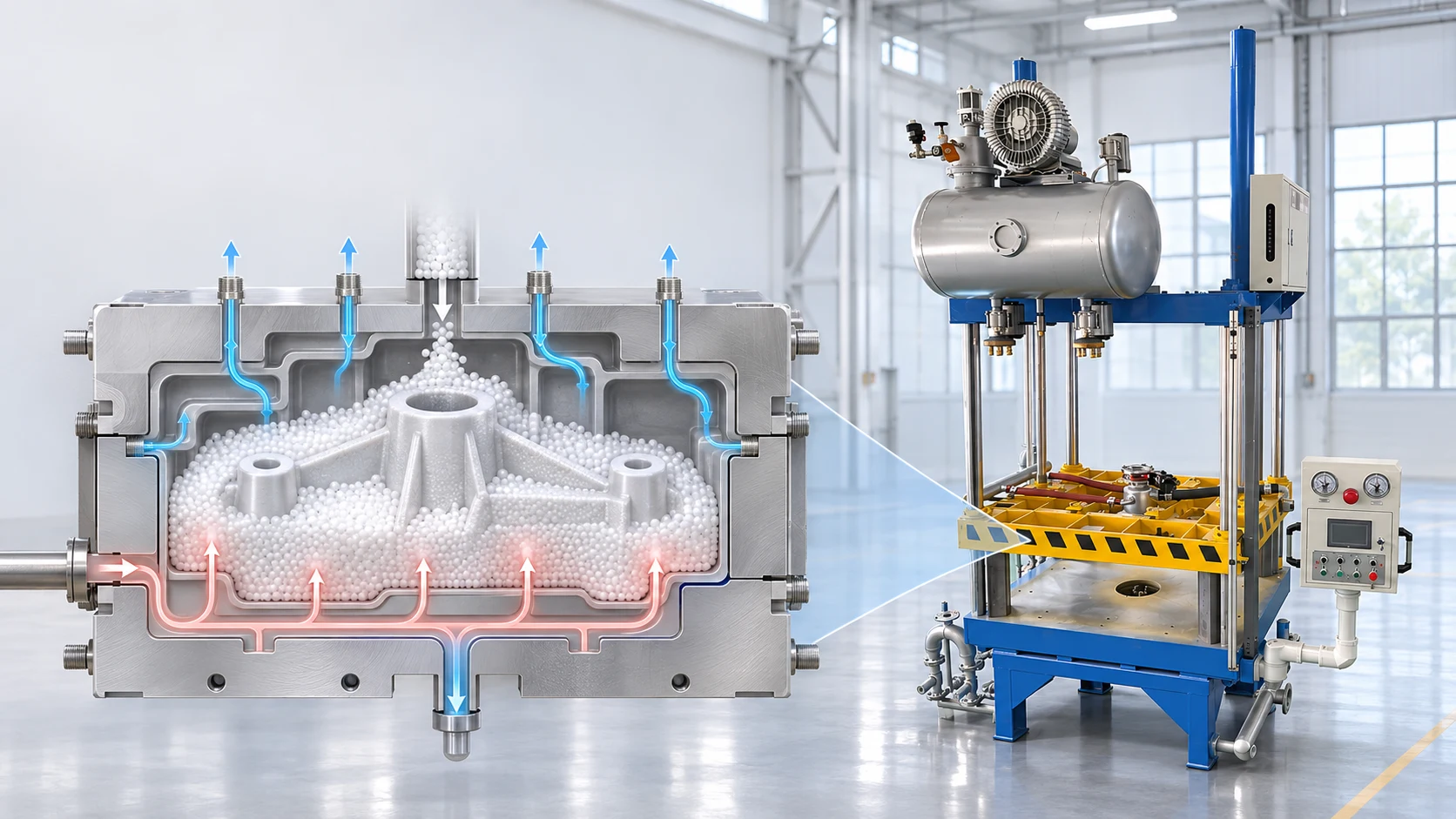
EPS mold venting has two connected jobs: it gives displaced air a controlled escape path during bead filling, and it helps steam move through the bead pack during fusion. When either path is restricted or uneven, operators may see incomplete filling, weak local fusion, rough surfaces, long heating, excess condensate, or unstable cycle times. The correction is not automatically more filling pressure or longer steaming. First locate where air, steam, and condensate stop moving as intended.
A useful review treats the mold and shape molding machine as one system. Fill guns, core vents, steam chambers, seals, drain paths, valves, compressed air, and vacuum all influence the result. Vent quantity and geometry depend on the part, bead size and density, mold construction, and process conditions, so final details should be verified with the mold designer and machine supplier.
Understand the Air and Steam Paths
During filling, beads enter through one or more fill points while cavity air must leave. A deep pocket or last-to-fill rib can trap air even when the total vent area appears adequate. During heating, steam travels from the steam chamber through mold vents and the bead pack. It must reach remote features without creating a permanently cold or waterlogged zone.
The mold also needs a route for condensate. A low point that retains water can delay heating, leave weak fusion, and extend cooling. Venting therefore cannot be reviewed as a list of holes alone. The drawing should show fill direction, likely last-to-fill areas, steam entry, vent distribution, drainage, seals, and the connection to cooling or vacuum.
Read Defects as Location Evidence
Incomplete Filling in One Feature
When one pocket, rib, or corner repeatedly remains short, inspect the local fill path and vent first. Check for blocked screens, damaged or contaminated vents, an unfavorable fill-gun direction, restricted air exit, or a feature that receives beads only after the main cavity is packed. If several molds show the same problem, the shared compressed-air or feeding system becomes more likely.
Weak Fusion in a Consistent Zone
A repeatable weak area points toward uneven steam access, a cold zone, retained condensate, or unsuitable vent distribution. Compare the location with steam-chamber partitions, drain points, thick and thin sections, and nearby fill hardware. Raising total steaming time may overheat the rest of the part while the restricted zone remains under-fused.
Long or Unstable Cycles
Break the cycle into filling, heating, pressure equalization, cooling, mold movement, and ejection. A blocked vent can slow more than one stage, but variable steam supply, valve response, vacuum recovery, or condensate drainage can produce similar symptoms. Compare several cycles and note which stage changes before modifying the recipe.
Review Venting on the Mold Drawing
Start with a marked cavity drawing rather than a generic vent count. Identify the fill points, deepest pockets, thin passages, isolated bosses, last-to-fill regions, and areas with the highest rejection rate. Mark every vent and the steam-chamber zone behind it. The map should make it possible to connect a visible defect with a specific air or steam route.
Do not copy a universal vent diameter or spacing from another part. Bead size, desired surface, wall thickness, cavity pressure, and mold material change what is practical. Openings must pass air and steam without unacceptable bead marking or bead loss. The mold maker should confirm the vent type, support, service access, and allowable cleaning method.
The broader دليل آلة تشكيل EPS explains the full sequence from pre-expansion through ejection. Use the venting review to go deeper at the mold-machine interface without changing upstream bead density or maturation settings at the same time.
Check Steam Distribution and Condensate Removal
Stable steam pressure at the plant header does not prove that steam reaches every mold zone. Inspect steam-water separation, branch layout, valve operation, steam-chamber condition, seals, and drains. Compare pressure or temperature indications only at approved measurement points. Temporary instrumentation must be installed under the plant’s safety and equipment procedures.
Look for evidence that changes with orientation or production rate. A defect that worsens after a cold start may relate to warm-up or condensate. A defect that appears when several machines run together may indicate a utility or shared-system limit. A defect fixed to one cavity location is more likely to involve the mold, its venting, or its local steam path.
Match Venting to the Molding Machine
The machine must support the mold’s intended fill and steam sequence. OC Technology’s vertical EPS shape molding machine uses pressure-controlled feeding, top multi-point or grouped filling, active exhaust during feeding, mold-cavity overpressure protection, stored parameters, and vacuum cooling. Those functions provide useful control points, but they cannot compensate for a blocked vent or an unsuitable mold layout.
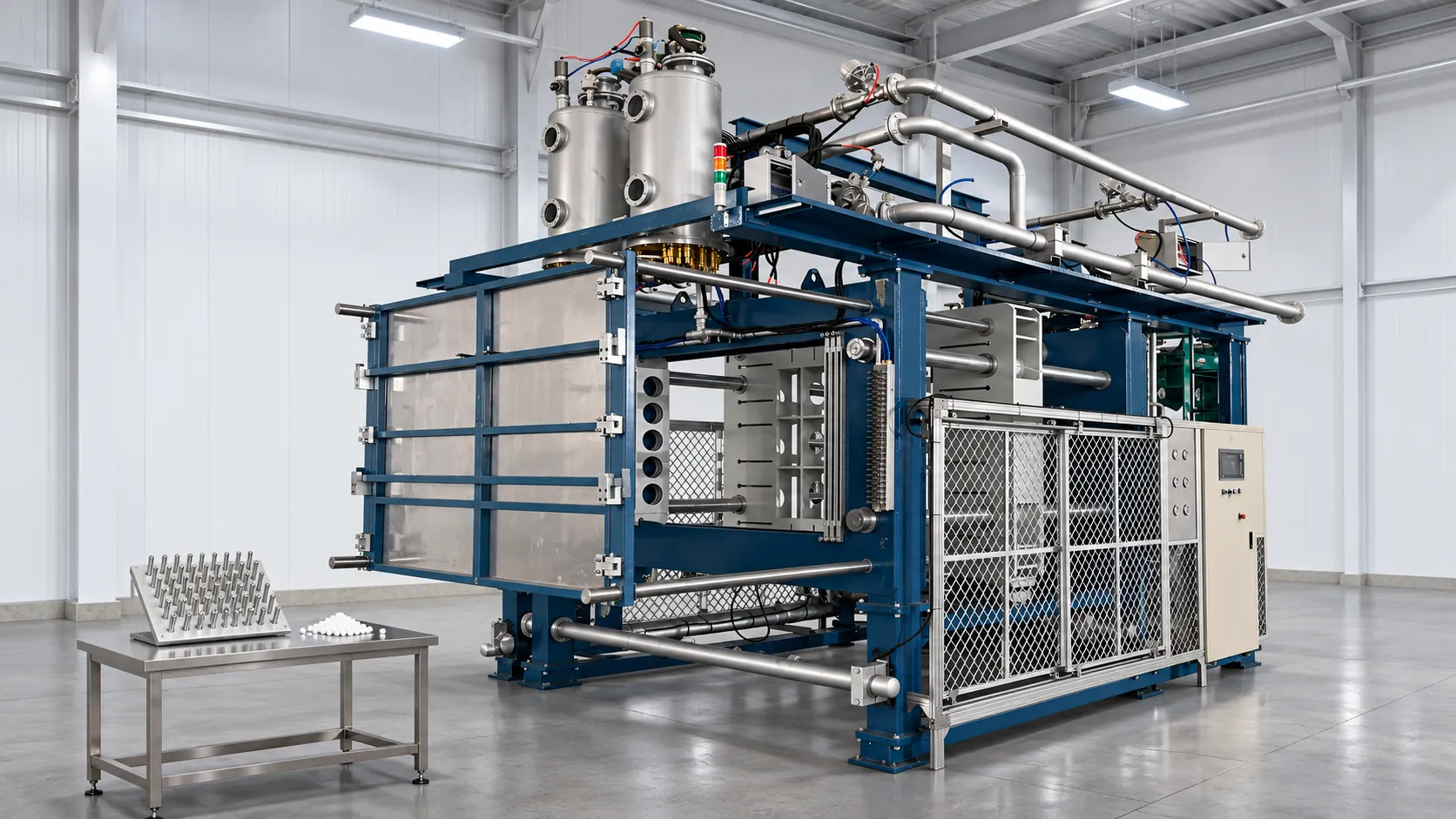
For larger molds or quick-change requirements, the آلة تشكيل أفقي uses proportional valve control, pressure sensing, and a heating-system bypass design. Confirm the mold face, steam connections, drains, fill pipes, seals, and control sequence as part of the technical agreement. The correct machine orientation depends on the mold and handling method, not on venting alone.
Use a Controlled Mold Trial
Commission a new or modified mold with a written trial plan. Record bead grade, bulk density, maturation condition, fill settings, steam stages, cooling, cycle time, and the location of every defect. Keep the material and utilities as stable as practical, then adjust one variable at a time.
- Verify the mold is clean, correctly installed, sealed, drained, and connected to the intended steam and vacuum zones.
- Run a filling check and inspect whether remote features receive beads without excessive pressure or repeated manual intervention.
- Compare fusion and surface condition by cavity location, not only by the average appearance of the part.
- Record heating and cooling stages separately so a shorter total cycle does not hide weak fusion or unstable demolding.
- Freeze the accepted recipe and inspection method only after consecutive parts meet the agreed criteria.
Maintain Vent Performance Without Changing the Mold
Treat vent cleaning as controlled maintenance. Use the approved tools and access method, and replace damaged vent components to the drawing. Drilling, scraping, or enlarging openings without authorization can change steam flow, surface marking, bead retention, and part-to-part consistency. Record the work so a later process change can be traced.
Trend localized defects, fill time, heating time, and accepted parts per shift. The EPS molding machine troubleshooting guide provides a wider machine-versus-process diagnostic path. Use it when the defect follows several molds or remains after the mold’s vents and steam routes have been verified.
خاتمة
Effective EPS mold venting is a flow problem that spans filling, heating, condensate removal, and cooling. Map the cavity, connect each defect to a location, verify the mold-machine interface, and change one condition at a time. A controlled trial and an approved cleaning method protect both product quality and the original mold design.
أسئلة متكررة
Can more filling pressure correct an incomplete EPS part
Sometimes, but it may only mask trapped air or a restricted local path. Inspect the affected cavity area, fill direction, vents, and shared air supply before raising pressure.
Does longer steaming fix weak bead fusion
Not reliably. If steam cannot reach one zone or condensate remains there, extra time may overheat other areas while the weak zone persists.
How often should EPS mold vents be cleaned
Set the interval from material behavior, cycle count, visible contamination, defect trends, and the mold maker’s maintenance instructions. Inspect sooner when fill or heating time changes.
Should vent openings be enlarged during troubleshooting
Only after an engineering review and drawing change. Uncontrolled enlargement may alter bead retention, steam balance, surface quality, and repeatability.
For an application review, provide OC Technology with the part and mold drawings, bead grade and density, defect map, cycle record, utility readings, and photos of the mold connections when you contact the technical team.


 Arabic
 English
 Hindi
 Indonesian
 Japanese
 Korean
 Malay
 Portuguese
 Spanish
 Thai
 Vietnamese