
A coating mixer can deliver a stable batch and still be the wrong choice for the production line. The real question is whether the coating station can match pattern throughput, cluster size, batch demand, and changeover frequency under normal production conditions.
For buyers evaluating lost foam casting coating equipment, annual casting tonnage alone does not provide enough information for equipment selection. A more reliable approach is to start with the number of clusters per shift, the largest pattern envelope, the coating workflow, and the required holding or immersion functions.
This matters even more in 2026, as foundry equipment planning increasingly focuses on process repeatability, production consistency, labor efficiency, process stability, and the challenges of high-mix production. The goal is not to specify the largest mixer available, but to select a coating station that fits the actual production rhythm. تكنولوجيا OC supports this project-based approach for lost foam casting equipment and EPC applications.
Coating Equipment Capacity Planning for 2026 Lost Foam Production
Coating preparation has to follow pattern output without becoming a constraint between foam-pattern production and the next process stage. That makes coating capacity a production-planning issue, not just a comparison of motor ratings or tank dimensions. Buyers evaluating معدات صب الرغوة المفقودة should therefore define coating demand separately from annual foundry capacity, particularly when one coating station serves several pattern families.
Coating Preparation Capacity vs Pattern Throughput
The practical starting point is the number and size of pattern clusters that need coating during a normal shift.
Two foundries may have similar annual tonnage and still place very different demands on the coating station. One may process a smaller number of large clusters. Another may handle many smaller assemblies across several product families.
For coating equipment selection, that second operation may require more frequent batch preparation, handling, and changeovers even though the annual casting target is similar.
A useful planning sequence is:
pattern family → cluster dimensions → clusters per shift → coating demand → coating workflow
This gives the equipment supplier information that can actually be used for sizing and layout discussions.
High-Mix Production and Coating-Station Load Variability
High-mix production makes coating demand less uniform. Different pattern families can bring different cluster dimensions, handling routes, coating volumes, and changeover requirements.
This is where process repeatability و process stability matter. The coating station needs to support a workable production rhythm across different batches instead of performing well only under one ideal operating condition.
Changeovers should also be treated as part of the workload. They may look minor in an equipment specification, but repeated cleaning, replenishment, and product changes can shape the real shift schedule.
Once pattern throughput and production variability are defined, buyers can determine which functions the coating station actually needs.
Defining the Equipment Scope of a Lost Foam Coating Station
A coating station can involve more than one operating function. Preparing refractory coating and keeping it in suitable motion during pattern coating are related, but they are not identical tasks. Separating these stages helps purchasing and engineering teams define the required scope before quotations are compared.
Refractory Coating Mixer vs Anti-Settling Immersion Tank
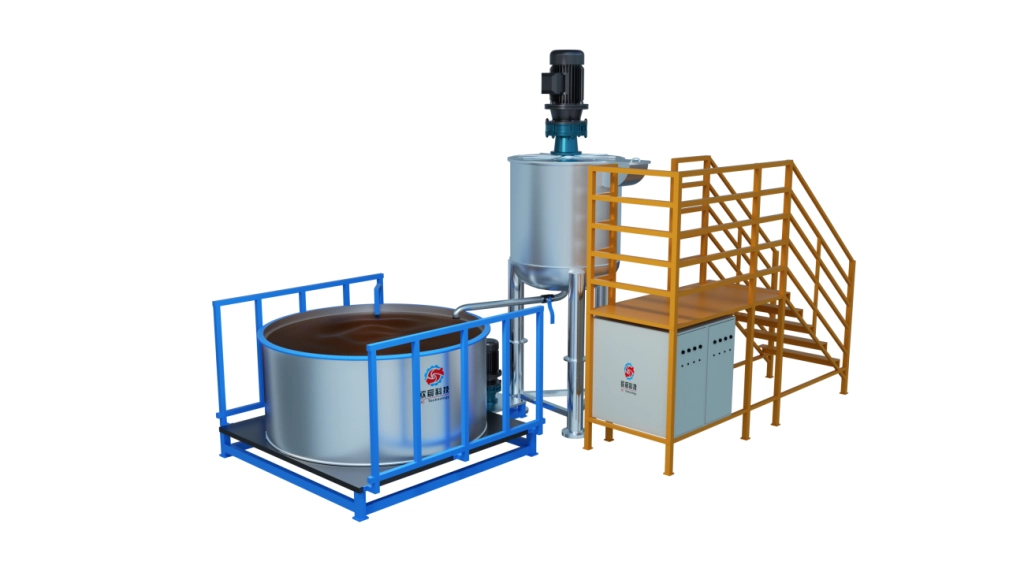
تكنولوجيا OC’ س مصنع نوع المصعد الخلاط للطلاء combines a main dispersing unit with a movable anti-sedimentation immersion coating tank.
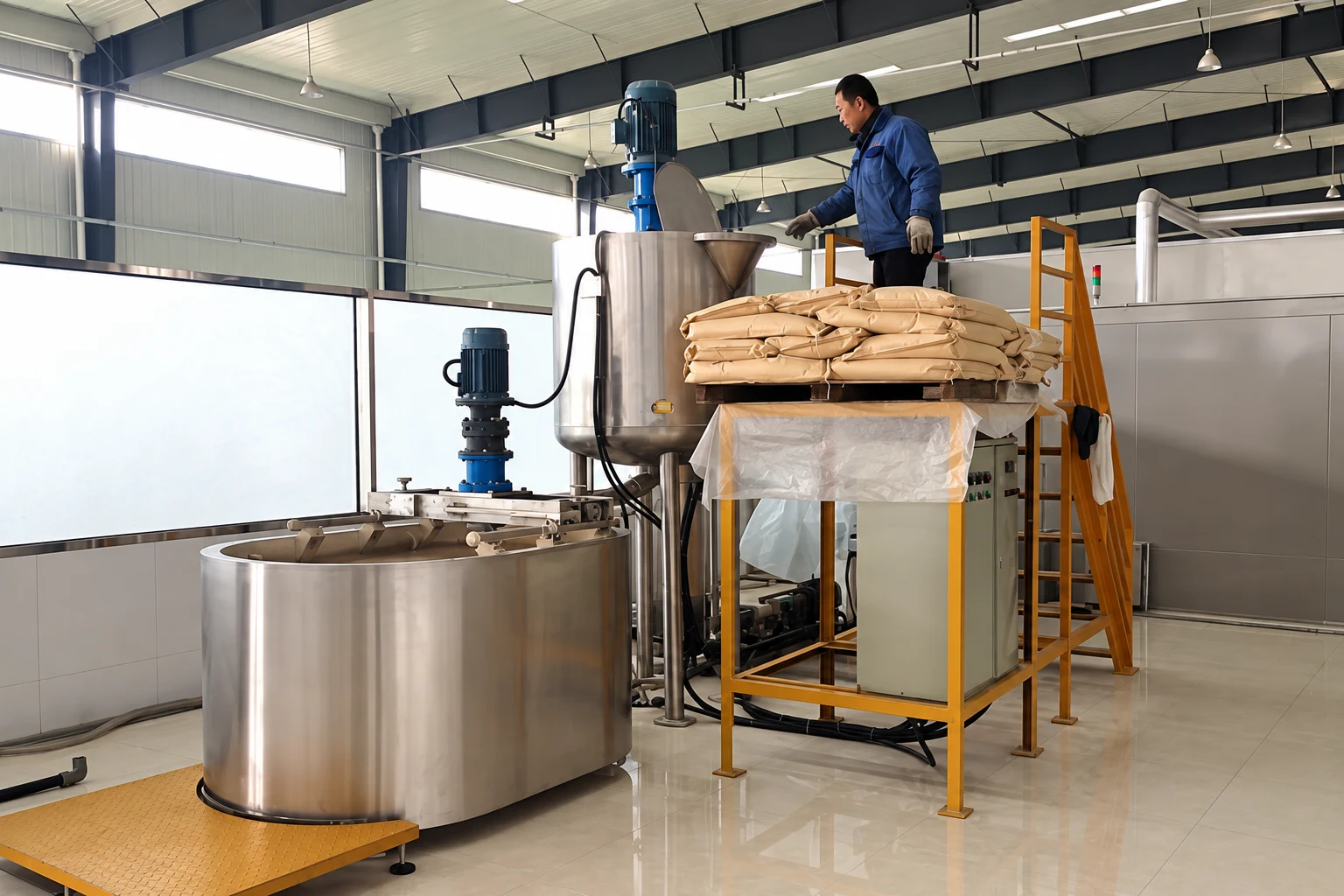
The main mixer handles coating preparation. During production, the immersion tank maintains slower movement to help keep refractory material suspended while patterns are being coated. The coating-contact section uses 304 stainless steel, and variable-frequency control allows the mixing operation to be adjusted for the required working condition.
For B2B buyers, the key issue is scope. A quotation for a refractory coating mixer alone is not directly comparable with one that also includes the immersion and anti-settling functions.
Pattern Envelope, Dipping Clearance, and Tank Selection
Tank selection should begin with the largest pattern cluster that must pass through the coating operation.
OC Technology’s immersion coating tank uses a 1.5 m diameter configuration. Whether that configuration fits a specific project still depends on cluster dimensions, dipping clearance, handling method, and available working space.
This is particularly important when evaluating dip coating equipment for several pattern families. A workable station must provide enough clearance for the required patterns without creating unnecessary handling difficulty.
The tank diameter is one specification. The usable pattern envelope is the purchasing question.
With the mixer function, immersion arrangement, and pattern envelope defined, the next step is to match the station capacity to the actual production schedule.
Matching Coating Equipment Capacity to Pattern Throughput
Many coating-equipment inquiries still begin with annual casting tonnage. That figure helps describe the foundry, but it does not show how many foam clusters reach the coating station during a shift. For lost foam coating equipment, pattern throughput is usually a more useful basis for discussing mixer and station capacity.
Start With Clusters per Shift, Not Annual Casting Tonnage
Buyers should estimate both normal and peak coating demand.
Useful inputs include:
- typical and maximum cluster dimensions;
- clusters requiring coating per shift;
- main pattern families;
- number of production shifts;
- expected product-change frequency.
These figures help define coating station capacity and give the supplier a better view of how often coating batches may need to be prepared, held, or replaced.
They also make technical discussions much more specific than a request based only on tons per year.
Account for Batch Preparation, Holding, and Changeover
A coating station does not simply mix one batch and stop.
Daily production may involve coating preparation, holding, dipping, replenishment, discharge, cleaning, and changeover. The exact sequence varies from plant to plant, so it would be misleading to apply one fixed cycle time to every project.
A stable single-product shift may have a relatively simple workflow. A high-mix operation can place more emphasis on batch handling and changeover frequency. These differences should be considered when discussing coating mixer capacity.
Technical Comparison of Lost Foam Coating Equipment Quotations
Once the required workflow is clear, quotations can be compared on the same technical basis. One proposal may include only the main mixer, while another may cover the immersion tank, control functions, discharge arrangement, and project services. Comparing headline prices without checking these boundaries can give purchasing teams the wrong impression.
Align Mixer, Tank, Control, and Service Scope
When reviewing foundry coating equipment, confirm whether competing proposals cover the same functions and responsibilities.
Important items can include:
- mixer and dispersing function;
- immersion or holding tank;
- variable-speed control;
- anti-settling arrangement;
- discharge and material-handling functions;
- equipment interfaces;
- agreed installation or commissioning services.
Buyers should also confirm whether functions such as timed mixing, controlled water addition, bottom discharge, and variable-speed control are included in the proposed scope. These functions are available in OC Technology’s Lift Type Paint Mixer configuration.
Do Not Compare Mixer Power or Tank Size Alone
Higher motor power does not by itself indicate a better refractory coating mixer match. The same applies to tank diameter.
Additional capacity has limited value if the pattern flow, batch demand, and shift schedule do not require it. On the other hand, specifying equipment only around average production can leave little flexibility during peak periods.
The stronger comparison is whether each proposal matches the defined pattern throughput, usable cluster envelope, and coating workflow.
What Should Be Included in a Coating Equipment RFQ?
A detailed RFQ reduces assumptions and makes supplier quotations easier to compare. This is especially important for overseas foundry projects, where equipment manufacturers and plant engineers may be working from different layouts, utility conditions, and production assumptions. The RFQ does not need to become a long technical specification. It needs the right production information.
Production, Pattern, and Site Data for Equipment Selection
For an initial lost foam coating equipment selection, buyers should provide the largest cluster dimensions, typical and peak clusters per shift, major product families, shift schedule, planned coating workflow, expected changeovers, available installation space, and the required equipment scope.
For an existing foundry, current coating-station conditions can also help define integration needs. For a new yellow-area project, pattern handling and station layout should be discussed before the final configuration is fixed.
This information allows the supplier to prepare a more relevant coating equipment quotation instead of working mainly from annual tonnage or motor power.
خاتمة
Selecting lost foam casting coating equipment is fundamentally a production-matching decision. Mixer capability matters, but so do pattern throughput, cluster envelope, dipping clearance, holding requirements, changeovers, and equipment scope.
For 2026 projects, a stronger purchasing approach is to evaluate repeatability, process stability, and real production workflow alongside individual machine specifications. OC Technology can review coating-equipment requirements for new or existing lost foam foundries based on pattern dimensions, shift demand, station layout, and required supply scope.
For a project-specific review, اتصل بتكنولوجيا OC with the largest pattern dimensions, clusters per shift, operating schedule, available space, and required coating-equipment scope.
الأسئلة الشائعة
Q1: What equipment is needed for a lost foam coating station?
A: A coating station can include a refractory coating mixer for coating preparation and an immersion or holding tank for the production coating stage. The required arrangement depends on pattern dimensions, throughput, coating workflow, and project scope.
Q2: How do I choose a refractory coating mixer for lost foam casting?
A: Start with the largest pattern cluster, clusters per shift, product mix, coating workflow, and changeover frequency. Motor power alone does not define the right mixer configuration.
Q3: How should coating mixer capacity match pattern production output?
A: Coating mixer capacity should support normal and peak pattern throughput while allowing for batch preparation, holding, dipping, replenishment, and product changes. Clusters per shift are generally more useful for this decision than annual casting tonnage alone.
Q4: Why is anti-settling important in a lost foam coating system?
A: Refractory material can settle while coating is being held during production. An anti-settling arrangement maintains controlled movement in the immersion tank, helping maintain a more consistent working condition between coating operations.
Q5: What information is needed for a lost foam coating equipment quotation?
A: Buyers should provide pattern or cluster dimensions, clusters per shift, product families, operating schedule, coating workflow, available installation space, and whether the required scope covers only the mixer or a broader coating-station package.


 Arabic
  English
  Hindi
Hindi  Indonesian
  Japanese
  Korean
  Malay
Malay  Portuguese
  Spanish
  Thai
Thai  Vietnamese