
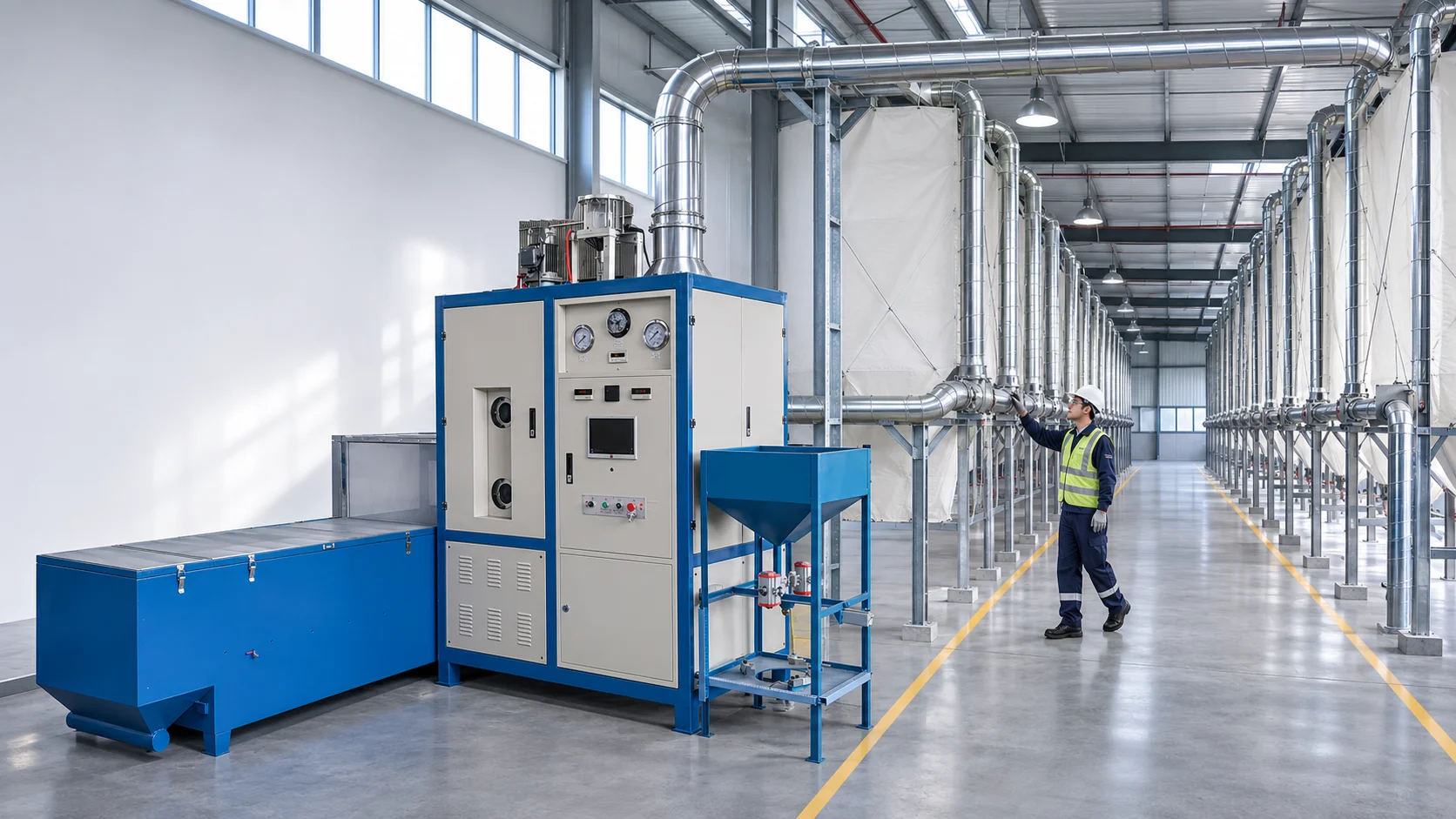
 A pneumatic conveying system for pre-expanded EPS beads must move a very light, compressible material without creating excessive impact, abrasion, static charge, or density change. The correct design is not the highest possible airflow. It is the lowest stable conveying condition that clears the route, avoids plugs, protects the beads, and delivers each batch to the intended maturation silo with traceable quality.
Why Pre Expanded EPS Beads Need a Different Conveying Strategy
Freshly expanded beads are softer and more vulnerable than raw EPS. They can be crushed at a fan, accelerated into tight elbows, rubbed along unsuitable pipework, or held in a line long enough to separate by size. Friction can also generate electrostatic charge. These effects may not be obvious at the receiving bin, yet they can appear later as a density shift, inconsistent mold filling, damaged bead surfaces, or poor housekeeping.
The conveying route is therefore part of the white-area quality process. It connects pre-expansion, fluidized-bed conditioning, maturation, and molding. Changes in blower condition, pipe routing, valve position, or silo demand can change how the same bead recipe arrives at the next process.
Define the Material and Route Before Selecting Airflow
Start with the operating envelope rather than a generic conveyor rating. Record the expanded bulk-density range, bead grade, batch mass, expected moisture condition, required throughput, vertical lift, total route length, number and geometry of bends, receiving silos, and allowable transfer time. Confirm whether conveying occurs immediately after pre-expansion or after recovery, because bead strength changes with time and condition.
Map every component that can accelerate, restrict, or trap the material: feeder, ejector or blower, flexible connection, diverter, elbow, sight section, separator, filter, bin inlet, and exhaust path. A route with repeated short-radius bends can be more damaging than a longer route with gradual changes in direction.
Control Velocity by Testing the Whole System
Use a stable window rather than one universal setpoint
Minimum transport velocity depends on pipe size, bead density, solids loading, air source, leakage, elevation, and fittings. Excess velocity raises impact and friction, while insufficient velocity allows fallback or plugs. Establish the operating window during commissioning with the actual bead grades and the longest, most demanding route. Record blower or valve settings together with batch time and receiving results.
Treat bends and transitions as damage points
Inspect elbows, tees, reducers, flexible hoses, and bin entries for concentrated wear or bead buildup. Prefer routing that avoids abrupt direction and area changes. A transparent observation section can help diagnose flow behavior, but its material and installation must satisfy the site’s static-control and safety requirements. It must not become an electrically isolated component in an otherwise conductive route.
Static Control and Pentane Vapor
Check the EPS safety data sheet. Beads expanded with pentane can release flammable vapor as they mature. Have a qualified person assess ventilation, ignition sources and gas detection for the silo headspace and nearby low points.
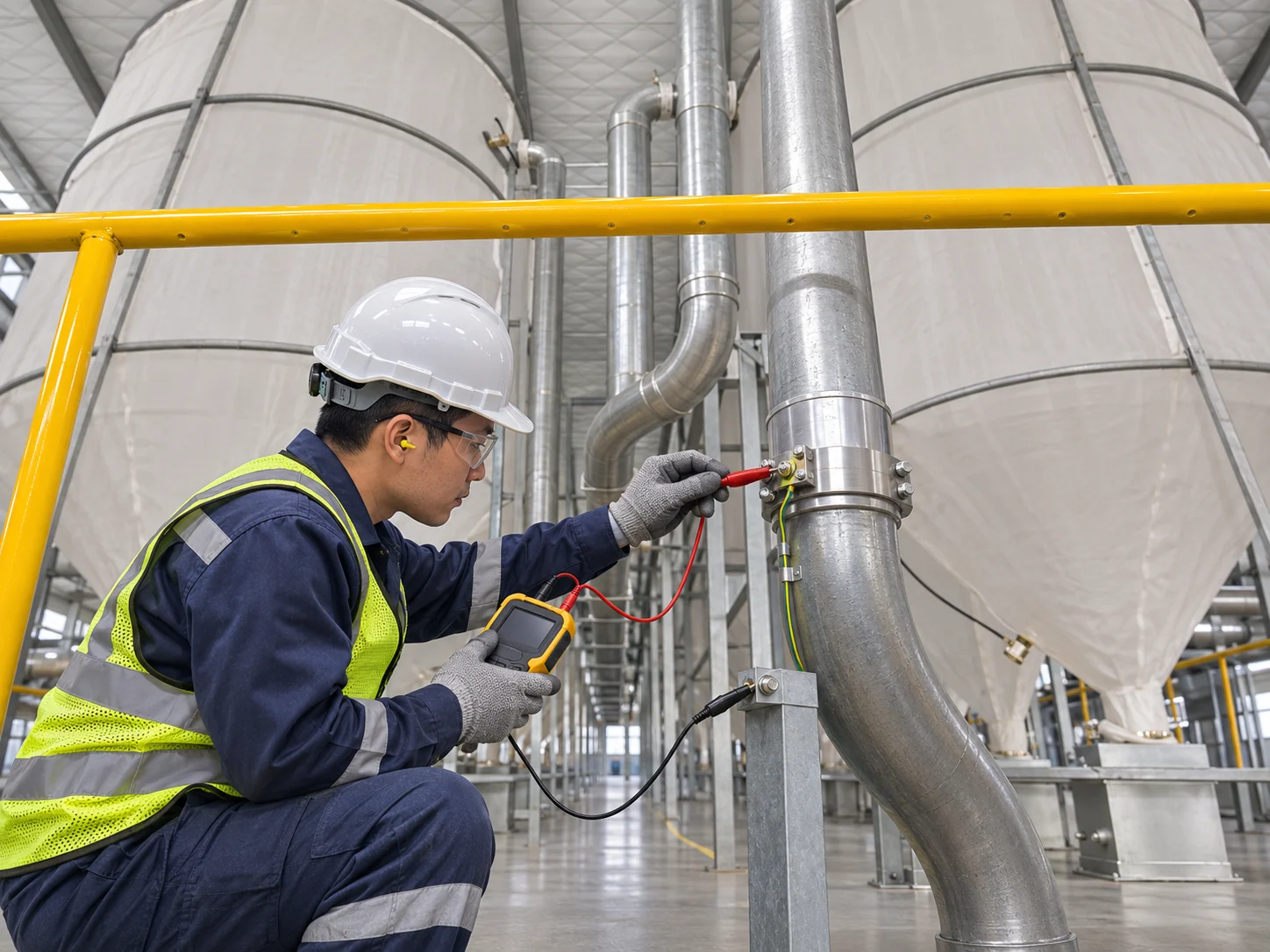
Static control requires continuity across the complete conveying path. Conductive metal sections, equipment frames, flexible connections, valves, and observation sections should be assessed for bonding and grounding by qualified personnel. A ground connection at one machine does not prove that every flange, hose, or removable section remains electrically continuous after maintenance.
إن OC Technology maturation silo system uses stainless steel conveying pipework and describes automatic routing to individual silos, high- and low-level detection, and display of maturation information. These functions can support material control, but the installed line still requires a site-specific grounding review, inspection access, safe dust and bead housekeeping, and confirmation under local electrical and fire requirements.
Include bonding checks in preventive maintenance. Paint, corrosion, loose clamps, replacement hoses, nonconductive gaskets, and temporary pipe repairs can interrupt continuity. If operators report shocks, beads clinging to surfaces, erratic flow, or unusual accumulation, stop and investigate the system rather than treating the condition as a housekeeping nuisance.
Verify That Conveying Does Not Change Bead Quality
Commissioning should compare material before and after conveying. Take representative samples using the same procedure and avoid selecting only surface beads. Useful checks include bulk density, visible fines, broken or collapsed beads, size distribution where relevant, moisture condition, and the amount of material left in the route after the batch.
Use a repeatable container, filling method, leveling method, scale, and calculation for density checks. The same principles described in the EPS pre-expander bulk-density test should be applied consistently at the conveyor inlet and receiving silo. A difference must be investigated before changing the pre-expansion recipe, because the transport step itself may be compressing, segregating, or losing material.
| Symptom | Possible conveying cause | First verification |
| Higher receiving density | Bead damage, fan impact, excessive velocity, sample inconsistency | Compare inlet and outlet samples; inspect the air source and first impact points. |
| Fines or collapsed beads | Tight bends, abrupt entries, mechanical fan contact | Inspect bends and bin inlet; run the least demanding route as a comparison. |
| Beads cling to pipe or operator | Poor bonding, isolated hose, dry conditions, high friction | Stop and have electrical continuity and grounding checked by qualified personnel. |
| Slow or incomplete transfer | Air leakage, blocked filter, wrong valve position, low velocity | Check route selection, pressure or airflow trend, filters, and line residue. |
| Wrong silo receives material | Diverter, control logic, sensor, or routing error | Perform a witnessed route test and confirm valve feedback before production. |
Coordinate the Pre Expander Fluidized Bed and Silos
إن fully automatic pre-foaming machine with fluidized drying bed includes screening before material is sent to maturation. That screening step can remove undesirable material, but it does not protect beads from damage created later in the conveying route. The discharge, transition bin, conveyor pickup, routing valves, and silo inlet should be commissioned as one connected process.
Avoid sending material to a silo that lacks available capacity or cannot provide the required maturation time. Level sensors and routing logic should prevent overfill, while batch identification should follow the beads through pre-expansion, transfer, aging, and molding. If two grades share a line, define the purge or line-clearance method and verify that residual beads cannot create unacceptable cross-mixing.
Commissioning and Routine Audit Checklist
- Confirm pipe route, diameter, bends, lift, valves, and receiving silo for every recipe
- Verify the air source and controls across minimum and maximum expected demand
- Test the longest route and each diverter position with actual production beads
- Measure transfer time, residual material, inlet and outlet bulk density, and visible damage
- Verify bonding and grounding continuity after assembly. Confirm silo ventilation and ignition controls for pentane-containing grades.
- Challenge high- and low-level sensors and confirm overfill prevention
- Check valve feedback and batch routing records
- Inspect filters, separators, elbows, flexible sections, and bin entries
- Define safe clearing methods for plugs and prohibit uncontrolled compressed-air intervention
- Repeat the audit after material, routing, air-source, or major maintenance changes
خاتمة
Reliable EPS bead pneumatic conveying is a quality-control task as well as a material-handling task. Define the bead and route, establish a stable conveying window with actual material, control static across every connection, and compare bead condition before and after transfer. When density or molding behavior changes, investigate the conveyor before altering an otherwise stable pre-expansion recipe.
For a line fit review, contact the OC Technology technical team with the bead grades and density range, batch size, required throughput, pipe layout, vertical lift, number of silos, routing logic, and available utilities.
أسئلة متكررة
What conveying velocity should be used for pre-expanded EPS beads?
There is no universal value. Establish the lowest stable window using the actual bead, pipe diameter, route, lift, loading, and air source.
Why does bulk density increase after conveying?
Possible causes include bead collapse, mechanical impact, excessive velocity, segregation, loss of fines, or inconsistent sampling. Compare controlled inlet and outlet samples.
Are stainless steel pipes enough to prevent static?
No. Qualified personnel should verify electrical continuity across the pipework, hoses, valves and removable connections. With pentane-containing grades, the silo also needs ventilation and ignition controls suited to the assessed vapor hazard.
Should beads be conveyed immediately after pre-expansion?
The acceptable timing depends on the material and process. Bead strength and recovery condition should be considered and verified during commissioning.


 Arabic
 English
 Hindi
 Indonesian
 Japanese
 Korean
 Malay
 Portuguese
 Spanish
 Thai
 Vietnamese