
Introduction: Why Foam Pattern Quality Defines Casting Success
फोम कास्टिंग खो गया stands as one of the most elegant and efficient metal-forming technologies available today. It lets foundries create complex, near-net-shape components with superior surface finishes and minimal machining. At the same time, it cuts material waste and production steps.
However, one critical factor determines success or failure. That factor is foam pattern quality.
In modern manufacturing, defects such as gas porosity, folds, or dimensional drift often come from inconsistent foam structures. This is why advanced foam molding machines for lost foam casting have become essential. Foundries use them to improve yield, reduce scrap, and achieve stable production quality.
The next generation of intelligent foam molding machines changes how things work. These systems turn expanded polystyrene (EPS) beads into flawless, uniform patterns. They rely on precise hydraulic control, digital monitoring, and smart automation. The result is higher efficiency, lower energy consumption, and faster time-to-market for competitive foundries worldwide.
What Is Lost Foam Casting and Why Foam Patterns Matter
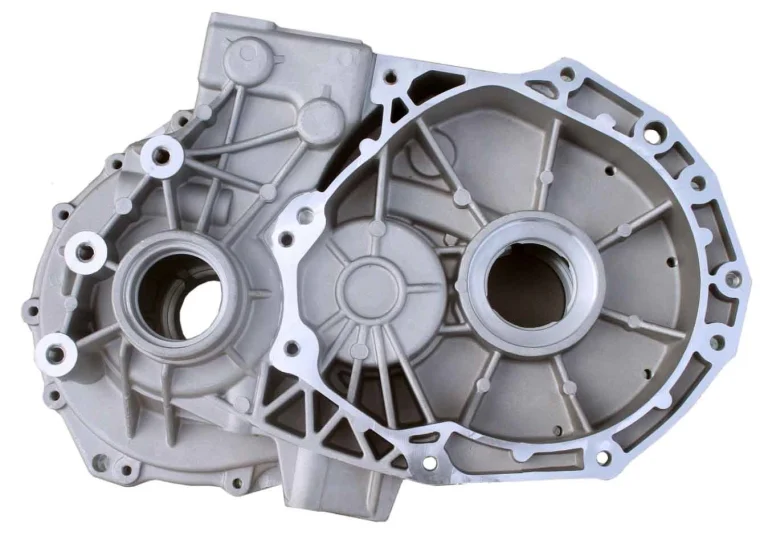
In lost foam casting, the foam pattern is more than a mold. It serves as the exact blueprint of the final metal component. During pouring, the foam evaporates. Molten metal replaces it and leaves a precise cavity that copies even the most intricate geometries.
Any inconsistency in bead distribution, density gradients, or heating uniformity can cause casting defects directly. These problems lead to higher scrap rates, increased rework, and weaker mechanical properties in the finished parts.
Modern EPS foam molding machines remove these risks. They use multi-point filling systems, stable cavity pressure control, and optimized steam and cooling cycles. The outcome is high-density, uniform foam patterns that deliver cleaner castings with excellent surface finish, reduced scrap rates and improved yield, as well as enhanced structural strength and dimensional accuracy.
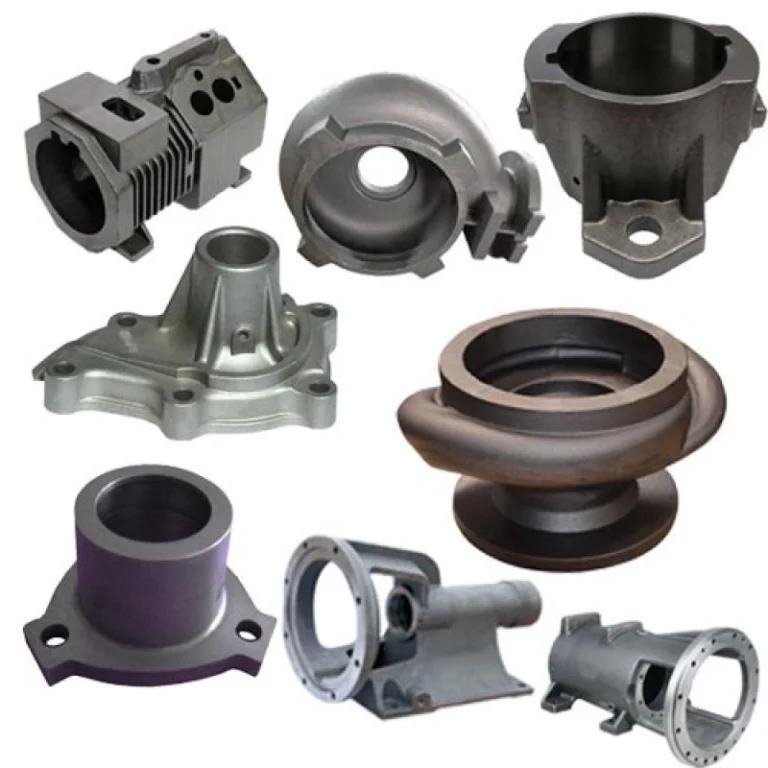
Industries such as automotive, agricultural machinery, heavy equipment, and industrial manufacturing rely on these technologies more and more. They help companies stay competitive in a market that demands both quality and cost efficiency.
Key Advantages of Advanced Foam Molding Machines
For foundries that want to reduce production costs while improving casting consistency, upgrading to intelligent foam molding machines offers one of the highest ROI investments in modern casting technology.
Key benefits include significantly higher production efficiency through shorter cycle times, reduced energy consumption via innovative recovery systems, improved pattern accuracy and repeatability, lower defect rates and scrap percentages, faster mold changeover for greater flexibility, and data-driven process control for continuous optimization.
These advantages build up over time. They turn the white area of lost foam casting into a highly automated, cost-effective powerhouse.
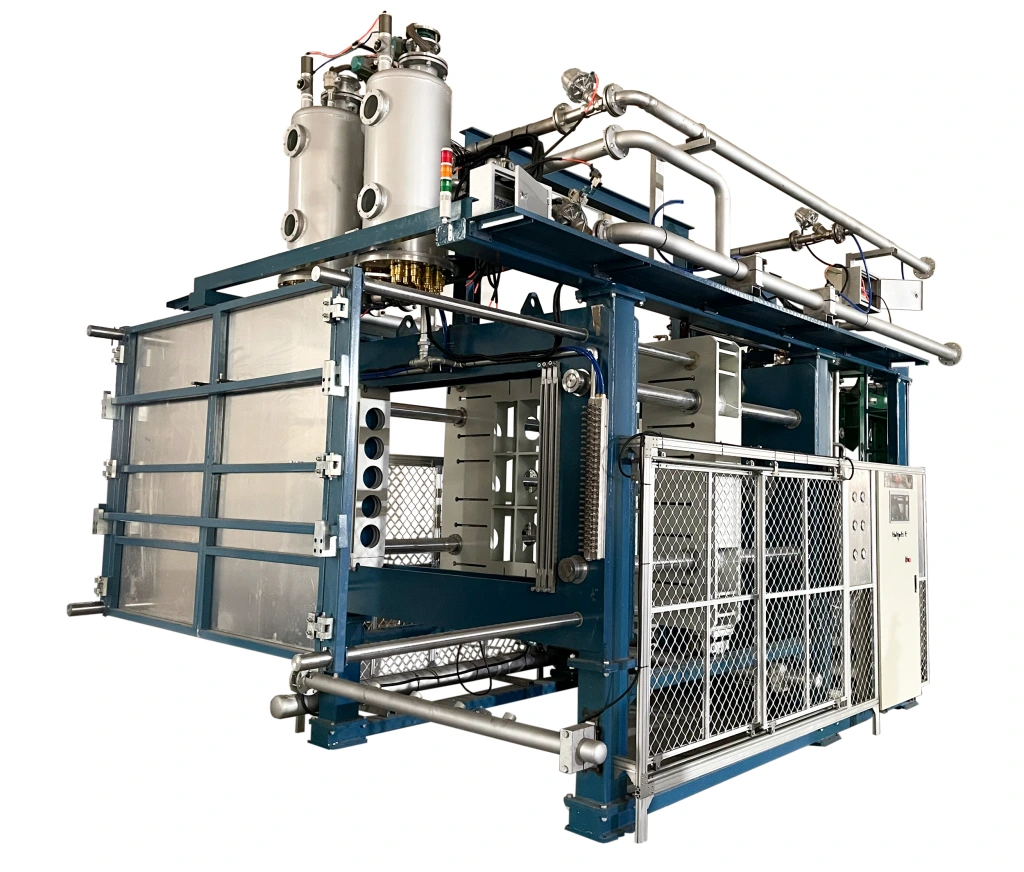
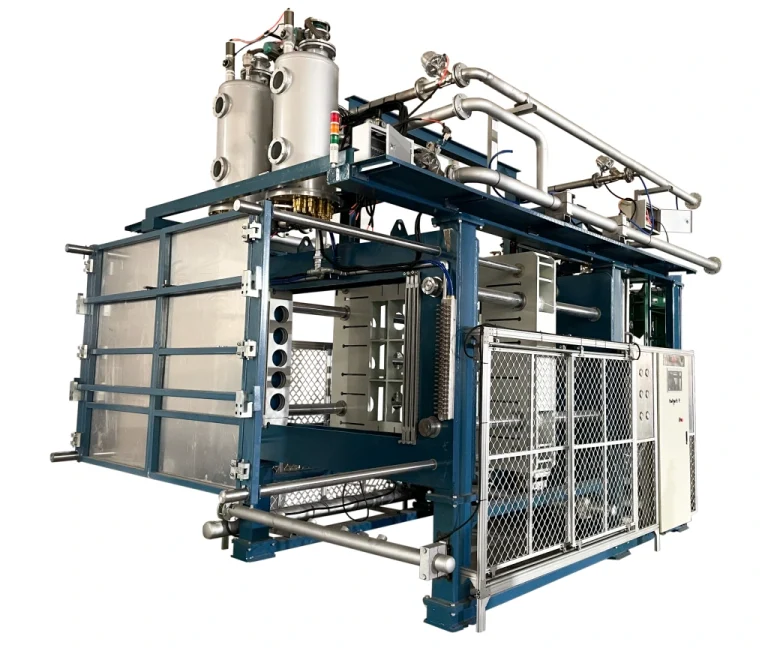
Horizontal Foam Molding Machines: Built for High-Volume Production
Horizontal foam molding machines are designed for stable, large-scale EPS pattern production. They work well for high-throughput operations.
Technical Capabilities
Mold face sizes range from 1200×1400 mm to 1600×1800 mm. Product height reaches up to 350 mm. Opening stroke measures 1200 mm.
These specifications support a wide range of pattern sizes. They still keep operational stability high.
Superior Mold Locking Performance
A next-generation hydraulic locking system provides higher locking pressure than conventional machines. It distributes force evenly across multiple points. This step virtually eliminates steam leakage. It improves heating efficiency and delivers consistent, high-quality patterns even during extended production runs.
Ultra-Fast Mold Change System
Downtime hurts profits in foundry operations. The innovative quick mold replacement system uses guide rails, precision material bumps, and quick-change racks. Workers can pre-assemble molds offline. Then they transfer the molds with simultaneous pipeline docking.
Changeover time is 20–30 minutes with the standard quick system. The one-touch automated system achieves about 5 minutes.
This breakthrough supports near-continuous production. It reduces labor needs and follows modern health, environment, and safety standards by limiting manual handling.
Digital Precision Control System
Advanced components replace outdated analog methods. These include electrical digital proportional valves, linear position sensors, and high-precision digital pressure sensors. They maintain stable cavity pressure throughout the cycle. As a result, they ensure repeatable molding quality while cutting steam consumption. An intelligent bypass pipeline design in the heating system shortens overall molding time. It boosts throughput without losing precision.
Siemens Intelligent Control Platform
The Siemens PLC system comes with a user-friendly Windows interface. Operators gain precise command over feeding, heating, blowing, and cooling phases. Full parameter storage creates a traceable production database for every pattern. This supports data-driven decisions, remote troubleshooting, and ongoing process refinement. The system turns the machine into a smart manufacturing asset rather than just production equipment.
Vertical PLC Foam Molding Machines: Flexible and Customizable Solutions
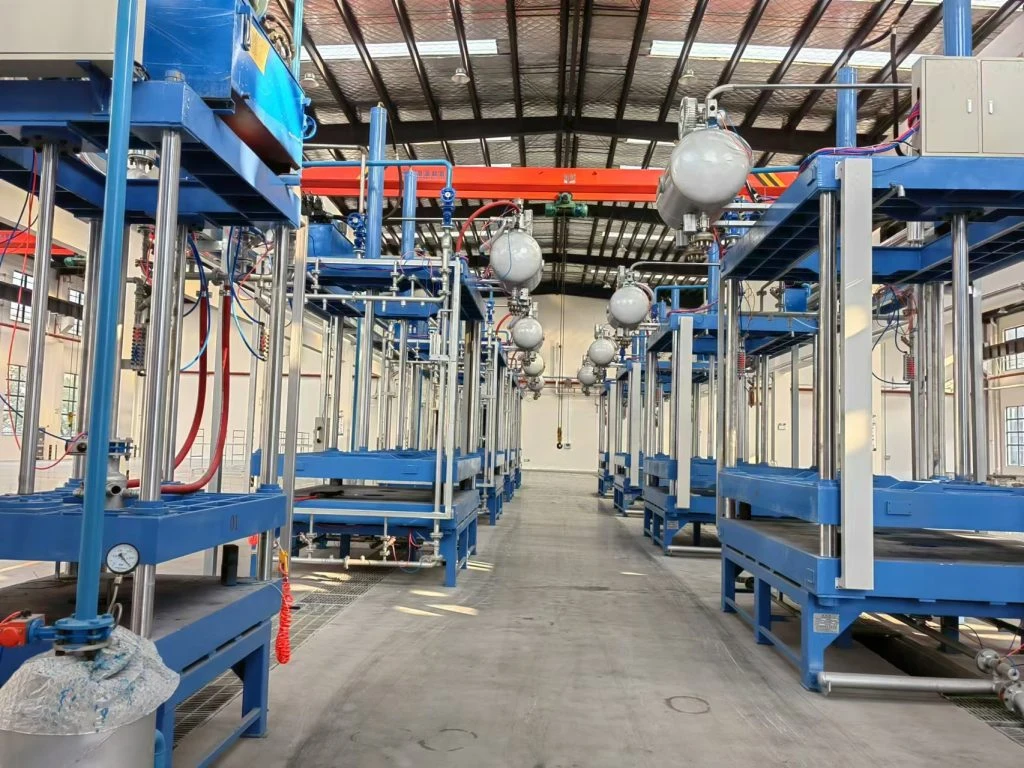
Vertical foam molding machines perform well in scenarios that need adaptability. Examples include custom EPS pattern production, large or complex components, and flexible manufacturing environments.
Technical Range
Working table sizes go from 1200×1000 mm to 2800×2200 mm. Stroke reaches up to 2500 mm. The machines offer full support for custom configurations.
Fully Automated PLC Operation
The PLC computer control handles the entire molding cycle automatically. It builds a comprehensive parameter database at the same time. This data-driven approach speeds up debugging for new molds. It removes guesswork and gives full traceability for quality assurance.
Remote Monitoring and Smart Support
The human-machine interface provides remote diagnostics, parameter optimization, and over-the-air system upgrades. Foundries gain responsive after-sales service without on-site delays. This ensures maximum uptime even in global operations.
ऊर्जा-बचत प्रौद्योगिकियां
Cutting-edge features such as steam-water separation, vacuum cooling with energy recovery, and high-temperature demolding raise efficiency. Pressurized feeding tanks with automatic proportional valve control allow uniform bead filling through top vertical multi-point or zoned systems. They minimize density gradients and create superior pattern integrity.
These innovations reduce energy consumption, shorten cycle times, and lower operating costs. They deliver measurable sustainability gains along with productivity improvements.
Durable Industrial Construction
Templates come from high-strength Q325 steel. They undergo 600°C heat treatment to prevent deformation. Additional processes include shot blasting, sandblasting, hot-dip galvanizing, and protective painting. Built-in over-pressure protection and active exhaust during filling improve operational safety and long-term reliability in harsh foundry conditions.
How Foam Molding Machines Improve Casting Quality
Advanced foam molding equipment directly enhances final casting results. It ensures uniform foam density, precise dimensional accuracy, and stable internal structure. Foundries achieve drastically reduced casting defects, superior surface finish on metal parts, and higher structural strength and consistency across batches.
This level of control matters a lot for mass production industries. Even minor variations can affect performance and compliance.
Complete Lost Foam Casting Line Solutions
Modern foam molding machines integrate smoothly with complementary white area equipment. This includes pre-foaming machines, air dryers, and central vacuum systems. The setup creates fully automated production lines. These lines support prototype development, medium-batch runs, and large-scale industrial manufacturing.
The integration of German EPS/EPP top technology with multiple independent intellectual property patents ensures these solutions deliver industry-leading performance, reliability, and innovation.
Partner with a Leading Manufacturer for Foam Molding Solutions
Manufacturers and suppliers that aim to upgrade their lost foam casting operations should partner with a proven expert in the field.
ओसी प्रौद्योगिकी is a leading manufacturer, supplier, and factory specializing in high-end intelligent lost foam casting equipment. As a National High-tech Enterprise in Zhejiang Province and an important partner of the China Lost Foam Industry Association, the company serves as a dedicated new equipment research and development base for the white area.
OC Technology introduces German EPS/EPP top technology combined with multiple independent intellectual property patents. Guided by the principles of science and technology, quality, high efficiency, and energy saving, the company focuses on automation and value-driven innovation. Its production base is located in Xindeng Town, Fuyang District, Hangzhou City — a strategic hub for EPS equipment manufacturing.
With mature after-sales service and a commitment to customized turnkey solutions, OC Technology delivers reliable, high-performance foam molding machines alongside complete white area systems.
दूरभाष: +86 15988479417 ईमेल: zyh@oc-epc.com
Contact today for technical consultation, detailed quotations, or tailored project planning to elevate your lost foam casting capabilities.
सामान्य प्रश्न
How do the mold replacement systems improve productivity?
Quick systems reduce changeovers to 20-30 minutes. The one-touch version achieves about 5 minutes. They convert internal downtime to external preparation and support near-continuous production.
Which control platform ensures stable and traceable operation?
Siemens intelligent PLC systems with Windows interface, paired with digital valves and sensors, deliver precise process control and full parameter storage for data-driven optimization.
 Hindi
Hindi  English
  Arabic
  Indonesian
  Japanese
  Korean
  Malay
Malay  Portuguese
  Spanish
  Thai
Thai  Vietnamese