
Lançamento de espuma perdida, also known as evaporative pattern casting, serves as a useful technology in modern foundry work. It helps create complex metal parts with good dimensional accuracy, fine surface finishes, and little need for extra machining. The main tool in this process is the EPS molding machine for lost foam casting. This machine makes high-quality foam patterns that disappear cleanly when metal is poured.
Advanced EPS molding machines use smart automation, exact steam and pressure control, and energy recovery systems. These features support high-volume production and keep pattern quality steady. Such quality matters for castings without defects.
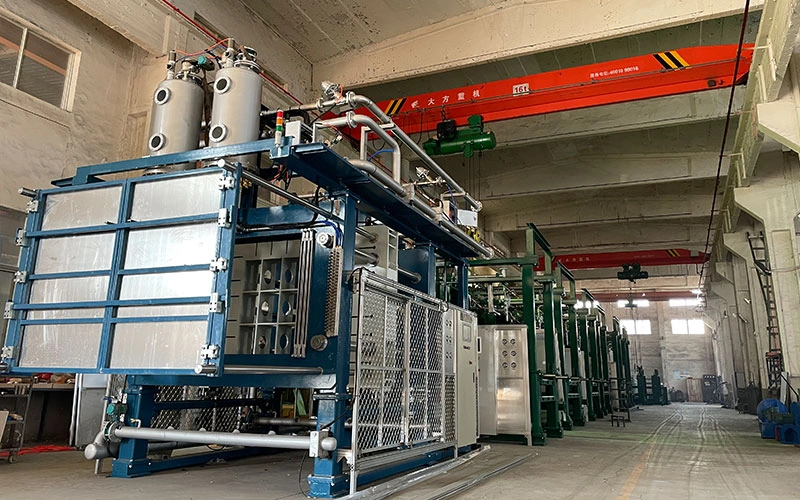
Understanding Lost Foam Casting and the Role of EPS Molding Machines
The Lost Foam Casting Process Overview
Lost foam casting starts with an expendable polystyrene foam pattern. This pattern matches the final metal part. Workers take pre-expanded EPS beads, mold them, assemble them into clusters, coat them with refractory material, put them in unbonded sand, and let molten metal replace the foam. The metal vaporizes the foam.
This method removes traditional cores, parting lines, and draft angles. It allows intricate internal passages and near-net-shape castings.
Critical Importance of Pattern Quality
The foam pattern needs uniform density, dimensional stability, and strong fusion. These factors decide if the casting works well. Changes in bead distribution or weak fusion may lead to gas problems, surface defects, or size errors.
Advanced EPS molding machines reduce these risks. They use multi-point filling, stable cavity pressure control, and optimized heating-cooling cycles. The result is high-density and uniform patterns. These patterns give cleaner castings and lower scrap rates.
Key Advantages in Modern Foundries
Design Freedom
Complex shapes and integrated parts cut assembly and machining steps.
Eficiência Material
Near-net-shape production reduces waste.
Surface Finish and Tolerances
Typical linear tolerances reach ±0.005 mm/mm with surface finishes from 2.5 to 25 μm RMS.
Sostenibilidade
Recyclable sand and less post-processing help greener manufacturing.
Key Features of Advanced EPS Molding Machines for Lost Foam Casting
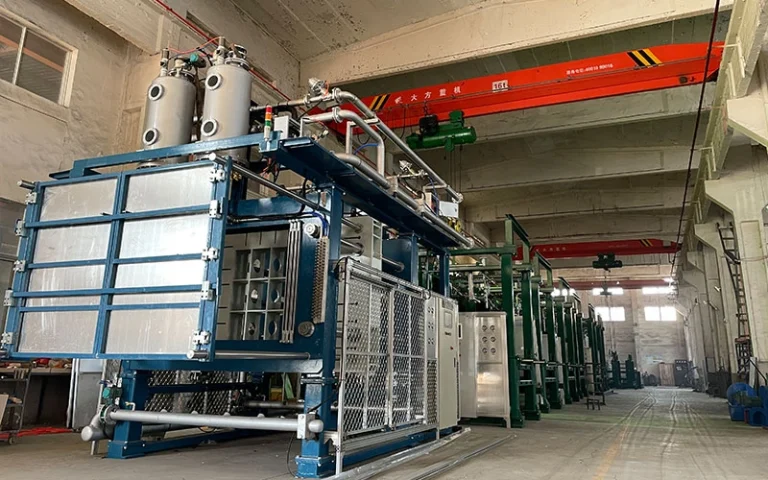
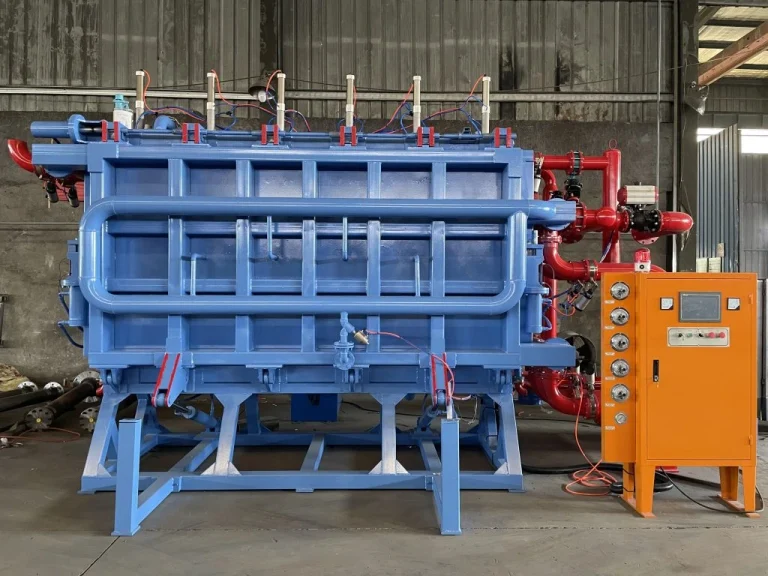
Vertical PLC Hydraulic Forming Machines
Precision Control and Automation Systems
Vertical models, such as the OC-CX-Y series with table sizes from 1200×1000 mm to 2800×2200 mm, use PLC computer control for fully automated molding cycles. These systems save process parameters automatically. They create traceable databases for quality checks and improvements. Operators do not need to guess settings.
Advanced Steam and Cooling Technologies
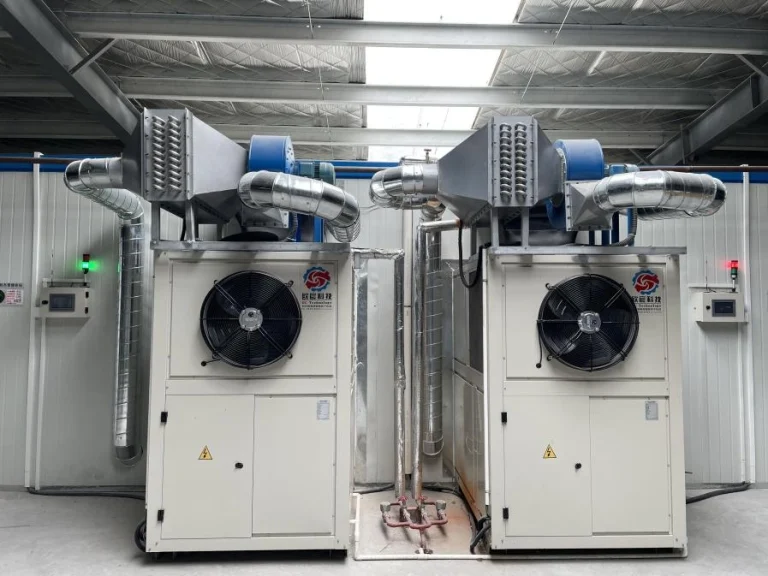
These machines include steam-water separation, vacuum cooling with energy recovery, and high-temperature demolding. They reach good fusion while they cut energy use and cycle times.
Vacuum systems allow fast cooling with less water. They also let molds stay hotter during demolding. This step lowers steam use in the next cycles.
Uniform Bead Filling Mechanisms
Pressurized feeding tanks with automatic air proportional valves keep pressure steady and add over-pressure protection. Top vertical multi-point or zoned filling reduces density differences. Active mold exhaust improves filling for complex patterns.
Horizontal Forming Machines
Robust Mold Locking and Quick Change Systems
Horizontal models, such as the OC-CX-W series, have strong hydraulic locking with even points. This prevents steam leaks and improves heating efficiency.
Quick mold replacement uses guide rails and racks. It cuts downtime to 20–30 minutes. One-touch automated systems reach about 5 minutes. This change supports maximum use of the machines.
Intelligent Control and Sensing
Siemens control systems work with electrical digital proportional valves, linear position sensors, and digital pressure sensors. They give exact and repeatable control over feeding, heating, and cooling.
Bypass heating pipelines shorten cycle times and save energy.
Comparative Benefits of Vertical and Horizontal Configurations
Vertical machines work well for flexible needs with complex or large patterns and custom jobs. Horizontal machines suit high-volume and repetitive work. They offer faster mold changes and steady operation.
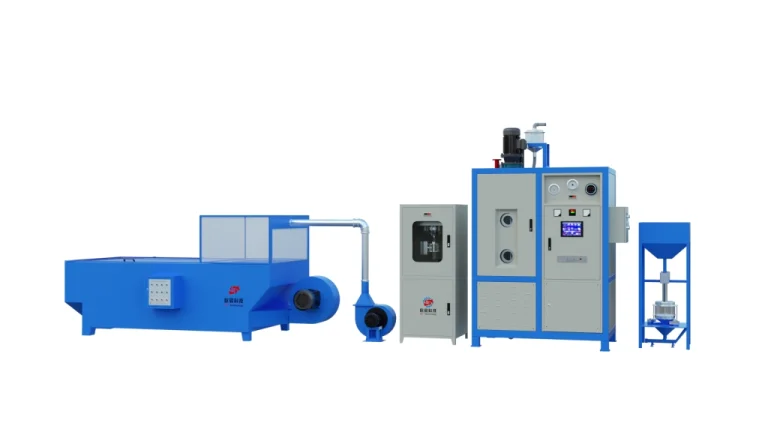
Many foundries use both types in integrated white-area lines. These lines include pre-foaming machines, air dryers, and maturation silos.
Benefits of Investing in Modern EPS Molding Technology
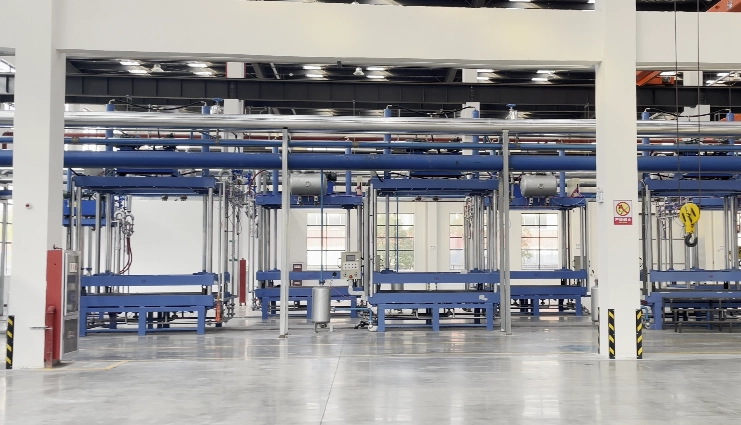
Operational Efficiency and Cost Reduction
Shorter cycle times, energy recovery, and automation decrease utility and labor costs. Remote monitoring and diagnostics support predictive maintenance. They reduce downtime.
Data-driven parameter management speeds new product development and process improvements.
Quality and Yield Improvements
Uniform patterns lower defects such as porosity and surface problems. They raise overall casting yield and part strength.
Consistent results help meet tight tolerances in tough applications.
Sustainability and Scalability
Vacuum cooling and steam optimization cut water and energy use. Modular and customizable designs permit step-by-step capacity growth.
They meet HE&S standards through less manual work.
Applications Across Industries
Automotive and Transportation
Engine blocks, cylinder heads, manifolds, and suspension components gain from intricate internal cooling channels and lower weight.
Agricultural and Heavy Machinery
Complex housings, structural parts, and large components reach cost-effective production with minimal machining.
Industrial Equipment and Pumps
The process does well with detailed, near-net-shape parts for valves, impellers, and machinery bases. These parts are hard to make with traditional ways.
Technical Considerations for Successful Implementation
System Integration and Material Handling
Good performance needs smooth connection with pre-expansion, drying, and coating stages. Steam quality, compressed air purity, and water treatment affect consistency and equipment life.
Operator Training and Maintenance
PLC interfaces and sensor calibration training increase uptime. Regular preventive maintenance on valves, vacuum systems, and hydraulic components keeps long-term precision.
Facility Layout Optimization
Good planning of mold storage, pattern assembly, and material flow improves overall line efficiency in high-volume settings.
Future Trends in EPS Molding for Lost Foam Casting
Industry progress moves toward AI-driven adaptive controls, real-time process simulation, and better predictive maintenance.
More attention on energy recovery, recyclable EPS materials, and modular systems will improve sustainability and growth for global foundries.
FAQ
What is an EPS molding machine for lost foam casting?
It is specialized equipment that shapes pre-expanded polystyrene beads into precise, uniform foam patterns used as expendable models in the evaporative casting process.
How do vacuum cooling and steam-water separation improve performance?
These technologies enable faster cycles, lower energy and water consumption, reduced product moisture, and higher mold temperatures during demolding for improved efficiency.
What are the typical mold change times?
Standard quick-change systems achieve 20–30 minutes; advanced one-touch systems reduce this to about 5 minutes.
Are the machines customizable?
Yes. Manufacturers accommodate special sizes, configurations, and integration requirements for diverse production needs.
parceiro com um fabricante e fornecedor confiável
Foundries and casting enterprises that seek reliable high-performance lost foam casting solutions should work with established manufacturers and suppliers.
Tecnologia OC acts as a dedicated manufacturer, supplier, and factory. It offers advanced vertical and horizontal EPS molding machines along with pre-foaming machines, air dryers, maturation silos, and full production lines.
Their engineering focuses on precision, energy efficiency, and intelligent automation for industrial needs.
Alcançar via:
- Tel: +86 15988479417
- Email: zyh@oc-epc.com
for consultations, technical specifications, and customized solutions to improve casting operations.
 Portuguese
  English
  Arabic
  Hindi
Hindi  Indonesian
  Japanese
  Korean
  Malay
Malay  Spanish
  Thai
Thai  Vietnamese