
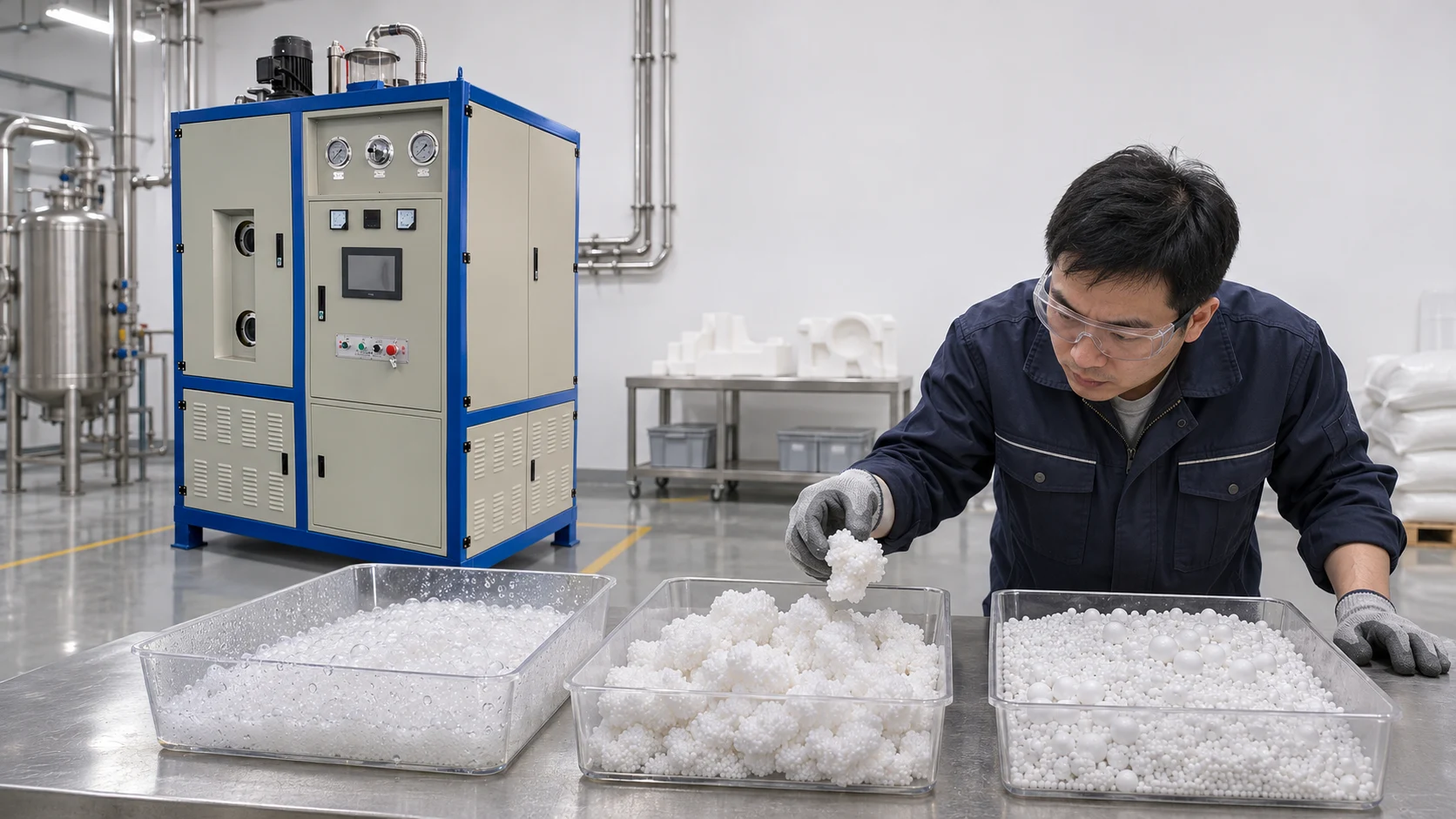
EPS pre-expander troubleshooting should begin by containing the affected batch, finding where the bead condition changes, and comparing the run with the last known good batch. Wet, clumped, or uneven beads may start in steam and condensate control, material feeding, chamber movement, fluidized-bed airflow, screening, or discharge. Preserve the evidence, then test one cause at a time.
Contain the Batch Before Adjusting the Machine
Stop affected beads from entering an approved maturation or molding batch. Label the material with the raw-material lot, recipe, time, and destination. If material is hot or equipment is energized, follow the machine manual and site isolation procedure before sampling or opening guarded areas.
When the layout allows, collect samples immediately after chamber discharge, after the fluidized bed or screen, and before the maturation silo. Record the cycle time, input weight, displayed temperature and pressure, utility conditions, alarms, and manual interventions. These samples show whether the symptom begins in the chamber or during cooling, screening, or transfer.
Use the last accepted batch as the baseline. Confirm the material grade, lot, recipe, utilities, and sampling location before increasing a parameter.
Use the Symptom to Choose the First Check
| Observed condition | First area to isolate | Practical comparison |
| Beads are visibly wet at chamber discharge | Steam quality, condensate drainage, venting, valve closure | Compare discharge sample with the last good batch under the same recipe |
| Beads leave the chamber acceptable but remain damp after the fluidized bed | Airflow, bed blockage, screen loading, transfer path | Compare samples before and after the bed |
| Soft clumps separate after a cooled sample is handled | Surface moisture, insufficient cooling or fluidization | Check whether the clump disappears after controlled drying |
| Hard fused clusters remain intact | Excess heat exposure, poor movement, delayed discharge, residual material | Inspect the cycle record, movement, and discharge sequence |
| Mixed large and small beads appear throughout the batch | Feed consistency, steam or temperature stability, agitation, raw-material variation | Compare multiple samples from the same batch and the next controlled trial |
Why Beads Leave the Pre-Expander Wet
First determine whether moisture is present at chamber discharge. If it is, review steam and condensate control before extending drying time. Wet steam, ineffective drainage, incomplete venting, or a valve that does not close as commanded can leave free moisture with the beads. Check separators, traps, drain legs, and the approved valve test procedure. Compare the controller signal with the physical response.
If the discharge sample is acceptable but material is damp after the fluidized bed, look for uneven airflow, blocked perforations, accumulated fines, screen loading, or a wet transfer point. Confirm the air supply is stable under load, not only while the machine is idle.
Restore drainage and airflow before adding heat; otherwise, the water source may remain while expansion and surface condition change.
Why EPS Beads Clump or Stick Together
Classify a cooled sample before deciding what caused the clump. Damp agglomerates may separate with light handling, while fused clusters remain bonded and often contain visibly distorted beads. That distinction directs the inspection toward either moisture removal or excessive thermal exposure and poor movement.
For damp clumps, repeat the wet-bead checks and confirm airflow reaches the full bed. For fused clusters, review steam and temperature trends, material circulation, residence time, discharge timing, and interruptions. A power or air interruption can leave hot beads stationary, while residual material can contaminate the next discharge.
Inspect the bottom-discharge path for incomplete opening and material hold-up. Verify the approved cooling-air sequence without bypassing protection functions. After correction, confirm complete discharge in a controlled trial.
Why Expansion Becomes Uneven
Uneven beads require more than one sample. Material can segregate during transfer, so collect from the beginning, middle, and end of discharge when the plant procedure permits. If every sample contains the same mixed sizes, the cause is likely upstream of conveying. If the fractions change along the route, screening or transfer may be separating the material.
Start with raw-material identity and feed consistency. Mixed grades, a new lot, excessive fines, or an irregular charge can produce different responses in one cycle. Then review steam and temperature stability, chamber movement, and the discharge sequence. Determine whether all beads received comparable heat and movement, not only whether an average reached its target.
Check the screen for damage, blockage, or incorrect assembly. Screening removes unwanted fractions but cannot correct unstable pre-expansion. Preserve an unusual retained fraction and investigate its source.
Use the Machine’s Built-In Checkpoints
OC Technology’s fully automatic configuration combines electromagnetic and steam pre-expansion with PLC-controlled operation, stored process parameters, a proportional valve for chamber-temperature control, a pressure-reducing valve for steam regulation, a fluidized bed with a double-layer vibrating screen, bottom discharge, and compressed-air cooling after the discharge door opens. These functions provide checkpoints for a structured investigation, but actual settings and test methods must be verified for the installed model and material.
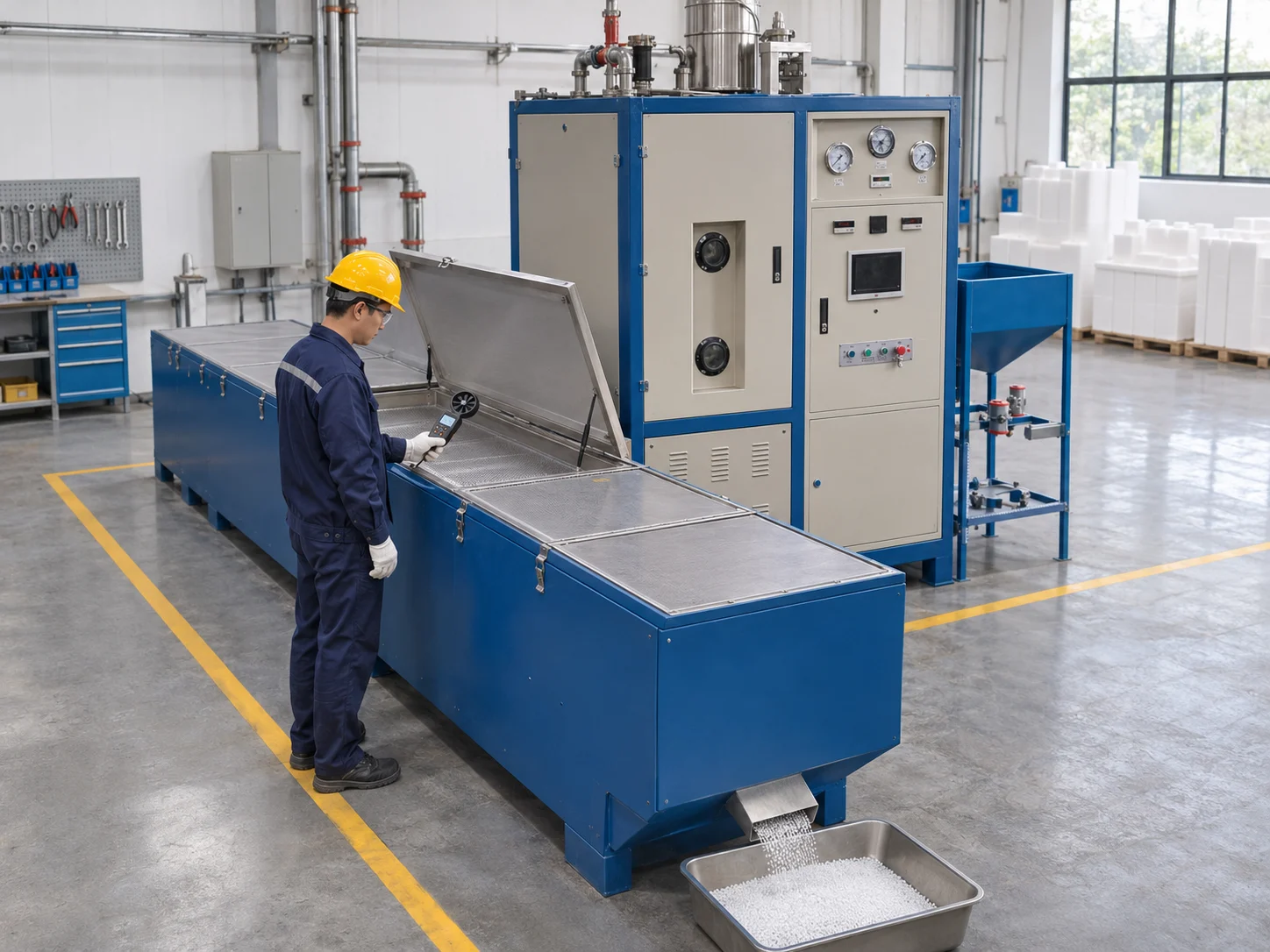
Begin with the stored recipe and alarm history. Confirm that the recipe matches the material lot. Compare commanded and observed valve behavior, inspect bed airflow and screen condition under the approved safe procedure, and verify complete bottom discharge and the post-discharge air sequence. The EPS pre-expander with fluidized bed page helps engineering teams identify which functions belong to the proposed configuration.
Prove the Correction Before Releasing Material
Correct one verified fault or change one controlled variable, then run a documented trial with the same material lot, sample points, and timing. Compare consecutive batches and record wetness, clump type, retained fraction, bead-size appearance, alarms, and discharge completeness.
Appearance is only one release check. Where bulk density is specified, use a defined repeatable bulk density test instead of estimating a sample. Keep the troubleshooting and density records separate so both the visible defect and quantitative result remain clear.
Before release, confirm that the receiving Silo trưởng thành is correctly assigned and questionable beads cannot mix with accepted production. Limits depend on the EPS grade, pattern specification, molding process, and approved quality plan.
Prepare Useful Evidence for Supplier Support
Escalation is faster when the supplier receives evidence rather than a general statement that the beads are bad. Provide the machine model, material grade and lot, selected recipe, input weight, batch sequence, utility readings, alarms, symptom location, and photographs of cooled samples. State whether the condition appeared after a material change, utility interruption, maintenance action, or extended stop.
For a new machine or a recurring configuration problem, use the pre-expander buying and FAT guide to separate equipment acceptance from site-utility and process responsibilities. OC Technology can then review the symptom against the installed configuration without treating every issue as a recipe problem.
Phần kết luận
Effective EPS pre-expander troubleshooting follows the material path. Contain the batch, compare fixed sample points, classify wetness, clump type, or size variation, and inspect steam, condensate, movement, airflow, screening, and discharge in that order. Correct one verified cause and prove the result across consecutive batches before release.
For an application review, send OC Technology the model, EPS grade, affected batch records, utility conditions, symptom photographs, and the point where the bead condition first changes. Teams can request a technical fit review to confirm which machine checks, material trials, or site-utility checks are appropriate.
Câu hỏi thường gặp
Can wet EPS beads be fixed by increasing fluidized-bed time?
Only when the root cause is insufficient downstream airflow or cooling time. If moisture enters through wet steam or failed condensate drainage, longer bed time may hide the symptom without correcting the source.
What is the difference between clumped and fused EPS beads?
Damp clumps may separate after a cooled sample is lightly handled. Fused beads remain bonded or distorted, which points more strongly to excessive heat exposure, poor movement, delayed discharge, or retained hot material.
Why should samples be taken at several locations?
Multiple locations show where the condition begins. Acceptable chamber discharge followed by damp material after the bed indicates a different investigation from beads that are already wet when they leave the chamber.
Should operators change steam, temperature, and cycle time together?
No. Multiple simultaneous changes make the cause difficult to identify and may create a second defect. Correct a verified fault or change one controlled variable, record it, and compare the next documented trial.


 Vietnamese
 English
 Arabic
 Hindi
 Indonesian
 Japanese
 Korean
 Malay
 Portuguese
 Spanish
 Thai