
Introduction to Lost Foam Casting and EPS Foam Requirements
Lost foam casting, also called evaporative pattern casting or full-mold casting, stands as a useful exact casting method often used in current foundries. The method uses an expanded polystyrene (EPS) foam pattern. This pattern gets fully turned to vapor by hot metal during the pour. As a result, it skips the need for usual mold split lines, cores, and tricky mold release tools. This leads to castings with better surface quality, close size limits, less need for extra cutting, and fewer problems like extra bits or sand bits.
The quality of the end metal casting depends right on the body and heat traits of the EPS foam pattern. Key needs for EPS foam in lost foam casting cover:
- Density range usually from 15–30 kg/m³ (about 0.016–0.030 g/cm³). This range keeps the shape solid during coating and moving. At the same time, it allows clean vapor turn with little leftover.
- Even cell build with steady bead join to avoid fall or twist
- Low leftover water level to cut gas-linked issues
- Good size steadiness and cut-ability for exact pattern making
- Set heat break-down action to make sure easy break without too much push-back or leftover
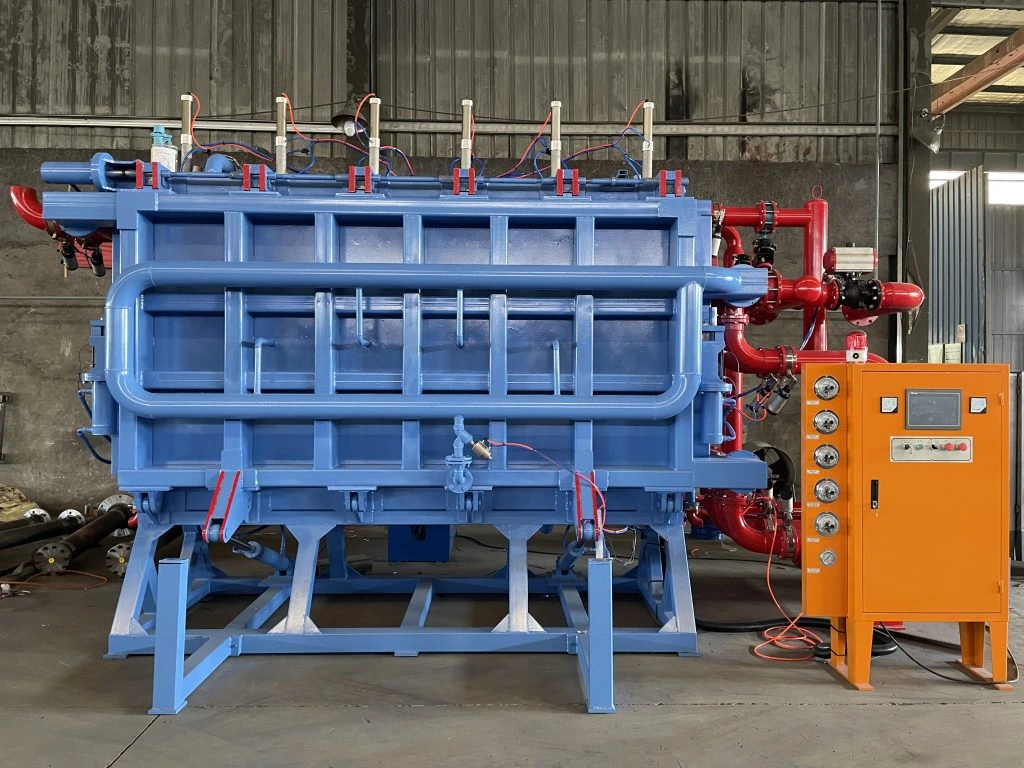
For middle-to-big or shape-tricky parts, patterns often get cut or put together from big EPS foam blocks or thick sheets. This makes the EPS Block Molding Machine (also known as EPS foam sheet machine or EPS block forming machine) a basic tool in the lost foam white area.
What Is an EPS Block Molding Machine?
Core Function in the Lost Foam Process
The EPS Block Molding Machine grows pre-foamed polystyrene beads (or mix beads) and joins them under set steam push and heat into big, square foam blocks or thick sheets. These blocks act as good base material. Later, they get worked on—through CNC hot-wire cut, shaping, or joining—into right vapor patterns. These patterns match the end casting shape.
Key Technical Characteristics
Current EPS block molding machines made for lost foam uses include new auto and process guide traits:
- PLC-based control system with work-grade touch screen setup for full auto running, error checks, and mix handling
- Stepless dimensional adjustment via code-reader-driven side walls — length and width get set by numbers with good repeat
- Negative pressure vacuum-assisted feeding joined with air-push filling to reach even density spread
- Anti-7-shaped, multi-directional steam dispersion heating system that makes sure even heat reach in big blocks (up to 2000 mm in length)
- Pulse high-flow cold air + negative pressure cooling method that speeds up heat pull and cuts leftover water
- One-time molding process with choice down-line belt join for steady, low-work make cycles
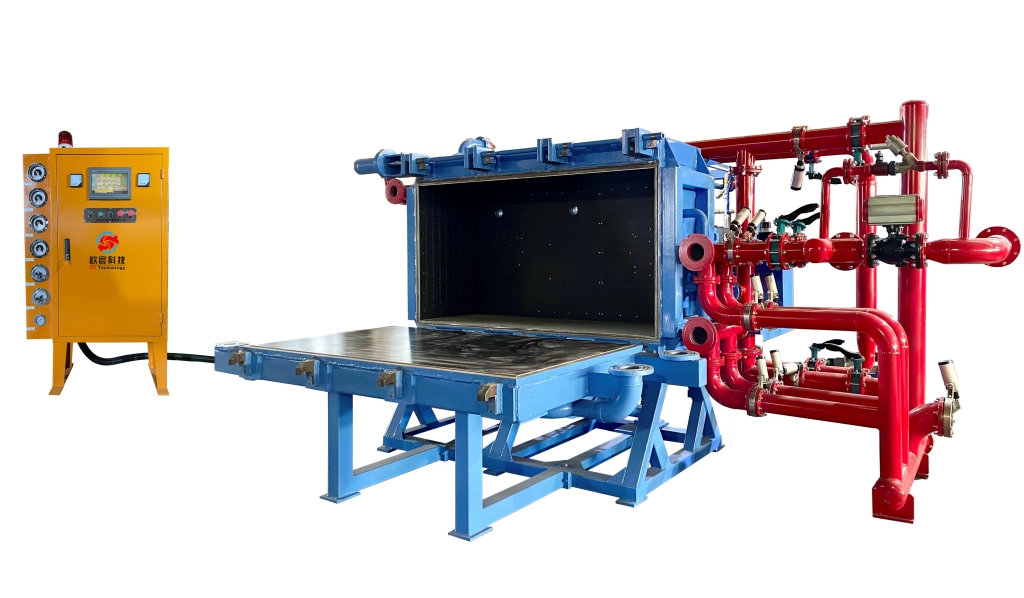
- Hydraulic single-door opening, auto push-out, and safety-locked un-mold tools
- Fit with usual EPS and pick mix resins for better work in set casting metals
These traits give foam blocks with low bend, steady density, firm bead stick, and few inside holes—traits key for issue-free lost foam patterns.
Critical EPS Foam Properties for Successful Lost Foam Casting
Density Selection and Its Impact
Density counts as one key setting in lost foam foam making. Low densities (15–20 kg/m³) make vapor turn simple and cut gas make. But they might weaken pattern firmness during hard coating and sand pack. High densities (25–30 kg/m³) give stronger body strength and size steadiness for big or detailed patterns. Yet, they need tuned heat and air out to stop half break-down or leftover.
Most new block molding machines let exact handle of grow rate and end density. They do this through changeable steam push, fill amount, and hold settings.
Cell Structure and Bead Fusion Quality
Even cell size (usually 250–1500 μm) and full bead-to-bead join matter a lot. They stop weak spots that might lead to pattern break or uneven metal flow. The special steam reach plan in new machines fixes this. It gives even heat spread. Thus, it leads to better join strength even in thick parts.
Moisture Control and Pattern Stability
Too much leftover water can make steam spots or gas issues during pour. Good pulse cold-air cool joined with vacuum help drops water to low points. This boosts pattern steadiness and cuts casting holes.
Why Uniform Heating and Cooling Matter in Lost Foam Casting
The Heating Challenge for Large-Size Foam Blocks
Making big foam blocks (1000–2000 mm long) with usual steam ways often makes heat differences between outside and inside areas. This causes under-joined middles, weak inside links, and higher chance of pattern cracks during move, coating, or sand shake.
New anti-7-shaped steam drain and all-way spread steps beat this limit. They push even steam flow and uniform set across the whole block space.
Cooling Efficiency and Final Product Quality
Old cool cycles can go over 20–30 minutes. They also leave high water levels. New negative pressure + pulse high-flow cold air setups cut cycles to 8–10 minutes per board. They reach almost no bend and very low water hold. This right away boosts pattern move strength, surface evenness, and cuts risks of sand stick, fall, or gas-linked casting issues.
Production Efficiency and Cost Advantages
Cycle Time and Output Capacity
Well-tuned EPS block molding machines finish a full cycle (filling, heating, cooling, demolding) in 8–10 minutes for usual lost foam board sizes. Quick air/vacuum filling, fast cool, and choice auto belt allow high daily output with little worker help.
Energy and Material Cost Savings
Big cost gains come from:
- Cut steam and power use per cubic meter
- Higher okay re-use material shares through better after-tune mix handle
- Lower work effort via auto
- Less waste rates due to steady foam quality and fewer inside issues
These points give solid money wins in middle-to-big lost foam foundries making high yearly casting amounts.
Typical Industrial Applications
EPS block molding machines tuned for lost foam casting back varied fields, including:
- Automotive — engine blocks, cylinder heads, transmission housings, intake manifolds
- Agricultural machinery — structural and wear-resistant components
- Pumps, valves, and compressor housings
- Rail transit and wind power castings
- Mining and heavy equipment parts
- Gray iron, ductile iron, and alloy steel precision components
The method allows making of light, tricky near-end-shape parts. These are hard or costly to build with usual sand casting.
FAQ
What is the main difference between an EPS block molding machine and a regular shape molding machine?
EPS block molding machines are optimized to produce large, uniform-density rectangular blocks/sheets ideal as raw material for lost foam pattern machining. Shape molding machines produce finished complex shapes directly.
How long is a typical production cycle for a large foam block?
Most modern machines complete one cycle in 8–10 minutes for standard lost foam foam board sizes.
Why is uniform steam penetration so important for lost foam foam blocks?
Uneven heating causes weak core fusion in large blocks, leading to pattern breakage, poor surface finish, or casting defects such as sand holes and collapse.
Can these machines use recycled EPS material?
Yes. Advanced post-adjustment systems allow significantly higher recycled material ratios while maintaining foam quality suitable for lost foam casting.
What is the benefit of negative pressure + pulse cold air cooling?
It shortens cooling time dramatically, reduces residual moisture to very low levels, and prevents deformation — delivering higher quality foam blocks and faster production cycles.
How precise is the size adjustment on modern machines?
Size adjustment is stepless via encoder control rods. Operators input desired dimensions on the touch screen, and the machine automatically positions moving walls with high accuracy.
What is the typical density range for EPS foam used in lost foam casting?
Most applications use 15–30 kg/m³, with 20–25 kg/m³ being common for balancing strength, machinability, and clean vaporization.
Partner with a Professional Lost Foam Equipment Manufacturer & Supplier
Lost foam foundries and pattern manufacturers seeking reliable, high-performance EPS Block Molding Machines should collaborate with an experienced manufacturer, supplier, and factory specializing in complete lost foam white-area solutions.
OC Technology focuses exclusively on high-end intelligent lost foam casting equipment. The company offers advanced foam sheet machines, pre-expanders, molding machines, air dryers, and integrated supporting systems — all engineered for automation, energy efficiency, and superior pattern quality.
Contact the team today: Tel: +86 15988479417 Email: zyh@oc-epc.com Website: https://www.oc-epc.com/ Factory address: Xindeng Town, Fuyang District, Hangzhou City
Request detailed technical specifications, production demonstration videos, factory audit arrangements, or tailored solution proposals for your lost foam casting project.


 English
  Arabic
  Hindi
Hindi  Indonesian
  Japanese
  Korean
  Malay
Malay  Portuguese
  Spanish
  Thai
Thai  Vietnamese